Metro: St. Petersburg and Moscow

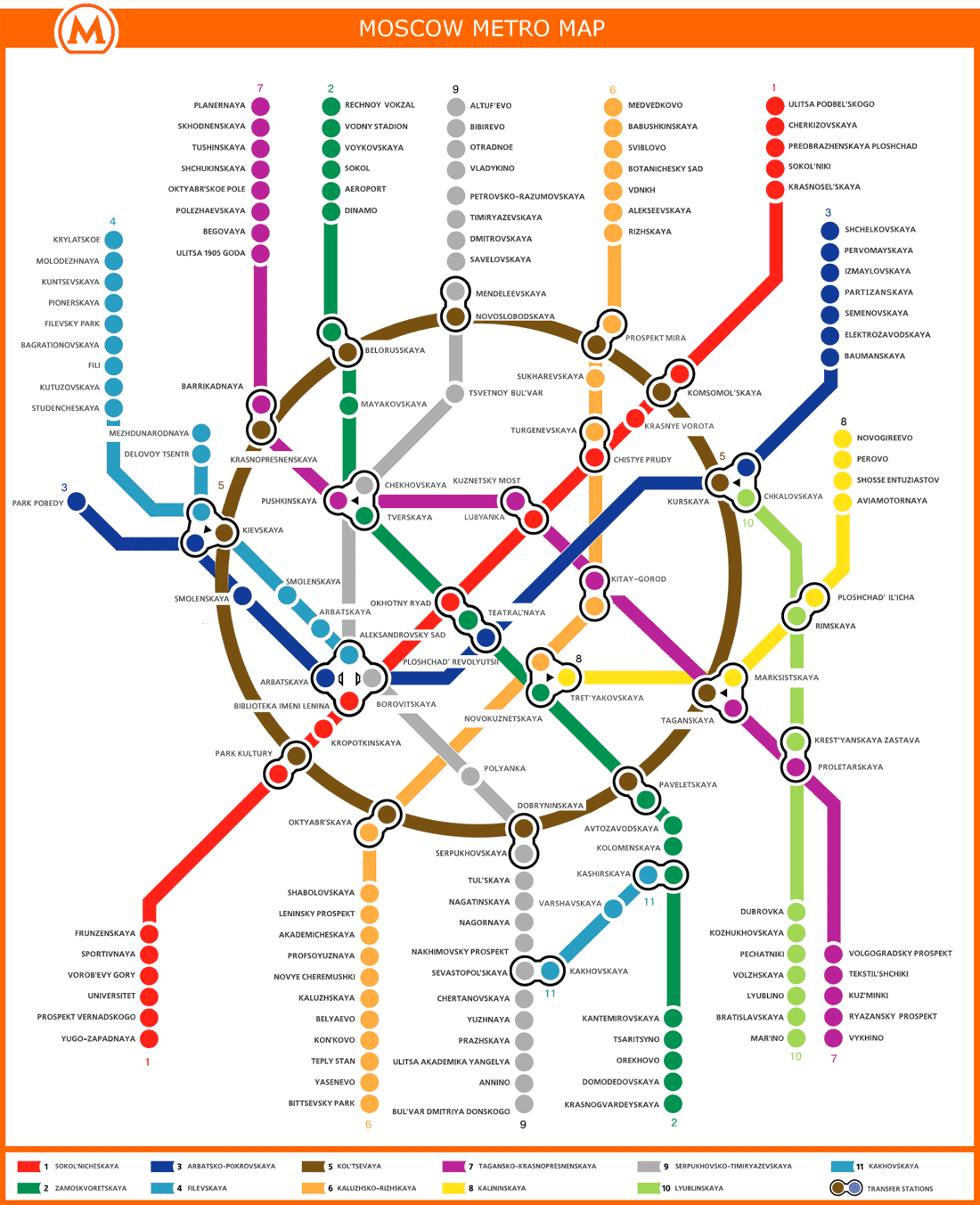
We have spent over a month riding around on the Moscow metro and I love it. It’s fast and affordable. So naturally, when we traveled to St. Petersburg, I was curious about the subway of Russia’s other capital city. St. Petersburg has fewer stations than Moscow does. First, Moscow is Russia’s capital. And second, canals and rivers wind their way through St. Petersburg, making it rather difficult to build a subway system rivaling the “underground palace” that Moscow has.
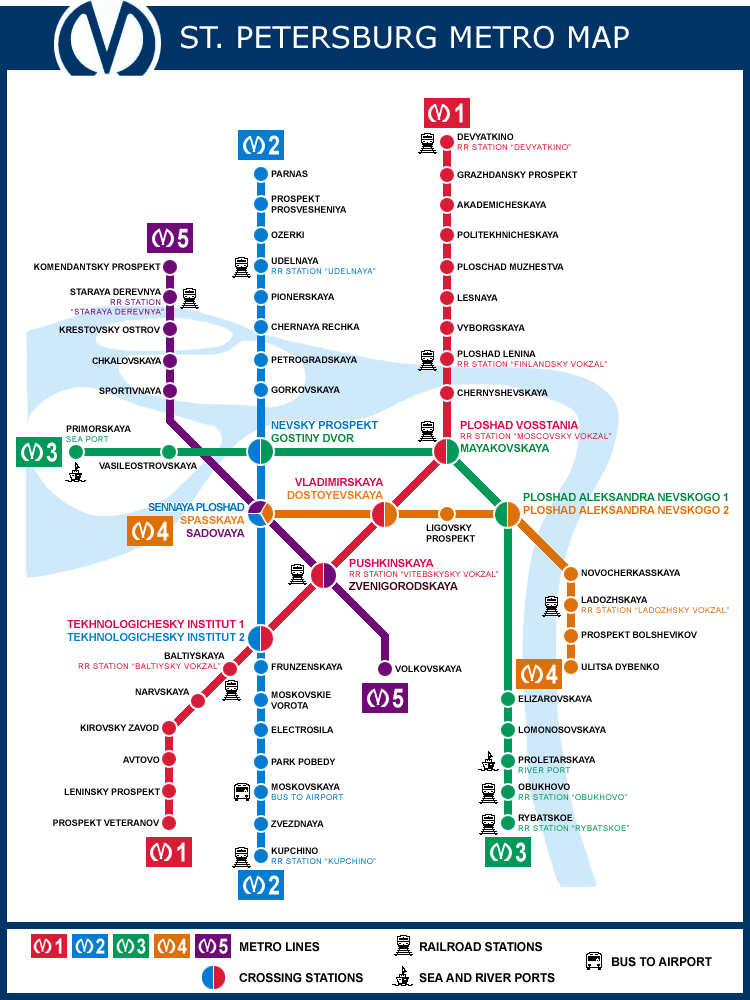
St. Petersburg has 67 stations

and Moscow has 194 stations

True, the Moscow metro is no small feat, pumping water out of its system every day, but it is not located on the bank of the Gulf of Finland as St. Petersburg is. In Sunlight at Midnight, Bruce Lincoln writes that the location of St. Petersburg is one of the worst possible places for a city – frequent flooding, poor soil, and harsh winters. Needless to say, the opening of a new St. Petersburg station is greeted as a greater accomplishment than a new station in Moscow is.
Compared to Moscow and the rest of Russia, St. Petersburg is a city of the west. For example, the city’s architecture favors European styles over traditional Russian styles (such as the traditional onion domes) and this European influence is even present in each city’s stations. To me, St. Petersburg’s stations seem more business-like than Moscow’s stations do. While the few stations we got the chance to see in St. Petersburg had artful entrances, the platforms beyond the escalator were rather stark, contrasting with some of the impressive, beautiful Moscow stations.

St. Petersburg’s Admirality station. From http://tour-to-st-petersburg.com/.

One of Moscow’s stations. Photo taken by Matthew Buck. From http://www.cntraveller.com/photos/photo-galleries/25-reasons-to-go-to-moscow/the-moscow-metro.

To enter the metro in Moscow, we hold our “smart cards” up to the turnstile’s scanner. Once we’re in, we can stay in the metro as long as we like and transfer to any station. The St. Petersburg metro operates the same way, but rides are paid for using coins instead of cards.

stpcoin

The coin I used in St. Petersburg.

edinyi

My Moscow metro card.

I greatly enjoyed exploring a few of St. Petersburg’s metro stations, and I wish we could have spent more time traveling around the city. But now we’re back in Moscow, whose underground palace provides more metro stations than we have time to explore.

Magical Gazirovki

I don’t think I can ever describe the beauty of Moscow in a way that will ever do it justice. With parks at every corner, churches adorned with golden kupola, and beautiful squares, I have yet to be disappointed. However, as I explore the city, I can’t help but feel something deep down, a desire that almost burns. Burns… the throat.
I am so thirsty.
I find myself making stops at food stands to buy a bottle of water, lemonade, perhaps a coconut with an umbrella in it—anything to put out this fire.
In this quest to quench this thirst, I’ve come across more than one of these:

This Soviet-era machine dispenses delicious soda.

This Soviet-era machine dispenses delicious soda.


The Soviet soda machine. Put a few rubles in the slot, grab a cup, and wait for this magical gazirovanaya voda (carbonated water) to dispense. Ahhh, I will never forget that sweet pear soda pop (that’s right, I’m from the Midwest) that I had on Victory Day.

The Search for Shostakovich

During the five hour break between classes today, I set off for the All-Russia Exhibition Center, rode one stop on the metro before deciding that I wasn’t up for the 13 additional stops, and got off the next time the train doors opened. I was at the Sportivnaya station and remembered hearing that Novodevichy Convent was close to that stop. So I naturally decided to set off to find one of my favorite composers, Dmitry Shostakovich, who is buried in the Novodevichy graveyard. Because this was a very spur of the moment decision, I hadn’t looked at any maps of this area in advance didn’t actually know where the convent was in relation to the metro station. Furthermore, once I got above ground, I quickly noticed that that there were none of the signs I had expected to point me the right way.

Novodevichy 2

The view that greeted me as I walked through the gates of the convent.


But after walking in a series of widening concentric circles centered around the metro station, I eventually found a landmark (the Olympic stadium) and was able to orient myself around that to find the convent. The convent itself is worthy of many a blog post and the grounds were exquisite with new growth, blooming lilacs, and tulips. I spent a while wandering the grounds and taking in the wonderful scents before I recalled my mission. I left the convent, without having a clue as to where the cemetery might be, but I walked along the walls until I found an entrance that happened to be the correct one. There is a map at the very front of the cemetery, which clearly divided everything into clean sections and states where the most well-known occupants are buried within those sections. To make a long story short, I apparently can’t read maps, because I scoured the graveyard looking for a section that I never did find and that Shostakovich was never buried in. Along the way, however, I ran across, Yeltsin, Khrushchev, Chalyapin, and Kropotkin to name a few. And after an enlightening revisit to the map, I realized my mistake and quickly found the composer’s tombstone. It was relatively modest, but I was exceptionally pleased to find that his musical signature was included beneath his name.
IMG_1026

Shostakovich’s tombstone with the DSCH (the composer’s initials when transcribed into German) motif found in many of his works.


It’s fantastic how you can set off to find one thing in Moscow and run across so much more than expected even if you never end up making it to your intended destination.

A Time For Dancing

Victory Day is perhaps my new favorite holiday. The streets of Moscow fill with people bearing orange and black ribbons, waving flags above the crowds. Everyone comes out of their hiding place to celebrate the day that Russia ended the Second World War.

IMG_2909

Our view of the parade


IMG_2929
The blini stand had a sign outside of it that read: “Сколько хотите, столько заплатите–Pay as much as you want, so long as you pay.” We confusedly fumbled with our rubles and, in keeping with the tradition of Minnesota nice, were perhaps a little too generous. We walked at a leisurely pace to Kuznetsiy Most’, where I payed 50 rubles for a sweet, carbonated drink from an old Soviet soda water machine. With my stomach full and thirst satisfied, I wandered the street to observe the festivities.

A family celebrating Victory Day


There were cries of laughter as children chased each other along the cobble-road. Someone actually smiled at me as they handed me a black-and-orange-striped ribbon. We passed a group of young men with horns and a drum kit. We were part-way down the street when we heard a familiar blaring of horns. We immediately turned back and joined the crowd that was now forming.
Katyusha is a song that was introduced to us back at Carleton, when the thought of going to Moscow was more a lofty consideration than reality. The song itself was composed in 1938, just before WWII. Katyusha wanders among the apple trees and thinks of her beloved, sending him a song of her love. Of all the wartime songs written during the era, soldiers were fond of this song, even nicknaming the BM-8, BM-13, BM-31 “Katyusha” rocket launchers. The song remains a token of the past, still known today even among the younger generations.
As the band played this lively song, a child began to dance. An older woman seized his hands and danced with him. Afterwards, she shouted “It’s Victory Day! We must all dance, we must all celebrate!” Unfortunately, my camera died at this point. As the next song started, she pulled people in, urging everyone to dance, including myself (I would like to note that she was supernaturally strong). Although I could feel my Carleton awkward seeping through, I couldn’t help but smile at her spirit and happiness.

Handshakes: A Man to Man Thing

I had just met Сережa (read: Seryozha), one of the Moscow State University students that has been showing us the city, and he shook my hand. He then showed Gisell Calderon and me around the university. Two weeks later a group of us were talking with Пётр (Peter, also a student at the university) and I shook his hand when we were about to part ways. Then Gretchen Fernholz decided she would shake his hand too. He became really surprised, and even backed up a little, to my utter confusion. When we talked for a short time with Пётр about why he was so weirded out, he told us that it just was not typical for a women to give a man a handshake here in Russia without being prompted first. When I met Сережа on subsequent occasions, he didn’t shake anyone’s hand but mine. I suddenly noticed that that was because the others with me when I met with Сережа were women. Clearly, there is a bit of a cultural difference in how handshakes operate here in Russia as opposed to in the United States.  Now I notice it everywhere. The standard acknowledgment among young men here at the university is a quick handshake.  Occasionally I forget that I’m in Russia, speaking Russian with Russian people. Whenever I notice the handshake, I get pulled back into reality, and notice again that I am, in fact, in Moscow, Russia.

Сережа shaking hands with me on one of the enormous escalators in the metro.

Сережа shaking hands with me on one of the enormous escalators in the metro.

Home Cooking

My homestay ended a couple of weeks ago now, and I’ve really been missing home-cooked food. On Monday, I finally decided to take action and attempt to make our group’s favorite Russian food: Borscht.
Kaylin is excited about borsch!

Kaylin is excited about borsch!

On Tuesday I looked up some recipes and a group of us headed out to Ashan, the grocery store near campus. We bought a ridiculous number of root vegetables, as well as a few other ingredients we needed, and brought it all back to the dorm’s kitchen.
Making borscht for ten people was even more exhausting than I expected. First, the beets had to be boiled for about an hour before they would be soft enough to cut up. While they were cooking, a few of us cut up vegetables.
Gisell is a cabbage-cutting master.

Gisell is a cabbage-cutting master.

As is generally the case with soup, there is no particular recipe that dictates how much of each ingredient to add, or what the result should taste like. We ended up working off two recipes: one, in Russian, was used for deciding how much to buy, and another, in English with nice illustrations, helped us figure out what order to cook things in.
Frying some onions!

Frying some onions!

When the beets were finished, we used the water they had boiled in as the soup’s broth. We tossed some sliced potatoes in and fried up some onions and carrots.
DSCF2047
When the potatoes were soft, we added the beets, onions and carrots, some cabbage, tomatoes, garlic, salt, pepper, and peas. We were a little nervous because the result didn’t look much like the dark red borscht we were used to buying in restaurants, but as we worked on our second pot, we realized that the secret was in waiting: the longer the borscht sat, the redder it became.
Two batches of borscht.

Two batches of borscht.

When the soup was done, we cut up some bread and filled our bowls with borscht and sour cream. The soup could have used some more salt, and maybe it had a few too many potatoes in it, but it was certainly edible, and I had a great time trying out Russian cooking with friends.
om nom nom

om nom nom

Bells in Kitai-Gorod

On my Kitai-Gorod tour, we saw a lot of interesting things, but the most memorable part for me was actually a sound.
My tour was on the Monday after Easter, and as we walked, we could hear church bells constantly ringing. At first, I assumed there was a wedding or something going on, but the praktikantki explained that the Russian Orthodox Church has a tradition that during Easter week, anyone who wants to can ring the church bells.

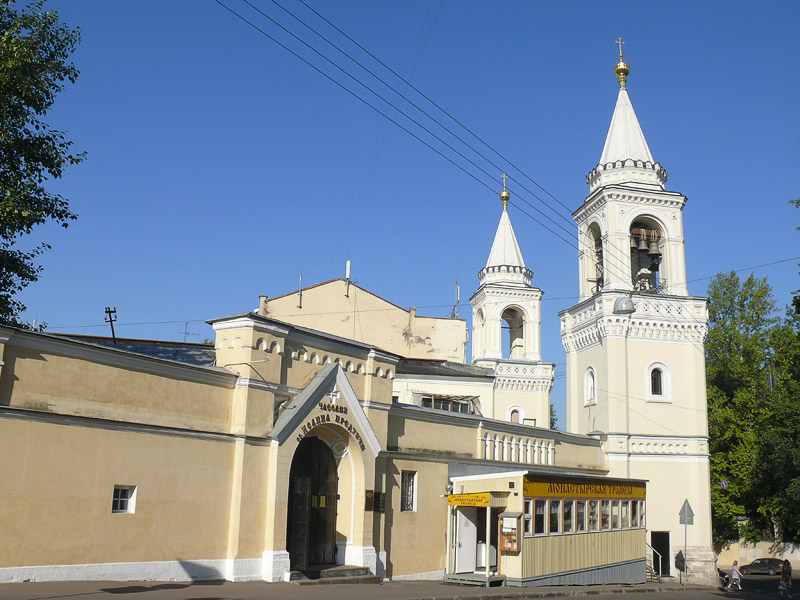
The bell tower of the John the Baptist convent. Photo credit: Darya Ogranovich, 2010.


The sound was coming from the Иоанно-Предтеченский (John the Baptist) convent, which is also called the Ivanovsky convent. People were filing up to the top of the bell tower for their chance to ring them, and the result was an endless chorus of bells. It was a little harder to hear the praktikantki giving their tour, but the sound was soothing and atmospheric for our tour, as we discussed the way the area had changed over time.
The convent was built in the fifteenth century, and for many years was a working convent, with a prison for noblewomen in the basement. Like much of Moscow, the convent burned down in 1812, and it was rebuilt at the end of the nineteenth century, only to be closed down by the soviet government a few decades later. Part of the state archives and a police academy were moved into some of the convent’s buildings, and when the monastery was reopened in 2002, these organizations remained, making the monastery an interesting representation of different facets of Russian life. You can read about the convent in English here: http://en.wikipedia.org/wiki/Ivanovsky_Convent.

Дом полярников (House of Polar Explorers)

When I learned that we would be visiting a house entirely devoted to polar explorers, I was not sure that I had heard correctly. To me, the idea of a house built for explorers seemed a little strange. However, as Caroline Brooks explains in her history of Moscow, “[a] law passed shortly after the Revolution entitled intellectuals to more living space than other people” and special construction took place to ensure that professionals (such as polar explorers) had a place to live in Moscow (Brooks 228).
DSCN2004
The house, located between Nikitskie vorota and the Arbat for those who are interested in visiting, was built in 1936, making it a perfect example of interwar Soviet architecture. Apparently, the house was built for members of the Glavsevmorput (a wonderfully contracted word that is translated as the Chief Directorate of the Northern Sea Route). The organization was created in order to explore the arctic reaches of the Soviet Union.

938569555

Georgy Ushakov, the first explorer (together with Nikolay Urvantsev) to explore Novaya Zemlya. Photo source: http://ria.ru/ocherki/20130521/938585693.html


One of the first people to live in the House was Arctic explorer Georgy Ushakov, a Hero of the Soviet Union who chose his apartment in the house based on its beautiful view of the Kremlin (for more information in Russian and to read an interview with his daughter about growing up in the House click here).
The house was recently recognized in the press last year when President Putin declared May 21 a national holiday, Day of the Polar Explorers. It has also been the cause of some controversy over restoration (as is the case with many old buildings in Moscow). For example, in the photo above you can see that the two balconied sections on either side of the house are no longer symmetrical. The house is a fascinating reminder of a time now past in which society was constructed and thought of in a completely different way.
Note: Time will tell whether or not Day of the Polar Explorers is widely celebrated this year.

Manezhnaya Ploshchad' Fountains

Since much has been written about the beauty of Red Square already, and because on May 1st all the fountains in the city were turned on (although the rain spell we are having today seems to have caused some of them to turn off again) I thought I would write about the fountains located just behind the Kremlin on Manezhnaya Ploshad’. When I first saw these fountains, they were devoid of water, which made them a bit less exciting than they are now. However, now the fountains are going full blast and the area has been taken over (again, rain notwithstanding) by strollers, lovers, and kids eager to enjoy spring.

DSCN2151

A poor picture of “Geyser,” the central fountain. The four horses are meant to represent the four different seasons of the year.


Back at Carleton, I took a class with our professor Anna Mikhailovna called “Russian Cultural Idioms of the 19th Century,” in which we learned about stories, works of art, quotes, and paintings that are well known in Russian culture. This class has proved to be extremely useful in Russia. For example, when looking at these fountains, I was able to spot many that represent stories we are familiar with from our classwork.

For example, the fountain below shows the character Alyonushka, a young girl whose brother gets turned into a goat for disobeying the instructions of his parents. The statue shows Alyonushka in a state of depression as she contemplates her fate. This pose was famously rendered by Vasnetsov in his painting “Alyonushka.” To watch a cartoon of the story (in Russian), click here.

  image282 415px-Vasnetsov_Alenushka

Another fountain that I recognized is based on a Pushkin story, “The Tale of the Fisherman and the Fish” (Сказка о золотой рыбке). In this tale, an old fisherman catches a golden fish who promises to fulfill all his wishes.
image294
 

The story goes that the old man, not knowing what to do with such a fish, throws it back into the sea. However, when his wife hears about the fish, she immediately starts requesting things. At first, she wants practical things that she and her husband need. Eventually, though, her greed overtakes her and she starts requesting more and more unrealistic things until finally, the golden fish decides enough is enough and leaves her with nothing.

To me, these fountains represent a series of moments here in Russia in which I have had the opportunity to see something that I recognize from a class or film and have a wonderful moment of clarity in which I realize that all those hours I spent studying at Carleton did pay off.

Classes at MGU

Before coming to Moscow, I worried about a variety of different things. Would I be able to communicate with people? Would I get lost in the city? Would I miss home too much? Strangely, thinking about classwork never really crossed my mind. I envisioned taking some kind of language classes and beyond that I just knew that I would hopefully improve my Russian and all would be well. However, after having taken almost four weeks of classes, I must say that the style of classes here as well as the challenge of taking classes completely in a foreign language has been real.
To begin with, we have phonetics, in which we try to pronounce sounds that our tongues seem incapable of making. My biggest challenge with this class is simply not laughing while my classmates and I repeatedly make baby sounds (“me me me”). It is incredibly strange to be evaluated on how well you can manipulate your mouth to make words and so frustrating when we are unable to perform as our professor would like. It has also been eye opening just how strong our accents are. Nonetheless, phonetics class is hugely rewarding in that I can see the progress we are making (or rather hear it) and learning about how Russian is spoken also makes it much easier to understand people in the real world.
We also have conversation practice class, in which we discuss, among other things, our love lives, our future spouses, and whether or not we would like to have children. My professor will often ask me and Dilara, the only other female student in our class, what we think about something “as women.” Gender relations in Russia are noticeably different than back home, even in the classroom. Another major difference between our classes back at Carleton: here, if you say a wrong answer, you will be told immediately that you are wrong. If you think too long about something, you will be told to hurry up. Our professor will often reprimand us for forgetting things that we should have learned. She has no problem pointing out that, while your presentation may have been decent, you made three tense mistakes and she wrote down every one of them. This is not to say that our professors are in any way unkind. In fact, I love having class with all of them. Having someone badger you about your mistakes makes you more aware of your speech and I can even get used to having my professor yelling at me for laughing while trying to pronounce the word “monastery” for the fortieth time in a row.

DSCN1999

Our trip to Novodevichy Monastery, which prompted the impromptu lesson about how to correctly say the word “monastery.”


Finally, we have grammar, which requires the most concentration and patience. Our professor has a systematic way of working through exercises that forces us to deal with all the pesky bits of Russian that I think most of us would rather forget. Yesterday we discussed the usage rules of the verbs «пользоваться» and «использовать» which frustratingly both mean “to use.” It is even more difficult when we have to ask clarifying questions about using the verb “to use” and how to pick which verb for “to use” to use.
All of this is to say that classes are a big part of our daily life and have highlighted to me both the incredible richness and depth of the Russian language as well as the mountain of things I need to learn before I will truly be able to understand this language.