The Beloved Not-Good Apartment

Today we got to see apartment No. 50 on Sadovaya Street.

the door to the not-good apartment

the door to the not-good apartment


This is where author Mikhail Bulgakov lived, and a very important place in his novel The Master and Margarita. The devil and his entourage take over the apartment, which already has a reputation as a place from which people disappear, and make its reputation even stranger by using it as their headquarters for spreading chaos in Moscow. The author refers to No. 50 as the nekhoroshaya kvartira, or the not-good apartment.
Gretchen and I standing in No. 50's stairwell. Thanks to our praktikantka Olya for taking the photo!

Gretchen and I standing in No. 50’s stairwell. Thanks to our praktikantka Olya for taking the photo!


The graffiti that covers the stairwell’s walls shows the deep connection that people have with this place, with Bulgakov, and with The Master and Margarita. You can see several versions of each of the main characters, quotes from the novel in Russian and in English…
OLYMPUS DIGITAL CAMERA

Woland 


OLYMPUS DIGITAL CAMERA

A version of Queen Margarita


OLYMPUS DIGITAL CAMERA

Behemoth getting on the tram


OLYMPUS DIGITAL CAMERA

Natasha and Nikolai Ivanovich


portraits of Bulgakov…
OLYMPUS DIGITAL CAMERA
plus your typical “I was here” graffiti. Stepping inside the stairwell gave me the feeling that I was in a special place.
Before even entering the apartment itself, I felt just how loved No. 50 on Sadovaya Street has become.
Adventures into the Underground: The Moscow Metro

So it was. It was our first day here in Moscow, and we were to be riding the metro all day, in an attempt to become more familiar with it. Due to jet lag and general lack of sleep, I did find that it was a bit difficult to understand at first, especially as we were weaving through crowds, looking at the design of various stations, and making transfers across the metro on the VERY LOUD subway cars.
 
After our trek on the metro we headed back to our dorms, and tried to get some rest.
Eventually, after a few trips, I started to get how the metro functioned, and how I could get from place to place. It became a necessity soon afterward, and is easily one of the most efficient methods to get around the city.
 
Not only that, but the web that is the Moscow Metro often becomes so much a part of one’s mental map of the city that the scale of the city shrinks, and getting from point A to point B becomes defined by how many stops on the metro are required get there. Occasionally, I notice the actual, much larger, scale of the city. One of these instances came when a group of us got lost somewhere between Парк Културы and Фрунзенская metro stations. Suddenly, the distance between stations on the same line seemed a bit longer than it did within the safety of the metro.
 
Another instance of a similar vein occurred during the time I rode a bike with Kaylin and some Kazakhstani students to Victory Park, which you can read about here.
 
However, sometimes these realizations overemphasize the scale of this city, particularly when getting closer to the city center, where there are more metro stations around and about. It is a very short walk to get to the Old Arbat from the Kremlin, for example, and the fact that I often traverse through the metro to these places separately means that the distance between them was distorted in my mind before I tried the walk there.
 
As of now, my mental map has become somewhat of a potpourri of random places, all connected by a web, but not necessarily connected to each other on the surface. It’s really a strange feeling, and definitely not something you experience in smaller towns in the United States.
 
Also, as a bonus, here’s a video of a typical trip through the metro! Enjoy!
 

A Tale of Two Clocks

I’ve been impressed by two clocks residing in Moscow:

  • The first is the Temple of Glory in the Armory Museum

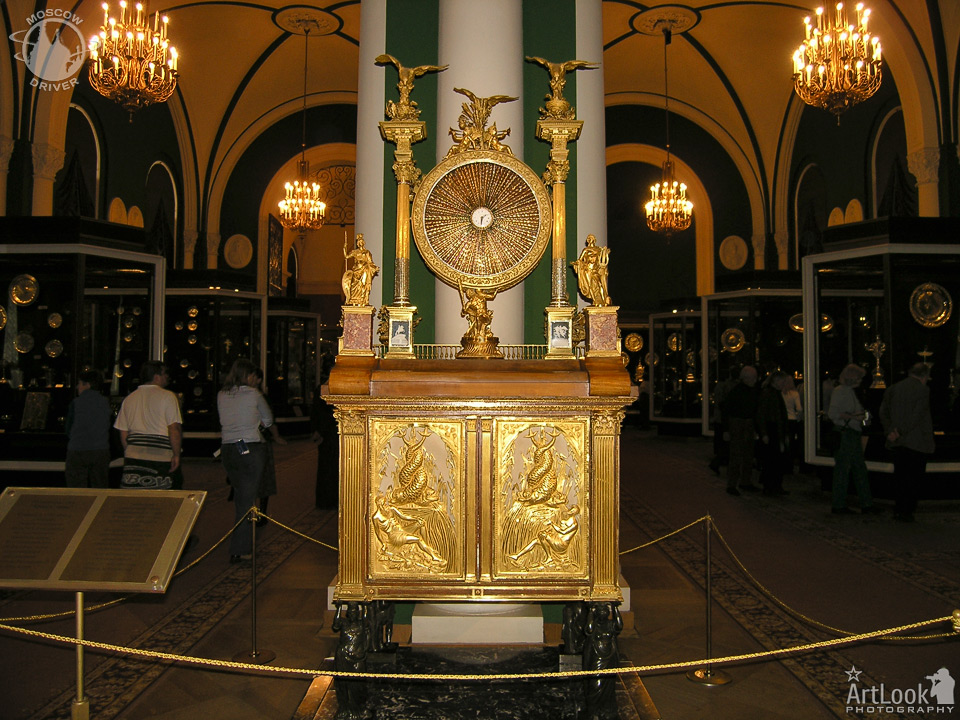
On Monday, May 5 (the same day that we got back from St. Petersburg!) we were given a tour of the Kremlin’s armory. We saw elaborate royal clothing and carriages, snazzy crowns, and gifts given to the royal family, such as golden tableware and my favorite – a chiming clock. It was gifted to Catherine the Great by Michael Maddox, who moved from England to Russia when he was twenty. The clock, Храм Славы (temple of glory), was completed in 1703. Although it is not functioning today, the clock would chime and play music to revolving figurines and flowers, different depending on the hour. (even though this is in Russian, my source is from here http://kraeved1147.ru/chasyi-m-medoksa-hram-slavyi/). Photography in the Armory was prohibited, but I managed to find this photo:

Michal Maddox’s clock to Catherine the Great, Temple of Glory. 1703. From http://www.moscow-driver.com/


  • And the second is:  Kremlin Chimes and clock

Each time I have visited to Red Square or the Kremlin, I love listening to the distinct melody of the Кремлёвские куранты (Kremlin Chimes).

The time kept by the clock is the official time of Moscow. The clock and its chimes are housed in the Spasskaya Tower http://en.wikipedia.org/wiki/Spasskaya_Tower, the main tower of the Moscow Kremlin, towering over Red Square.

St. Basil’s Cathedral is on the left and Spasskaya Tower is on the right. From the wikimedia commons.


Somewhere between 1491 and 1585, the clock was added to the Spasskaya Tower and since then, it has been rebuilt multiple times. The clock’s face is just over 20 feet (6 meters) in diameter and the minute hand is nearly 11 feet (3 meters), impressively big. The clock lets out a short chime every fifteen minutes and a longer tune on each  I find the scale of both of these clocks impressive – Spasskaya Tower’s clock is huge and the Maddox’s clock is very intricate.

The Kremlin's "Secret" Gardens

The Kremlin is the heart of Moscow. It is an incredible, bewitching place. Poet Mikhail Lermontov put it this way:

“neither the Kremlin nor its crenellated walls, nor its dark passages, nor the splendid palaces can be described. They must be seen, they must be seen. One must feel all that they say to the heart and the imagination,” (Brooke, 1).

We were finally able to visit the Kremlin this last weekend and see several of its sacred places and objects, including the building in which Stalin lived, the Tsar Bell and the Tsar Cannon, the building that Putin works in, and the striking Cathedral Square. To my surprise, my favorite place in the Kremlin ended up being Taynitsky Gardens, named for the nearby Taynitskaya Tower. Taynitsky means “secret,” and the secret of the Tower was a hidden well and a passageway to the Moscow River. They were both done away  with (filled up and blocked off, respectively) during the Stalin period. The Gardens themselves used to be the site of a church, though that too was demolished after the 1917 Revolution.
OLYMPUS DIGITAL CAMERA
The sweet smell of lilacs pulled me into the park. The day we took our tour was unusually chilly and wet, but the Gardens still glowed with beauty. Tulips were in full bloom, and everything looked fresh and green. It is a colorful, lovely place.
OLYMPUS DIGITAL CAMERA               OLYMPUS DIGITAL CAMERA

OLYMPUS DIGITAL CAMERA

Taynitskaya Tower


OLYMPUS DIGITAL CAMERA

Sneaking a peek at Putin’s helipad from the park.

Classicism, Modernity, and the Hiding Tchaikovsky

In Белый город (read: Belyi gorod) a number of architectural styles came together during the area’s long history. As a result, all of the buildings around the area are unique, and I noticed a few interesting ones while I was strolling around. So naturally I had to snap a few pictures.
While I was walking along, I noticed the buildings that were the start of Moscow State University. These buildings now hold the journalism department of the university, among other things. The columns in particular scream classical architecture here.

Side of one of the older Moscow State University Buidlings

Side of one of the older Moscow State University buildings


A slightly better picture. Same architecture, of course.

A (slightly) better picture. Same architecture, of course.


Then I came upon the Ryabushinsky Mansion, which you can read more about here. The front fences have a natural shape to them, and the windows also have organic elements, which are indicators that this is a building in the Modern Style, which emphasized natural lines in architecture as opposed to the stark shapes of the classical era.
The Ryabushinsky Mansion

The Ryabushinsky Mansion


A close up of the fence and the window.

A close up of the fence


Finally, when I came upon the Moscow Conservatory, I knew (or so I thought) that it was also classical architecture. The elements, such as the classical columns and similarity to the old buildings of Moscow State University all seem to point to classicism, but it turns out that this building was constructed much later, making this building neoclassical.
The Moscow Conservatory

The Moscow Conservatory


However, there was a little more to this neighborhood than first meets the camera lens. In front of the conservatory there is a statue dedicated to Tchaikovsky. However, when I attempted to photograph the monument, suddenly a darkness descended to protect the monument. My photo turned out strangely dark.
The Hiding Tchaikovsky

The Hiding Tchaikovsky


I figured it was just a freak accident, so I try again. Same result. I give it another shot from a different angle. Still a darkness descended to shroud the composer’s statue from my camera’s gaze. After a couple attempts I was fairly certain that the statue had been cursed by some god who doesn’t like photo-taking tourists.
The Shroud.

The Shroud, which decided the building was free to be photographed, but not Tchaikovsky.


Despite my growing frustration, I persisted. Eventually, I succeeded. With further thought about the incident, I suspect that the shutter speed on my camera must have been too quick to catch enough light. The cursed monument has a better ring to it though, so I think I’m going to stick with that.
The Shroud Lifted

The Shroud Lifted!

Lost in the Solar System

When I was little, I was always fascinated by space. I used to tell people that when I grew up, I was going to be an astronaut. Later, I found out that astronauts had to know a lot of math, and I changed my mind, but outer space still has a place in my heart.

My favorite book for most of my childhood. (Cover from Scholastic Books)


Since we’ve been in Russia, I’ve been to the Moscow Planetarium, Yuri Gagarin’s parent’s house, a small space museum in the town of Gagarin, and, most recently, the Memorial Museum of Cosmonauts.
We got in to the Museum of Cosmonauts free for Moscow's Museum Night!

We got in to the Museum of Cosmonauts free for Moscow’s Museum Night!


It’s been especially fun to see the Russian side of the space race. Of course, I’ve learned a lot more about Yuri Gagarin than I would have thought possible, but I’ve also learned about the other, less famous faces of Russian space exploration. Yesterday at the Museum of Cosmonauts, I saw a great exhibition on women in space, and I had the chance to read about the first woman to leave Earth’s atmosphere, a cosmonaut named Valentina Vladimirovna Tereshkova.

Valentina Tereshkova, the first woman in space. (Photo from Wikimedia Commons)


A textile-factory worker chosen for the space program due to her amateur skydiving experience, Tereshkova became the first woman to go to space on June 16, 1963, at the age of 26. She spent almost three days in orbit, which meant that she spent more time in space than all American astronauts combined before that point. She still lives in Star City, a private development made specifically to house current and former cosmonauts. You can read more about Valentina Tereshkova here.

Valentina Tereshkova, alive and well, carrying the Olympic torch in Sochi. (Photo from rsport.ru)

The Day We Didn't Get Lost

Looking for something to do on Sunday morning, we remembered that one of our teachers had strongly recommended Tsaritsyno Park, so we headed out for a stroll. We entered the park through a side entrance and were greeted by a sea of trees (and few people).

Almeda's true calling:  navigation.

Almeda’s true calling: navigation.


The woods part of the park was more deserted than we thought it would be for a nice, Sunday afternoon. It was cloudy, but there wasn’t a drop of rain.
Throughout the woods, we encountered small monuments and ruins. On this particular path, we found a small grotto with a statue inside.

Throughout the woods, we encountered small monuments and ruins. On this particular path, we found a small grotto with a statue inside.


We meandered through the woods in search of an elusive “большое дерево” (big tree) that was labeled on the park map, but we never managed to find it. Instead, we found a palace, which we supposed was an adequate substitute.
The entrance to the palace courtyard.

The entrance to the palace courtyard.


The palace was commissioned by Catherine the Great in 1775, and construction took place from 1776-1785. When Catherine visited the construction site soon before the palace’s completion, she disliked the building’s design so much that she ordered her new palace torn down and fired its architect. In 1786, construction began on a new design for the estate, but when Catherine died ten years later, her successor discontinued work on the new palace, and it stood unfinished for more than two hundred years. In the early 2000s, the palace was restored and finally completed, as a tourist attraction rather than a residence. You can read more about the history of the park here.
There's a hidden surprise in this picture. Can you find it?

There’s a hidden surprise in this picture. Can you find it?


We decided not to go on a tour of the buildings because the weather was so pleasant. From the palace, we headed downhill to a large pond. On our way, we found a cluster of playgrounds–for adults as well as children.
Almeda doing strength training on the playground. Is this a playground for adults?

Almeda doing strength training on the playground. Is this a playground for adults?


Sahree hanging out in the park.

Sahree hanging out in the park.


After a childish climbing interlude, we continued along the shore of the pond to a manicured tulip garden.
Sahree pretending to be a tulip.

Sahree pretending to be a tulip.


On our way out, we stopped by a fountain spouting from the middle of the pond. Above us, enormous kites flew through the sky. We had a great day, and we didn’t even get lost!
The park's huge fountain with kites flying above.

The park’s huge fountain with kites flying above.

Biking to Victory (Park)

We had both just gotten back from classes, and one of the students from Kazakhstan, Айымгұл (Aeemgul, probably the best way transcribe the name) offered us to go on a bike trip to Victory Park. After a bit of internal debate (homework ever present in our minds) we decided to head out anyway. We, along with three students from Kazakhstan, rented bikes from the basement of Perviy GUM (the building in which we have classes).

"Riding a bike is pretty neat." -Chet

“Riding a bike is pretty neat.” -Chet


As we set out, we weren’t certain how long we would be out, since we had no idea how far away Victory Park actually was by bicycle (The metro distorts one’s sense of distance here in Moscow). Eventually, after riding for about forty-five minutes we made it to a fantastic little park with a view of the Moscow skyscrapers.
IMG_0791
However, we still had a ways to go, and after a few incidents of fallen planks and stairs along the bike path, we managed to catch a glimpse of the park. We had already visited the park for Victory Day but this was an entirely different experience. First of all, we had the park almost to ourselves, aside from a few teenagers on skateboards, a stark contrast to the hordes of people who were there on May 9. We were able to see the various monuments in the park, including an Orthodox Church, a synagogue, and a mosque. After circling the park once, we took a rest on a bench by the fountains. It was an extremely peaceful scene. This was not the Moscow of crowds, cars, and chaos that we have become so used to.
IMG_0779

Fountains at Victory Park


After enjoying the beauty of the park and the cool breeze of a Moscow evening, we turned back to head towards campus. We never imagined that we would be riding a bike in Moscow, and had no idea there were even bike paths in Moscow. But if there is one thing we have learned from being here, it is that Moscow is full of the unexpected. Living here in the dorms, we have had the amazing opportunity to meet other students and we are always surprised at how willing they are to include us. In fact, one word keeps coming into our head here in Russia: generosity. We have been incredibly touched by the generosity we have been shown here.
IMG_0784

Tretyakov Gallery: Nikolai Petrovich Lomtev

Wandering through the Tretyakov, I came across a few of Lomtev’s paintings. Even though his name was unfamiliar to me, it was easy to lose myself in his detailed scenes, impressing me with the complication he was able to express in each of his paintings.
The first of Lomtev’s paintings to catch my eye is titled “Three Youths in the Fiery Furnace” from 1858.

Lomtev’s “Three Youths in the Fiery Furnace”


In the gallery, the painting’s English title is “Three Hebrews in the Fiery Furnace” but I had a difficult time finding it online since I had misspelled Lomtev’s name. My search was not in vain, especially since I found a theme. In the Priscilla Catacomb, there is a wall painting with this title from the mid-3rd century AD.

“Three Hebrews in the Fiery Furnace” from the Priscilla Catacomb, Rome, 3rd century. Photo from www.globallightminds.com/.


And another depiction:

From http://themanandthewall.blogspot.ru/.


Initially, I did not know why there were multiple paintings of such similar scenes with such similar titles. What particular scene could be so well known that there have been references to it in different countries? The answer is simple:  these paintings depict a scene from the bible, Daniel 3.
“They saw that the fire had not harmed their bodies, nor was a hair of their heads singed; their robes were not scorched, and there was no smell of fire on them. Daniel 3:27” (From an article Ineffective Flames by Keith White).
Here are a few more of Lomtev’s paintings that I liked from the Tretyakov Gallery (from here):

Lomtev’s “The sermons of Savonarola in Florence”. 1850.


Lomtev’s “Angels proclaim the heavenly punishment Sodom and Gomorrah”. 1845.


Lomtev’s “Daniel the prophet rebukes the priests of the God Vila before Nebuchadnezzar”. 1858.

In Honor of Victory

Across cultures, it is common to attribute victory in battle to supernatural forces. Russia is no exception to this: many of the most prominent churches in Russia were built “в честь победы,” or “in honor of victory.”

St Basil's on Red Square was ordered by Ivan the Terrible in 1555 to commemorate Russia's capture of Kazan and Astrakhan.

St Basil’s on Red Square was ordered by Ivan the Terrible in 1555 to commemorate Russia’s capture of Kazan and Astrakhan.


Kazan Cathedral in St Petersburg is associated with Russia's defeat of Napoleon in 1812.

Kazan Cathedral in St Petersburg is associated with Russia’s defeat of Napoleon in 1812.


This practice has such a long history that I probably shouldn’t have been surprised when I saw the Cathedral of George the Victorious at Victory Park on Victory Day (is that enough victory yet?). The cathedral is a truly stunning building, shaped like the twelfth-century churches we saw in Vladimir and Suzdal, but with thinner walls and larger windows for a modern touch. Because of the generally secular atmosphere of this holiday, I hadn’t expected to find a church at the park in the center of the celebrations, but there it was.
image
The cathedral was built in the 1990s to commemorate the fiftieth anniversary of the end of the second world war, as part of Victory Park’s memorial complex. I later learned that a memorial synagogue and mosque were also built nearby.

Photo from Wikimedia Commons


Photo from Wikimedia Commons


One of the most powerful things about Victory Day for me was how fresh and recent the war seemed. Most holidays I’ve experienced celebrate events that no living person remembers, like American independence or the birth of Jesus, and they lack the sense of modernity I felt on Victory Day in Moscow. The religious buildings in Victory Park connect this uniquely modern holiday to Russia’s ancient roots.