Our Heroes Made of Clay

After getting back onto our bus after the tour of МЧС, Diane wouldn’t tell us where we were going next, only that it was a surprise. And it was! We were invited into a ceramic shop to make our own clay figurines.

The cabin-like entrance to the ceramics shop.

The cabin-like entrance to the ceramics shop.


First, we were given a brief demonstration of how a clay wheel works, shaping a lump into something symmetrical, such as a vase or the bases for our clay figurines. In high school, I took an art class that was exclusively about how to make ceramics using a clay wheel, and it was one of my favorites. Even during breaks from Carleton, I like to make little clay characters and animals. I would have loved a chance to try out their wheel (it was slightly different from the wheels I’ve used) but we had our clay heroes waiting to be born.
Making a vase has never seemed so easy!

Making a vase has never seemed so easy!


Next we were led over to the premade bases – or rather, bodies – for our clay heroes.
Getting started.

Getting started.


We were guided through the initial steps of making indents for the legs and head and attaching arms.
Gisell putting finishing touches on her Siberian girl.

Gisell putting finishing touches on her Siberian girl.


Before getting too engrossed, we were told to have a character in mind. I chose a dragon. I learned some neat techniques for detail work:  a metal tube bent at one end in the shape of a tear-drop was perfect for decorating my dragon with scales.
My dragon.

My dragon.


All of our heroes are unique:  we’ve got babushkas (Russian grandmas) and dedushkas (Russian grandpas), beautiful Russian girls, a shaman, a penguin and a nerpa (Baikal seal). Can you spot them all?
Here they are in all their glory.

Here they are in all their glory.


Clay is my favorite medium and this was one of the best surprises I could have asked for. Thank you to Diane and everyone who made this possible!

Sporting Around Ulan-Ude

In Russia, and particularly in Siberia, I have noticed sports facilities and locals dressed up in sporting outfits. Perhaps this simply isn’t something I’ve noticed at home, and this isn’t just a Russia/Siberia thing. However, I think it’s interesting and would like to mention a few places and things we’ve seen in Siberia.
During one of our tours through Ulan-Ude, we drove past a huge, red sports complex. It’s one of the largest sports complexes in Eastern Siberia.

The big, red sports complex in Ulan-Ude. Picture from http://survincity.com/2011/07/in-ulan-ude-opened-one-of-the-largest-sports/.


The entire complex is 36,000 square meters, nearly nine square acres. It has multi-purpose stadiums, rooms for archery, martial arts, and even an Olympic-sized swimming pool.

The complex’s pool. Picture from http://survincity.com/2011/07/in-ulan-ude-opened-one-of-the-largest-sports/.


Not far from Ulan-Ude, we visited the Ivolginsky Datsan, a Buddhist university monastery that was opened in 1945 (see Dilara’s Three Faiths blog and Almeda’s Dog Blog). When we first arrived and then again later on, our attention was brought to the datsan’s outdoor stadium.
Colorful seats!

And the seats were colorful, trust me!


Unfortunately, I don’t have a better picture nor could I find one on the internet. I don’t know what the Buddhist monks do in their airy stadium, but it sure looks like it’d be fun!
Like in Moscow, even Ulan-Ude had citizens proudly donning their track suits. A few of us have considered buying matching track suits embroidered with “RUSSIA” until we noticed the price tags. But I still wouldn’t mind having the kurtka (light jacket) part of the track suit. Anyways, I mentioned earlier that even though we’ve noticed nice sports facilities and track suits around in Siberia and Russia, maybe we simply don’t notice our gyms and people at home. Either way, it’s fun to watch out for different types of sports complexes and track suits!

Arguably the Greatest Cheese: Tvorog

One of my favorite foods here are pastries and deserts made of творог (tvorog), a sweet cheese. Tvorog can be translated as farmer’s cheese. The best is сырники (syrniki) – a patty of fried, sweet cheesiness, which goes great with sour cream (сметана – smetana) or jam. Before we entered Kolomenskoye, we stopped by for a bite to eat at a rather fancy café and I’ve never had such delicious syrniki and smetana. The smetana was whipped and fluffier than the store-bought varieties and the jam was spread decoratively next to the syrniki.

I forgot to photograph the syrniki, jam, and smetana in its entirety before starting. But the organization on the plate had been beautiful - magazine quality.

I forgot to photograph the syrniki, jam, and smetana in its entirety before starting. But the organization on the plate had been beautiful, even magazine quality.


Another yummy treat – an open-faced pastry with tvorog in the middle.
d

As Kaylin says about tvorog, “It makes your heart soar.”


And the last – pirog filled with tvorog.
Tvorog-filled pirog, from a cafe called Pirogovaya (it's known for its pirog).

Tvorog-filled pirog, from a cafe called Pirogovaya (it’s known for its pirog).


How is this wonderful food made? Most tvorog recipes use only milk and buttermilk, such as this oneThis recipe suggests using organic milk for a richer taste. The process is long, but the result is worth it and I will be trying these recipes when I get home.

Water Quality

Everybody that I’ve met so far in Moscow and in St. Petersburg drinks bottled water instead of water from the tap. The bottles we get are in increments of liters:  I have nearly gone through four 5-liter bottles during my stay here. Ashan (they sell everying from nylons to kulich Easter bread) is the cheapest place to buy water, but it’s a bit of a hike, especially while carrying a large jug of water. Solution? If you don’t mind spending a few rubles more, the mini-marts in the Glavnoe Zdanie is much closer.

Somehow, I’ve managed to buy four different brands.

Somehow, I’ve managed to buy four different brands.


In Russian 150, I wrote a research paper about the drinking water quality of St. Petersburg but I only found one source that had been updated within the past five years. There have been water quality checks from outside sources, finding subpar results. Since then, Vodokanal (the company in charge of providing sanitized water to the city’s people) has implemented new technology and opened new water treatment plants. They assure that the water is safe to drink, but the population tends to buy bottled water despite this, perhaps out of habit.
In my paper, I did not research Moscow’s water quality, but the situation seems similar to that of St. Petersburg. At the dorms, we are told that even if the water tastes fine and we don’t get sick, there may be heavy metals (carcinogens) from the pipes webbing through the our homely monolith. We have chainiks (electric tea kettles) to boil water, but heavy metals don’t boil away.
It is impossible to know the water quality situation exactly – recent English sources are lacking and in St. Petersburg, Vodokanal does not make all of its statistics publicly available. Perhaps the water in both cities is drinkable and there are pipes (privately owned) that unintentionally add contaminants. We do as the Russians do; we drink bottled water. It is simply a safety precaution.

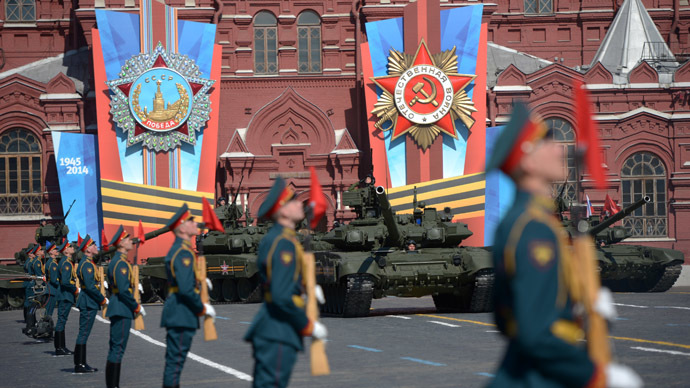
Red Square on Victory Day

After our adventures at Patriarch’s Ponds, Gretchen, Almeda, and I visited Red Square. It being May 10, the day after Victory Day, we watched workers take down the huge, metal-framed structures built for the holiday.

Taking it all down.

Taking it all down.


Returning to class Monday, at least two, maybe three, of our professors told us that it would have been better for us to watch the parade on Red Square on TV instead of craning our necks, standing on our tiptoes, and watching from a different part of the parade route. But for us, the goal was to experience the festivities in person and not through a screen. After all, we can always look online and see what we may have missed! And yes, I was curious:  how had Red Square had looked like the day before, on Victory Day? The weather was perfect and the streets were packed. However, the following day was overcast, threatening to rain, and the streets were deserted.
Here are a few comparison pictures:

From http://rt.com/news/157780-wwii-victory-parade-red-square/.


kaspersDSCF2449
http://rt.com/news/157780-wwii-victory-parade-red-square/

The view above Red Square. From http://rt.com/news/157780-wwii-victory-parade-red-square/.


The view in front of GUM, a shopping center.

The view in front of GUM, a shopping center.

Red Square filled with people. From http://pbs.twimg.com/.

On Wednesday (May 21) I traveled back to Park Pobedy, Victory Park, to visit the Museum of the Great Patriotic War. It was sunny and uncomfortably warm, and as with Red Square on May 10, Park Pobedy was deserted except for a few people playing in the fountains.

May 21

May 21st. Not a holiday. All this open space was filled on Victory Day!

May 9th, Victory Day on Park Pobedy.

May 9th, Victory Day on Park Pobedy.

Graffiti

Vinzavod (or Winzavod)
For the Night at the Museum, a world-wide event in which museums and art galleries open their doors for free, I was with Lily and Dilara at Vinzavod. The buildings of Vinzavod used to be part of a winery and some of the mechanical structures inside have been left as decoration to add an interesting atmosphere. There are even galleries in old wine cellars! Lily and Dilara covered much of what we saw, and I would like to bring attention to the graffiti. As far as graffiti goes, perhaps what is there is not anything special, but since I rarely see any graffiti at home in Northfield, all graffiti stands out to me. Sometimes graffiti is vandalism, and sometimes it is art. The graffiti at Vinzavod is part of the latter. In fact, the whole area is dedicated to Viktor Tsoi, the now deceased leader of Kino, a soviet rock band.

Some of the graffiti we saw at Vinzavod.

Some of the graffiti we saw at Vinzavod.


Bulgakov Museum
On Wednesday (May 21) the praktikantki took us on a tour of Bulgakov’s House, now a museum. Bulgakov is the author of The Master and Margarita, a book we read for class. On the way up to the floor of the museum, the walls were covered with renditions of characters from the book.
Behemoth – a cat that acts like a human.

Behemoth – a cat that acts like a human.


Another rendition of Behemoth. In the beginning of the book, Behemoth boards a trolley while standing on two feet and even holds out his payment to the cashier, but she refuses him, yelling that no cats are allowed. Behemoth decides to hang on the outside of the trolley, getting a free ride. “С котами нельзя!” “Cats are not allowed!”

Another rendition of Behemoth. In the beginning of the book, Behemoth boards a trolley while standing on two feet and even holds out his payment to the cashier, but she refuses him, yelling that no cats are allowed. Behemoth decides to hang on the outside of the trolley, getting a free ride. “С котами нельзя!” “Cats are not allowed!”


A depiction of Woland, the devil, with Behemoth’s paw prints nearby.

A depiction of Woland, the devil, with Behemoth’s paw prints nearby.


The Patriarch’s Ponds Area
On Sunday (May 11), Gretchen, Almeda and I set out to visit Patriarch’s Ponds, which is the opening setting of Bulgakov’s book. We found this interesting line drawing on our way there:
“Sorry” has been misspelled as “Sory”. Notice that another passerby made a correction, adding another “r”.

“Sorry” has been misspelled as “Sory”. Notice that another passerby made a correction, adding another “r”.


And today with Chet and Natasha, we took a look at a free library box (give a book, take a book) near on the bank of the Patriarch’s Ponds.
kaspersDSCF3258 kaspersDSCF3259

It’s the same artist! How neat is that?

The Arbat
On the Arbat, a place visited by many tourists as well as Russians, there is a wall dedicated to graffiti.

Gisell and I striking a pose in front of this awesome wall.

Gisell and I striking a pose in front of this awesome wall.


Kolomenskoye
On the boat (see Almeda’s post), we saw some noteworthy graffiti.
Looks pretty intense. It reminds me of the graffiti we saw at Vinzavod.

Looks pretty intense. It reminds me of the graffiti we saw at Vinzavod.


Petersburg
Here are a few more interesting photos:
Does this count as graffiti? No matter, as long as it’s interesting.

Does this count as graffiti? No matter, as long as it’s interesting.


And to end this post, here is our dramatic mathematician:
I wish I could be that cool.

I wish I could be that cool.

Sweet, Sweet Honey

After our tour of Suzdal and learning that it is famous for its honey, I bought a half-pint for 200 rubles (just over $5). There had been other honey sellers nearby, but a friendly old man convinced me to buy his.

Part of the souvenir market in Suzdal.

Part of the souvenir market in Suzdal.


He asked where I was from, and then I told him that I was studying at Moscow State University. He smiled and briefly told me about one of his relatives currently studying there. Then he continued, showing me pictures of his beehives and telling me about another delicacy he was selling – to me, it looked like a crunchy bar made of bees. Maybe it wasn’t meant to eat. I’m not sure. I managed to buy the honey that I wanted, thanking him, and then we bid farewell.
The honey is delicious. At Ashan I bought some crunchy-breads, hoping they would be like toast. They were strange. Then I realized they were lemon-flavored. To make them into a real treat, I spread honey on them and dare I say it? They were amazing! Magic honey.
Almeda agrees: they're lip-smackin' good!

Almeda agrees: they’re lip-smackin’ good!


A few days ago on Monday (May 19), Chet, Almeda, Gretchen and I visited Kolomenskoe Park (sound familiar? Read this!). We spotted a few signs for honey.
Only 50 meters!

Only 50 meters! (photo: Almeda)


And then another.
Getting there!

Getting there!


Finally the stand!
Hurrah!

Hurrah!


But wait – it’s closed.
The sign in the window says closed: закрыто (zakryto).

The sign in the window says closed: закрыто (zakryto).


And so ends the quest to find honey. (Never fear, I still have some!)
On our way out of the park, we found a stand selling medovukha, a drink made of honey.
Medovukha - made from all that honey goodness.

Medovukha – made from all that honey goodness.


Since we had tried some in Suzdal, we decided not to lug around a bottle on such a hot day.
It turns out that Kolomenskoe sells honey products because it used to have bee-keeping farms. Today, a few of the wooden beehives still stand.
The Three Little Beehives.

The Three Little Beehives.


While planning my blog about honey, I was excited to find another place besides Suzdal that has been known for its honey. Honey tastes better when there’s a story behind it.

A Tale of Two Clocks

I’ve been impressed by two clocks residing in Moscow:

  • The first is the Temple of Glory in the Armory Museum

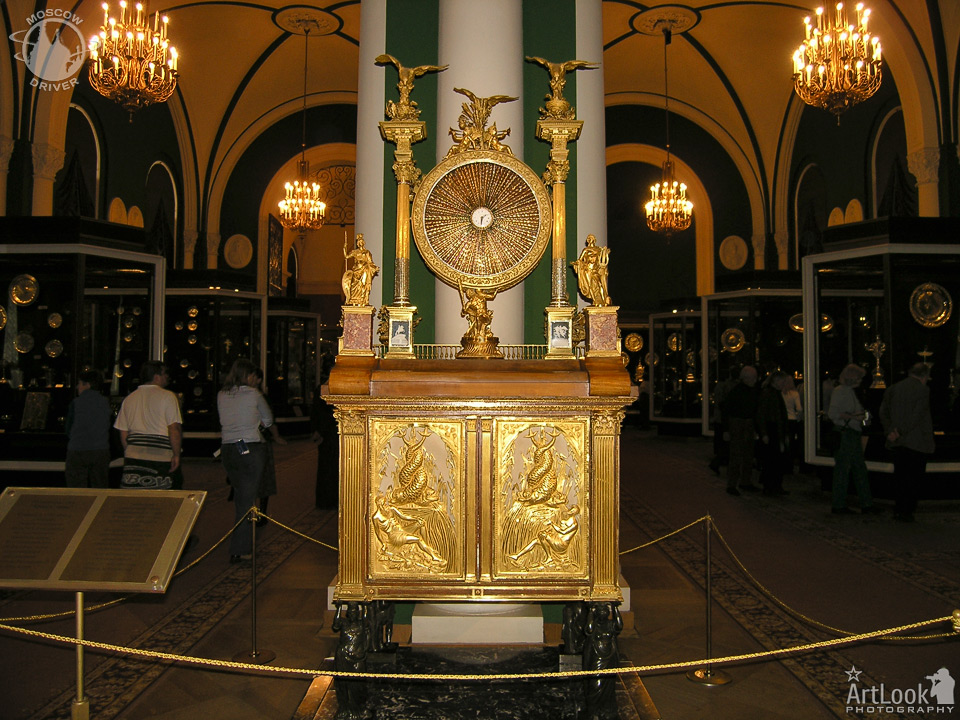
On Monday, May 5 (the same day that we got back from St. Petersburg!) we were given a tour of the Kremlin’s armory. We saw elaborate royal clothing and carriages, snazzy crowns, and gifts given to the royal family, such as golden tableware and my favorite – a chiming clock. It was gifted to Catherine the Great by Michael Maddox, who moved from England to Russia when he was twenty. The clock, Храм Славы (temple of glory), was completed in 1703. Although it is not functioning today, the clock would chime and play music to revolving figurines and flowers, different depending on the hour. (even though this is in Russian, my source is from here http://kraeved1147.ru/chasyi-m-medoksa-hram-slavyi/). Photography in the Armory was prohibited, but I managed to find this photo:

Michal Maddox’s clock to Catherine the Great, Temple of Glory. 1703. From http://www.moscow-driver.com/


  • And the second is:  Kremlin Chimes and clock

Each time I have visited to Red Square or the Kremlin, I love listening to the distinct melody of the Кремлёвские куранты (Kremlin Chimes).

The time kept by the clock is the official time of Moscow. The clock and its chimes are housed in the Spasskaya Tower http://en.wikipedia.org/wiki/Spasskaya_Tower, the main tower of the Moscow Kremlin, towering over Red Square.

St. Basil’s Cathedral is on the left and Spasskaya Tower is on the right. From the wikimedia commons.


Somewhere between 1491 and 1585, the clock was added to the Spasskaya Tower and since then, it has been rebuilt multiple times. The clock’s face is just over 20 feet (6 meters) in diameter and the minute hand is nearly 11 feet (3 meters), impressively big. The clock lets out a short chime every fifteen minutes and a longer tune on each  I find the scale of both of these clocks impressive – Spasskaya Tower’s clock is huge and the Maddox’s clock is very intricate.

Tretyakov Gallery: Nikolai Petrovich Lomtev

Wandering through the Tretyakov, I came across a few of Lomtev’s paintings. Even though his name was unfamiliar to me, it was easy to lose myself in his detailed scenes, impressing me with the complication he was able to express in each of his paintings.
The first of Lomtev’s paintings to catch my eye is titled “Three Youths in the Fiery Furnace” from 1858.

Lomtev’s “Three Youths in the Fiery Furnace”


In the gallery, the painting’s English title is “Three Hebrews in the Fiery Furnace” but I had a difficult time finding it online since I had misspelled Lomtev’s name. My search was not in vain, especially since I found a theme. In the Priscilla Catacomb, there is a wall painting with this title from the mid-3rd century AD.

“Three Hebrews in the Fiery Furnace” from the Priscilla Catacomb, Rome, 3rd century. Photo from www.globallightminds.com/.


And another depiction:

From http://themanandthewall.blogspot.ru/.


Initially, I did not know why there were multiple paintings of such similar scenes with such similar titles. What particular scene could be so well known that there have been references to it in different countries? The answer is simple:  these paintings depict a scene from the bible, Daniel 3.
“They saw that the fire had not harmed their bodies, nor was a hair of their heads singed; their robes were not scorched, and there was no smell of fire on them. Daniel 3:27” (From an article Ineffective Flames by Keith White).
Here are a few more of Lomtev’s paintings that I liked from the Tretyakov Gallery (from here):

Lomtev’s “The sermons of Savonarola in Florence”. 1850.


Lomtev’s “Angels proclaim the heavenly punishment Sodom and Gomorrah”. 1845.


Lomtev’s “Daniel the prophet rebukes the priests of the God Vila before Nebuchadnezzar”. 1858.

Freemasonry in St. Petersburg

Yesterday was the second time that the topic of Freemasonry came up. In class, we had been discussing Bulgakov’s The Master and Margarita, and we briefly discussed a reference to the secretive Freemason society. The first time this topic came up was in St. Petersburg when somebody asked about the pattern above the grand entryway of Kazan Cathedral.

eyeofkazancathedral

The back side of the Kazan Cathedral


Diane informed us that it was one of the Freemason’s symbols. The freemasons are a secret society (or rather, a “society of secrets”) whose members have been famous leaders, inventors, and politicians such as George Washington and Benjamin Franklin.
Knowing very little about the Freemasons, I browsed the internet for general information and for Freemason symbols along with the structures that these appear on. One of their most famous symbols is the Eye of Providence:

Eye of Providence. From the Wikipedia Commons.


This symbol has appeared across the world. Take this church in Germany, which has the Eye of Providence above its roof:

Church of St. Peter (Church of Illumination) in Munich, Germany. Picture from http://www.thestillman.com/stillmanfiles/.


The Freemasons played a significant part in the American Revolution, and the Eye of Providence appears on the dollar bill.

The US dollar bill. Picture from listverse.com.


Eye of Providence has also been associated with the Illuminati, another secret society, making it difficult to determine whether this particular symbol belongs to the Freemasons or to the Illuminati.
Diane directed me to Nicolas Berdyaev’s The Russian Idea for some information about Freemasonry in Russia. The first masonic lodges (a lodge is a local, organized group of masons) emerged in 1731 during the reign of Catherine the Great. In 1738, Catherine suppressed Freemasonry, but when Alexander I came to power in 1801, bringing with him his Freemason connections, Freemasonry once again became popular with Russia’s intellectuals and political activists (such as those who classified as Decembrists in the revolt of 1825). On December 1 1825, Alexander I died from an illness. The people were shocked to find out that Constantine, the Alexander I’s successor, had secretly renounced his claim to the throne. And so, when Nicholas I claimed the throne, the Decembrists revolted, and among them were the Freemasons. During one of our walks around St. Petersburg, Diane referenced the Kazan Cathedral and its symbol of the Eye of Providence, informing us that the Freemasons in Russia played a part in the Decembrist revolt of 1825.
Kazan Cathedral.

Kazan Cathedral


Freemasonry is a difficult topic to write about. Historically, it has been a secretive society, and to do it justice with this short post is impossible. My goal is to make a brief connection with the Freemasons, a group that has spread its influence throughout the world, to a beautiful and famous St. Petersburg building – the Kazan Cathedral.