Giving to Baikal: The Good and the Not-So-Good

Lake Baikal is comprised of an amazing array of ecosystems – a freshwater sea, an island, and mountains. However, pollution threatens to disrupt these delicate relations. Tourists and local residents visit sacred sites, leaving garbage behind, whereas worshipers try to leave their mark in a more environmentally friendly manner.


One of the key ideas of shamanic ritual is to give back to nature. A modern circuit of the Baikal area will inevitably expose visitors to some of the most beautiful natural scenes in the world, along with special spiritual places marked by bright scarves, called ‘himurin’. These spiritual places receive gifts from those following shamanic customs of giving back to nature.  Passersby wishing to show respect frequently stop at the side of the road and sprinkle water or vodka on the ground of a spiritual place.  Alternatively, when we cook outdoors, we will give a portion of the food, whether leftovers or scraps, back to nature.
Ritual poles, called serge, decorated with himurin.

Ritual poles, called serge, decorated with himurin.

Like any area inhabited by humans, however, Baikal is in danger. Spending more time here exposes the issues threatening the lake, such as the open-air dumps, and the factories pumping out chemicals that can stream into the water. Where people once left offerings of food and milk, now the ground is littered with garbage. The lake cries out with a critical question: just what are we giving back to Baikal today?
The view from one of the many sacred cliffs on Olhon Island.

The view from one of the many sacred cliffs on Olhon Island.

The shamanic practice of leaving offerings represents the most basic concept of conservation: when we take something from nature, give back something that will contribute. Sprinkling water or leaving decomposable gifts will promote further growth on that spot, ensuring its beauty for future visitors.  While our modern movements for conservation are only decades old, these shamanic practices have lasted for thousands of years.


Along with the breathtaking views and hopeful rituals, though, we have noticed something sad. At overlooks, beaches, and picnic spots all around the lake, we found piles of litter ranging from empty vodka bottles to rusty wrenches and broken bricks.  Some residents and visitors here may continue shamanic rituals of giving back, but that conscientious attitude is not always shared by all people around Baikal.


Lake Baikal is renowned for its ability to cleanse itself, but how long can this last? No one knows exactly how much Baikal can handle, but everything we put into the lake or its watershed brings us closer to that limit. Open air dumps leave plastic bags blowing in the wind, and hardly a street can be found without empty bottles.  Even inside the Pribaikalsky National Park, signs of littering or abandoned construction accompany every scattered table or gazebo.  The mark of human habitation can be found almost everywhere with a close look.
Garbage on the shore of Baikal.

Garbage on the shore of Baikal.

But humans give back the worst indirectly, for most of the pollution in the lake itself comes from industrial waste.  The Baikalsk Paper Mill has attracted environmentalist attention for failing to keep up to water contamination limits.  Likewise, the many factories on the Selenga River, Baikal’s largest tributary, release a huge variety of harmful chemicals into the water.


Nearby residents and factories may be the main concern, but we realize that as visitors to the lake, we are also part of the problem. Since we come to appreciate Baikal’s magnificent beauty and learn about it, we want to make sure we can give back and keep it pristine for future visitors.


What can we, as tourists, do to fix this pollution problem?
  • Leave our picnic sites cleaner than we found them, making sure our candy wrappers don’t get taken by the wind
  • Make an effort to stay on established trails whenever possible
  • Collect only dead wood for fires, or even better, bring our own firewood
  • Avoid driving around when we can walk

A small group of Carleton students can’t possibly solve all the problems facing the lake, but we can do our best to minimize our impact.

We love Baikal!

We love Baikal! Photo: Rada

Dog Blog

On one of our first days in Siberia, we drove out to the Ivolginsk Datsan, a Buddhist monastery near Ulan-Ude. It was cold and windy in the grasslands outside of the city, but it was pleasant to spend some time outside.

One of the temples of the Ivolginsk Datsan.


The buildings in the complex were beautiful, of course, but I was even more interested in the dogs that wandered freely around the grounds of the monastery. I thought they could be strays, but I think the lamas at the monastery feed them: even though they were dirty, they seemed well-fed.
One particularly friendly dog followed us for almost the whole tour.

One particularly friendly dog followed us for almost the whole tour.


Ivolginsk Datsan is actually famous for its dogs; more specifically, the rare Hotosho breed the monks raise there. The Hotosho is an ancient breed that Buryat and Mongol nomads used for herding, and which doubled as a guard dog for their settlements. Hotosho are enormous, with long, shaggy fur to insulate them against the harsh Siberian winter.

Photo from Wikimedia Commons.


The Hotosho is often described as having four eyes because of the eye-like spots many of them sport on their foreheads. The Buryat traditionally believed that these “extra eyes” make for better watchdogs. At the monastery, we visited the row of kennels where the Hotosho live.
The dogs we saw at the Datsan.

The dogs we saw at the Datsan.


The dogs weren’t too pleased to be stared at by a group of strangers, and they barked like mad. They were very fluffy and I thought they were adorable from a distance, but all the same, I’m not sure I’d want to meet one up close.

Moscow Evenings

In class at Carleton, we listened to a song called Подмосковные вечера, or Moscow Evenings. You can listen to it here. I thought it was a lovely song, about how nice it is to walk around Moscow at night. The first verse can be translated like this:

Not even rustlings are heard in the garden.
Everything here has died down until morning.
If you only knew how dear to me
These Moscow evenings are!

One of our first nights in Moscow, we walked out the Glavnoe Zdanie’s main entrance to look out over the Sparrow Hills. That was my first time seeing the city lights, and it was beautiful.

Gretchen enjoying the view of the city from the University's Sparrow Hills overlook.

Gretchen enjoying the view of the city from the University’s Sparrow Hills overlook.


For the next few weeks, we were very busy, and the next time I really experienced a Moscow evening was on Victory Day. After a long day of strolling, we finally took the metro to the Sparrow Hills metro station, which is located on a bridge over the Moscow river. From the bridge, we watched the Victory Day fireworks light up the darkening sky.
image
Since then, I’ve found myself outside in the evening on many occasions. Tonight, Sahree and I went out in search of a riverboat cruise to look at the city lights. Unfortunately, the dock we went to had already closed for the night, and we didn’t know where to find another one. Instead, we took a walk along the riverbank. I think a night cruise is still in order, but we did enjoy ourselves.
We didn't find a boat we could ride, but we did find a boat-shaped restaurant. It was far too expensive for us, so we ate imaginary burgers outside of it instead.

We didn’t find a boat we could ride, but we did find a boat-shaped restaurant. It was far too expensive for us, so we ate imaginary burgers outside of it instead.


All silliness aside, I think I finally understand the feeling behind the song. There really is something magical about Moscow evenings.
image

Trains!

As you may already know, I like boats. It turns out that my interest in vehicles extends beyond boats, and into the realm of things with wheels. The most interesting type of thing with wheels, in my opinion, is the train.

A train which, incidentally, I saw from the deck of a boat.

A train which, incidentally, I saw from the deck of a boat.


Trains in Russia are much more common, and more useful, than the American trains with which I am familiar. Moscow has no less than thirteen train stations, with trains ranging from the rickety elektrichki that connect Moscow to its many suburbs, to sleeper trains that travel as far afield as Paris (38 hours from Moscow on a high-speed line) and Vladivostok (7 days from Moscow on the Trans-Siberian Railway).

The Moscow station we left from on our way to St Petersburg, which is confusingly called Leningrad Station. Photo from 1tv.ru.


We have ridden on a variety of these trains during our visit. We took elektrichki on our trip to Gagarin, and again when we went to Vladimir. These rides were fairly short, between two and four hours, with multiple stops along the way. Although we did ride one elektrichka with compartments for four, most elektrichki that we rode had large, open seating areas. On this type of elektrichka, people walk up and down the train selling a range of souvenirs and food.
Sahree enjoying the cheese pirozhok she bought from one of the food salespeople on the train to Gagarin.

Sahree enjoying the cheese pirozhok she bought from one of the food salespeople on the train to Gagarin.


Later, we had the chance to ride an overnight train to St Petersburg. I was very excited about this, since I’ve always wanted to try sleeping on a train, and I was not disappointed. On our way north, we rode in the lap of luxury, in sleeping compartments with only two people per room.
Kaylin's and my sleeping compartment on the way to St Petersburg.

Kaylin’s and my sleeping compartment on the way to St Petersburg.


On the way back to Moscow, we had four people in the same amount of space (with bunk beds), but even though that was a little more cramped, I still thoroughly enjoyed the ride. In fact, I’m convinced that trains are almost as cool as boats.

Hammers and Sickles and Stars, Oh My!

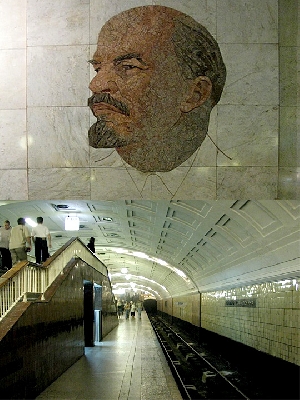
When I first got here, I was surprised for some reason to see that a lot of Soviet symbolism remains in Moscow. This is especially evident in the metro, where hammer-and-sickle emblems and portraits of Lenin still decorate many stations, which have names like “Revolution Square,” “Partisan,” and “Komsomol.”

One of many statues of good Soviet people decorating the Revolution Square station. It's supposed to be lucky to rub the dog's nose as you pass.

One of many statues of good Soviet people decorating the Revolution Square station. It’s supposed to be lucky to rub the dog’s nose as you pass.


I found this enormous statue in the Partizanskaya (partisan) station.

I found this enormous statue in the Partizanskaya (partisan) station.


One of the largest Lenin profiles I’ve seen in the metro is at the station Biblioteka Imeni Lenina, or Lenin Library. Photo from mosgid.ru.


This shouldn’t have been surprising, given that the Russian Federation is less than thirty years old, and it would be foolish and wasteful to try to remove all traces of seventy years of Soviet rule. It isn’t uncommon to find communist symbols even on government buildings. The stars on top of the Kremlin towers are a good example. Installed in 1937, the stars are of varying sizes up to 12 feet across, and are made of red glass.
The Kremlin's Spasskaya tower, with its red star on top.

The Kremlin’s Spasskaya tower, with its red star on top.


After the Soviet Union collapsed, some people wanted to remove the stars. In the end, though, it was decided that they were a great achievement of art and engineering, and so they stand there to this day.

Boats!

I’m sure that by now my friends are getting pretty tired of hearing me talk about boats. Boats, especially tall sailing ships, really bring out my sense of adventure. Like Chet, I loved seeing the Aivazovsky paintings at the Tretyakov gallery and at the Russian Museum in St Petersburg.

Russian Squadron on the Raid of Sevastopol, Ivan Aivazovsky. I loved the traditional favorites, of course, but I liked this painting because of its detail. If you look closely, there are tiny sailors standing in the rigging of all of the ships.

Russian Squadron on the Raid of Sevastopol, Ivan Aivazovsky. I loved the traditional favorites, of course, but I liked this painting because of its detail. If you look closely, there are tiny sailors standing in the rigging of all of the ships.


I was also intrigued by the huge, strange monument to Peter the Great that stands by the Moscow river. Almost 100 meters tall, it depicts an oversized Peter standing at the helm of a stylized sailing ship, looking out over Moscow. The monument, built in 1997, was designed by the artist Tsereteli, who also designed several other statues in Moscow and elsewhere. You can read more about the statue here. While the boat is appropriate (Peter worked tirelessly to make Russia a naval power in the early 18th century) its location in central Moscow is somewhat odd, since Peter hated Moscow, and spent as little time here as possible.

Moscow’s boat-themed monument to Peter the Great. Photo by Alexander Leo Phillips.


While I haven’t yet found a chance to ride on a sailing ship here in Russia, I have been on a couple of boats. As I mentioned in an earlier post, we had the opportunity to take a tour of the canals of Saint Petersburg, which was amazing. Then, yesterday I got to go on another boat, this time on the Moscow River.
He's on a boat.

He’s on a boat.


It was a hot day, and we had been walking in the park at Kolomenskoe for a few hours. We were getting pretty tired, and we were thinking about what to do next when we spotted a sign advertising hour-long rides down the river. We bought ice cream, then got on board.
It was a great day for a boat ride!

It was a great day for a boat ride!


It was a beautiful day for a river cruise. Once we got moving there was a nice breeze, and the sunlight sparkled on the (slightly smelly) water. For a while, we rode past the park, with forests and fields on either side.
Our view of Kolomenskoe Park.

Our view of Kolomenskoe Park.


We went under a couple of train bridges, and soon we were surrounded by rows of apartment blocks rather than trees. Seeing all those apartment buildings reminded me of just how many people call Moscow home.
Apartment blocks like these are a common sight in Moscow, which has a population of around 12 million.

Apartment blocks like these are a common sight in Moscow, which has a population of around 12 million.


Even though it wasn’t a sailing ship, I had a great time on the riverboat. My next project is to go on another ride down the Moscow River, this time at night, to experience the city lights. Until then, maybe I’ll try to stop talking about boats. Maybe.
Chet staring majestically into the distance, wondering if I'm done talking about boats yet.

Chet staring majestically into the distance, wondering if I’m done talking about boats yet.


Lost in the Solar System

When I was little, I was always fascinated by space. I used to tell people that when I grew up, I was going to be an astronaut. Later, I found out that astronauts had to know a lot of math, and I changed my mind, but outer space still has a place in my heart.

My favorite book for most of my childhood. (Cover from Scholastic Books)


Since we’ve been in Russia, I’ve been to the Moscow Planetarium, Yuri Gagarin’s parent’s house, a small space museum in the town of Gagarin, and, most recently, the Memorial Museum of Cosmonauts.
We got in to the Museum of Cosmonauts free for Moscow's Museum Night!

We got in to the Museum of Cosmonauts free for Moscow’s Museum Night!


It’s been especially fun to see the Russian side of the space race. Of course, I’ve learned a lot more about Yuri Gagarin than I would have thought possible, but I’ve also learned about the other, less famous faces of Russian space exploration. Yesterday at the Museum of Cosmonauts, I saw a great exhibition on women in space, and I had the chance to read about the first woman to leave Earth’s atmosphere, a cosmonaut named Valentina Vladimirovna Tereshkova.

Valentina Tereshkova, the first woman in space. (Photo from Wikimedia Commons)


A textile-factory worker chosen for the space program due to her amateur skydiving experience, Tereshkova became the first woman to go to space on June 16, 1963, at the age of 26. She spent almost three days in orbit, which meant that she spent more time in space than all American astronauts combined before that point. She still lives in Star City, a private development made specifically to house current and former cosmonauts. You can read more about Valentina Tereshkova here.

Valentina Tereshkova, alive and well, carrying the Olympic torch in Sochi. (Photo from rsport.ru)

Venice of the North

St Petersburg is often described as the “Venice of the North,” a city of canals and bridges built on the marshlands where the Neva river flows into the Gulf of Finland.

A view of St Petersburg from the water.

A view of St Petersburg from the water.


Its location, surrounded by water, has not always been an asset. While in Petersburg, we read Pushkin’s poem The Bronze Horseman, which is set during the devastating food of 1824. Floods were not uncommon in St Petersburg for three hundred years after the city’s establishment, and were not brought under control until the 2011 completion of a highly controversial dam in the Gulf of Finland. You can read more about the dam here: http://en.wikipedia.org/wiki/Saint_Petersburg_Dam.
As a tourist, though, I really appreciated the city’s water. After over a month in landlocked Moscow, I was ready for the smell of salt water and some slightly less dry air, and I found that in St Petersburg.
Gisell and Lily looking cold on our boat tour.

Gisell and Lily looking cold on our boat tour.


On our second day in St Petersburg, we went on a very windy boat tour of the city’s canals. It was fun to see the city from Peter the Great’s intended perspective (he had hoped that Petersburg would be navigated almost exclusively by boat).
On Saturday, we visited some of the royal estates outside of the city and got to see (and briefly stand in) the freezing cold Gulf of Finland.

“You can tell it’s the ocean because of the way it is!”


I can think of very few other large cities with such tight connections to water, and I loved getting to experience that in St Petersburg.

The Day We Didn't Get Lost

Looking for something to do on Sunday morning, we remembered that one of our teachers had strongly recommended Tsaritsyno Park, so we headed out for a stroll. We entered the park through a side entrance and were greeted by a sea of trees (and few people).

Almeda's true calling:  navigation.

Almeda’s true calling: navigation.


The woods part of the park was more deserted than we thought it would be for a nice, Sunday afternoon. It was cloudy, but there wasn’t a drop of rain.
Throughout the woods, we encountered small monuments and ruins. On this particular path, we found a small grotto with a statue inside.

Throughout the woods, we encountered small monuments and ruins. On this particular path, we found a small grotto with a statue inside.


We meandered through the woods in search of an elusive “большое дерево” (big tree) that was labeled on the park map, but we never managed to find it. Instead, we found a palace, which we supposed was an adequate substitute.
The entrance to the palace courtyard.

The entrance to the palace courtyard.


The palace was commissioned by Catherine the Great in 1775, and construction took place from 1776-1785. When Catherine visited the construction site soon before the palace’s completion, she disliked the building’s design so much that she ordered her new palace torn down and fired its architect. In 1786, construction began on a new design for the estate, but when Catherine died ten years later, her successor discontinued work on the new palace, and it stood unfinished for more than two hundred years. In the early 2000s, the palace was restored and finally completed, as a tourist attraction rather than a residence. You can read more about the history of the park here.
There's a hidden surprise in this picture. Can you find it?

There’s a hidden surprise in this picture. Can you find it?


We decided not to go on a tour of the buildings because the weather was so pleasant. From the palace, we headed downhill to a large pond. On our way, we found a cluster of playgrounds–for adults as well as children.
Almeda doing strength training on the playground. Is this a playground for adults?

Almeda doing strength training on the playground. Is this a playground for adults?


Sahree hanging out in the park.

Sahree hanging out in the park.


After a childish climbing interlude, we continued along the shore of the pond to a manicured tulip garden.
Sahree pretending to be a tulip.

Sahree pretending to be a tulip.


On our way out, we stopped by a fountain spouting from the middle of the pond. Above us, enormous kites flew through the sky. We had a great day, and we didn’t even get lost!
The park's huge fountain with kites flying above.

The park’s huge fountain with kites flying above.

In Honor of Victory

Across cultures, it is common to attribute victory in battle to supernatural forces. Russia is no exception to this: many of the most prominent churches in Russia were built “в честь победы,” or “in honor of victory.”

St Basil's on Red Square was ordered by Ivan the Terrible in 1555 to commemorate Russia's capture of Kazan and Astrakhan.

St Basil’s on Red Square was ordered by Ivan the Terrible in 1555 to commemorate Russia’s capture of Kazan and Astrakhan.


Kazan Cathedral in St Petersburg is associated with Russia's defeat of Napoleon in 1812.

Kazan Cathedral in St Petersburg is associated with Russia’s defeat of Napoleon in 1812.


This practice has such a long history that I probably shouldn’t have been surprised when I saw the Cathedral of George the Victorious at Victory Park on Victory Day (is that enough victory yet?). The cathedral is a truly stunning building, shaped like the twelfth-century churches we saw in Vladimir and Suzdal, but with thinner walls and larger windows for a modern touch. Because of the generally secular atmosphere of this holiday, I hadn’t expected to find a church at the park in the center of the celebrations, but there it was.
image
The cathedral was built in the 1990s to commemorate the fiftieth anniversary of the end of the second world war, as part of Victory Park’s memorial complex. I later learned that a memorial synagogue and mosque were also built nearby.

Photo from Wikimedia Commons


Photo from Wikimedia Commons


One of the most powerful things about Victory Day for me was how fresh and recent the war seemed. Most holidays I’ve experienced celebrate events that no living person remembers, like American independence or the birth of Jesus, and they lack the sense of modernity I felt on Victory Day in Moscow. The religious buildings in Victory Park connect this uniquely modern holiday to Russia’s ancient roots.