Final Day

Goodbyes are hard. After a boat tour on the Moskva River, our group parted ways on the trusty Moscow Metro, where we tightly embraced and waved prolongedly through the windows to each other as our train cars pulled away. Only Chet, Almeda, Sahree, and I remained, but the four of us were determined to make the most of our last day in Moscow, and that we did.
In the morning, Chet and I met up with James, a fellow Moscow holdout, at Izmailovsky Market. From a distance, Izmailovsky resembles a bizarre Renaissance Festival storefront.

Photo from http://jdombstravels.com/wp-content/uploads/2013/09/Jdombs-Travels-Izmailovo-Market-1.jpg.


Inside, it strongly reminded me of the quaint country flea market near my grandma’s old house, where I spent many a Saturday morning as a child. The spirit of routine and camaraderie amongst the shop keepers was uncannily similar. I can’t count how many times at Izmailovsky I saw grizzled old men shuffling from booth to booth, shaking their fellow vendors’ hands and shooting the breeze. I wondered how many sellers used Izmailovsky as their primary source of income. I also pondered whether they grew tired of trying to explain prices to non-Russian-speaking tourists every day. I imagine they do.
I left with far more souvenirs than my suitcases have room for, but the prices really spoke to me. I bought two wooden dolls, which I had been wanting this entire trip, from a woman who hand paints them herself. We got to talking and covered all the usual pleasantries, like where I was from and what I thought about the difficulty of the Russian language. Chet, James, and I somehow managed to meet up multiple times, and we eventually left the market, but not before I bought a Russian flag off the front of one stand and finally obtained the crown jewel of my souvenir collection: a track suit.
In the early evening, the four of us met up with Taya to stroll around the Kremlin one last time. Although we weren’t able to get into the Manege’s new exhibit for free, we did cover all the usual tourist bases. We watched one final changing of the guard at the Tomb of the Unknown soldier and witnessed a new stage on Red Square being put up for Russia Day – sadly, we won’t get to see the finished preparations.
There's always something going on at Red Square.

There’s always something going on at Red Square.


Having wandered across a bridge overlooking the Kremlin, we ate a delicious supper at Grabli.   We became a bit turned around on the way to the metro and ending up facing the Kremlin again. We crossed the bridge, crossed the famous square, listened to an old man singing songs that we actually knew, and said farewell to that part of the city… for now, anyways.
IMG_8526
Goodbyes are hard, but when you remember that the people and places you left are still there, waiting for you to return someday, they become a little easier. And the set of wonderful things you left behind on the way to your new adventure are the ones that will greet you when you arrive home.

The Borsch Strikes Back

I said I would do a follow up to my borsch blog, so here it is. Enjoy!
Cold borsch at Cafe Stolle, St. Petersburg

IMG_3455

Pre-smetana stir.


Post-smetana stir.  It was a remarkably neon shade of pink.

Post-smetana stir. It was a remarkably neon shade of pink.


My Kazakhstani friend Dilya first told me about the wonders of cold borsch. Although we didn’t get to eat it together as planned in Moscow, I was able to try it in St. Petersburg. As advertised, it was chilly and just generally intriguing. Beets remain the primary ingredient of cold borsch, but it usually contains radishes and other hard vegetables. Yogurt or other milk products hold everything together. At least one hard-boiled egg lay beneath the violet surface of my borsch. It was good, but in a different way, and Edward had to help me finish it. The last cool thing: cold borsch actually has its own word in Russian, svekol’nik (свекольник). It’s not as popular in Moscow though, so I didn’t run into it much there.
Homemade dorm borsch in the Glavnoe Zdanie
IMG_4264
With Almeda and Sahree spearheading the effort, our group made a (huge) batch of homemade borsch after everyone was back in the dorm. You can read extensively about it here. We bought the usual things: several beets, potatoes, and onions.  In the process, we finally learned how to buy produce at Ashan.  The group couldn’t eat the whole batch, so leftovers were served more than once. As the Russians will swear, it really was better the second time around. Svetlana, one of our dorm ladies, was just thrilled to hear that we had finally cooked something by ourselves.
Mumu borsch, various locations around Moscow
b8
I ate Mumu borsch several times, so it deserves a mention. Mumu, in my opinion, is over-priced and overrated. Their borsch is too salty, like all their food, and ridiculously difficult to eat. Why are enclosed bowls even made? How am I supposed to dig the last five spoonfuls of soup out of my dish? I usually try tipping it (to little avail) and often end up spilling on myself in the process. Mumu borsch seems much more manufactured than the kind one would receive prepared at a restaurant. In my opinion, this is because they toss a little cardboard boat of meat into the soup right in front of you as soon as you order. I suppose this is to eliminate the need for two pots of borsch: that is, a meaty one and a vegetarian one. Anyway, Mumu borsch works in a pinch, but there are better varieties to be found.
Spicy borsch, Mini Hotel, Khuzhir, Olkhon Island
After a strong headache, weak nausea, and general tiredness after arriving on Olkhon, I contend that this borsch single-handedly revived me. I had no desire to eat, but from the first bite I knew it was a special borsch. I had never eaten one with so much hot, spicy flavor, but it was a fantastic combination. As I recall, it was light on beets and instead utilized other hearty vegetables like large pieces of potatoes and long onions. It was incredibly delicious and made me feel 110% better than I did when I sat down at the table.
Last borsch, Cafe Gribli, Moscow
b10
I knew I couldn’t leave Moscow without a last bowl of borsch. After my ten week love affair with the dish, it’s become such a normal part of my dining routine. I don’t know what I’ll do without it. Gribli’s borsch was possibly a little scant on the beef, but that may be because it’s self-serve, and I didn’t scoop to the bottom of the pot. On the plus side, the smetana (sour cream) was also self-added. In general, this borsch was most worthy, and I ate my final Russian meal with great company.

Nerpa Blog

Shockingly, no one in our group has written a full blog about nerpas, the famous freshwater Baikal seals. Given our fascination and adoration with these cute little creatures, a more comprehensive look at their remarkable properties and our interactions with them is required.
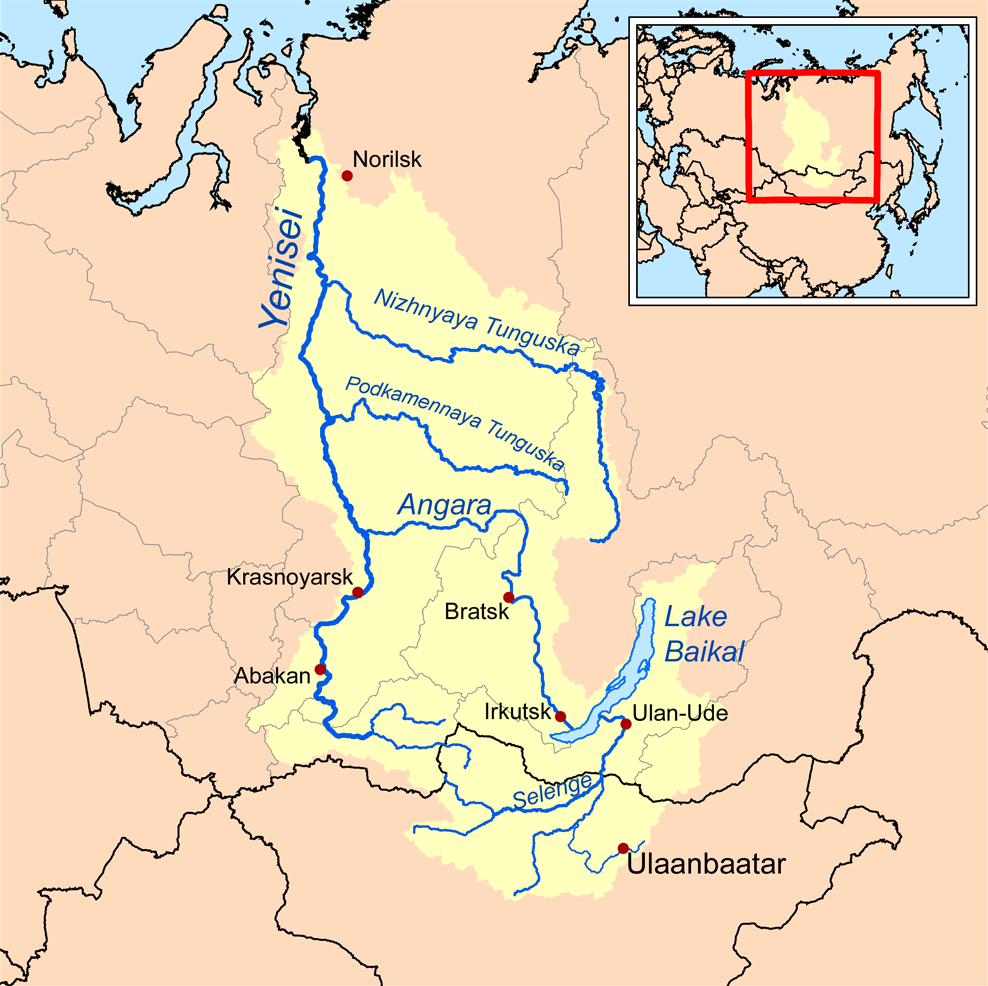
Nerpas are unique for being the only species of exclusively freshwater seal in the world. They live in the deep, cold waters of Lake Baikal, but it’s uncertain just how they arrived in this landlocked body of water. Some ecologists think nerpas swam south down the Yenisei-Angara River system, while others think they arrived much earlier, when Baikal was joined with an ancient inland sea.

That’s a long way for a little nerpa to swim. Photo from Wikimedia Commons.


Nerpas migrate within the lake’s banks every year. In the summer, they enjoy lounging on the rocky Ushkany Islands or on more southern shoreline. During winter, they migrate northward to find thicker ice, on which they give birth to their young.
Nerpas have unusually large eyes compared to other pinnapeds. They’re small, round, and ball-like, as we found out when visiting the Baikal Limnological Museum near Irkutsk. Nerpas appear to have no neck, and they’re almost entirely round when free floating. They stretch out a bit once they start swimming, but only about to the shape of a well-inflated football.

So round! Photo: http://wikifaunia.com/wp-content/uploads/2013/01/Foca-del-lago-Baikal.jpg


Seeing a mama and baby nerpa in the museum’s aquarium was great, because it offered us the chance to gaze upon their minute physiological details up close. The museum also featured a “Nerpa cam”, which we viewed upstairs after our tour. The footage streams from one of the nerpas’ favorite hangout spots, the Ushkany Islands, which I mentioned earlier. We turned into giggling children as we watched one lazy, fat nerpa lying on its side and seemingly hitting another seal with its flipper, over and over again.  Eventually he calmed down and resumed his nap.  Sadly, I can’t seem to find the stream online, but if I do, I’ll add the link here.
Little did we know, our encounters weren’t over yet. For the first time since this program has been in operation, the group saw a wild nerpa. High on a cliff overlooking the clear blue water, our guide excitedly pointed out a small speck in the distance. Everyone rushed over to the cliff’s edge to look. Bobbing in the gentle ripples was a little seal, watching us and listening to the excited squeal of our voices.
DSCF5922

What’s that in the distance?
Photo credit: Sahree Kasper


DSCF5923

Wait… could it be??
Photo credit: Sahree Kasper


DSCF5924

IT REALLY IS!!
Incredibly marvelous photo credit: Sahree Kasper


We all stayed that way for a couple minutes, until the nerpa decided he or she needed to get back to work. Even as the seal swam away, we could still see it for several seconds – such is the clarity of Baikal’s water. It was an honor to experience the nerpa’s company, and it was a highlight for many members of our group.
Interesting source and further reading: http://scienceblogs.com/tetrapodzoology/2010/06/15/most-inconvenient-seal/

The Other Side of War

When we first arrived in Ulan-Ude, one of the first things I noticed as we drove through town was a healthy display of Victory Day banners and billboards. I was a little surprised, to be honest – it didn’t occur to me that the Great Patriotic War could have possibly affected small-town Siberia.
Indeed, the battles of World War II never reached Buryatia – the Pacific Front, as it concerned the Soviet Union, consisted of a few land grabs. On Russia’s Western Front, the Nazis came within miles of Moscow, sieged Leningrad, and fought a horrific battle at Stalingrad, but Buryatia remained safe several time zones away.
Siberia became a safe haven for the Soviet Union during that time. Entire factories were picked up and transported eastwards across the rail lines to keep them out of Nazi hands. Wounded soldiers, too, found themselves in the safe embrace of the steppe. With this influx of new arrivals, even regular citizens were brought face to face with the war effort. In Ulan-Ude, for example, every school was converted to a temporary hospital. Imagine how startling and strange it would be as a young student to see your school overwhelmed by injured soldiers from far-flung places.
br1
This memorial, which we saw on our first day in town, commemorates the Great Patriotic War. Each pillar symbolizes a different year in the conflict. The first year, 1941, was marked by extreme difficulty, such as the near-capture of Moscow and the beginning of the Siege of Leningrad. As a testiment to the great hardships of this year, its pillar is leaning heavily, seemingly about to collapse. 1942 was also a very trying time, so it, too, tips sideways. But the tide began to turn as the war went on. The Nazis were eventually pushed back, and this is reflected in the straight, steadfast pillars that represent 1943 and 1944.
We encountered World War II again on our last evening in Ulan-Ude, when we found ourselves in the Philharmonie, a Soviet-era theater on the city’s main square. The building was beautiful inside, decorated with mouldings of hammers and sickles, bundles of grain, and other communist motifs.
br2
We came to view a (new) play, presented by local actors and featuring performers from around the area. The production told the story of a group of nurses at a Buryat military hospital during the war and showed how intimately the far-off battles affected these women’s lives. One struggles with the distance separating her from her lover on the front lines. Others meet and fall in love with wounded soldiers from far corners of the Soviet Union, people they would never otherwise have met.
br3
Seeing the war from the perspective of these nurses, it was much easier to understand the extreme scale of World War II and the Soviet Union. In this small city more than 2500 miles from Moscow, people of different races, cultures, and traditions were thrown together by the same war, as citizens of the same nation. It’s easy to see the differences between eastern and western Russia, but seeing the role of Ulan-Ude in the war was a good reminder of the strong ties that keep the people of Russia connected.
Other sources: Rada, our amazing Buryatia tour guide

The Sun Also Rises

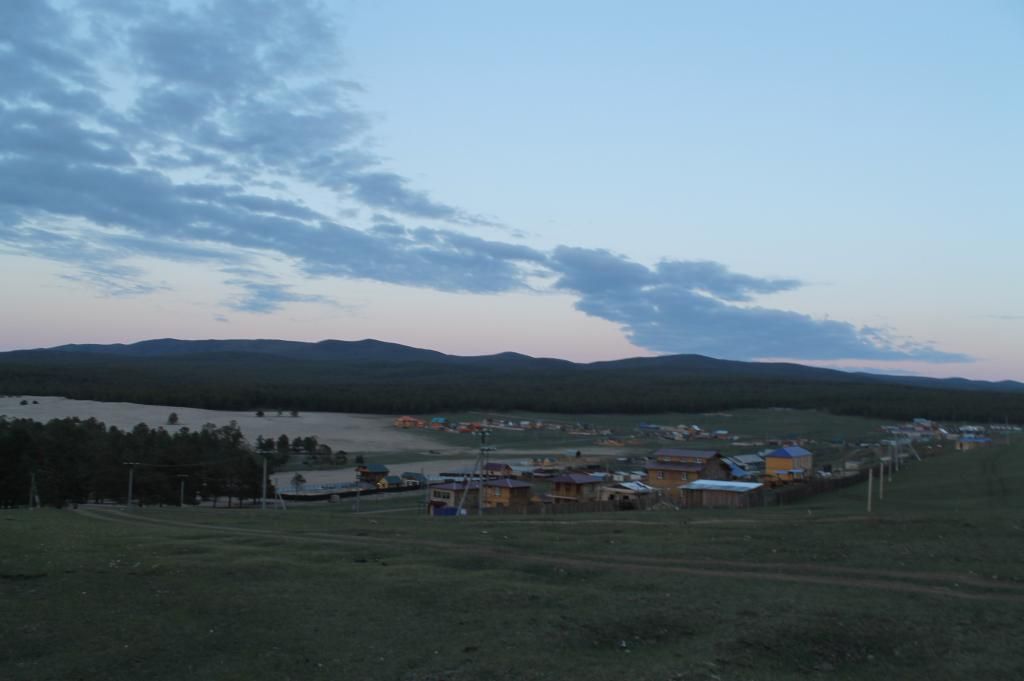
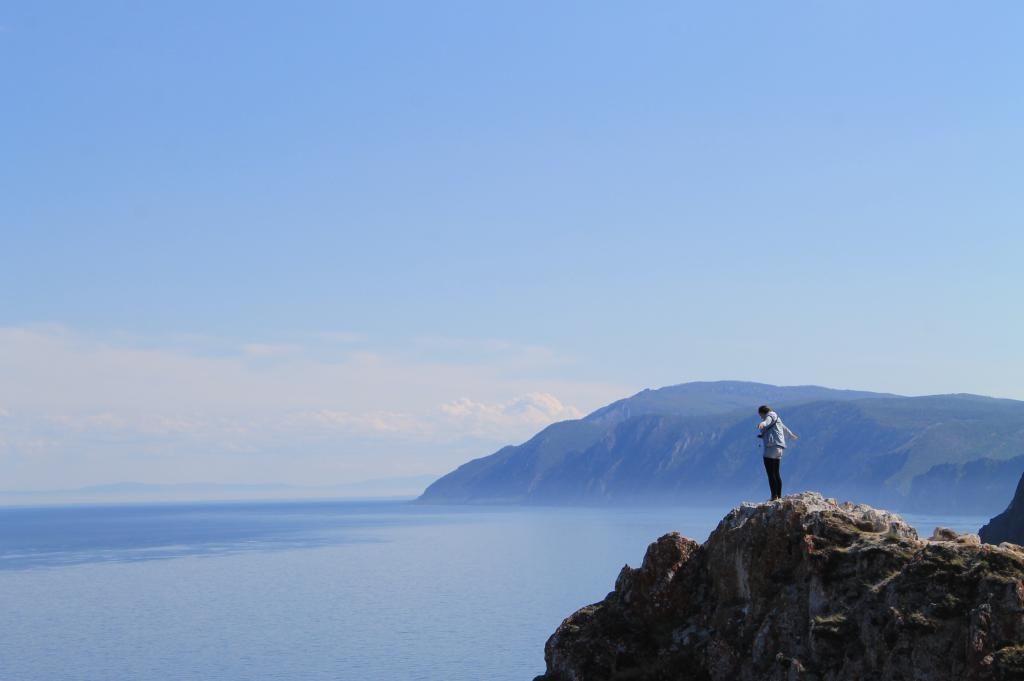
Olkhon. Have you ever heard of such a place? It is the largest island in Lake Baikal, with a combination of harsh, steep cliffs and rolling green hills. It is beautiful.

The view from our hotel.


When Russian explorers came to Baikal in the 17th century, Olkhon was the first place they visited. The island is considered the sacred center of Baikal, filled with legends, 143 archaelogical objects, and many holy places. It is certainly unlike any other place I’ve ever seen.
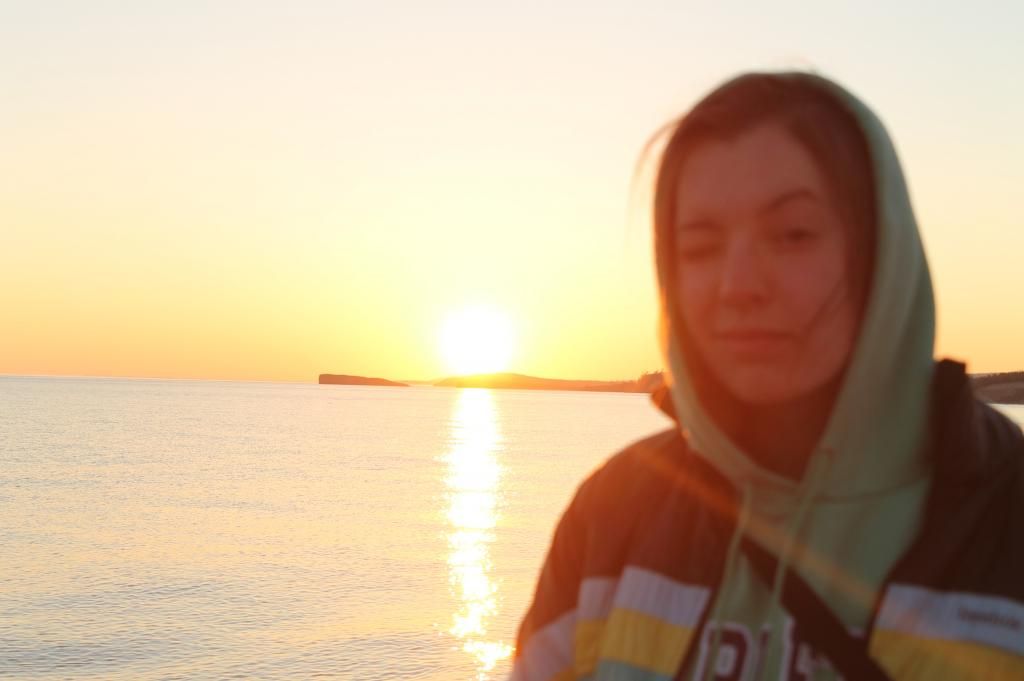
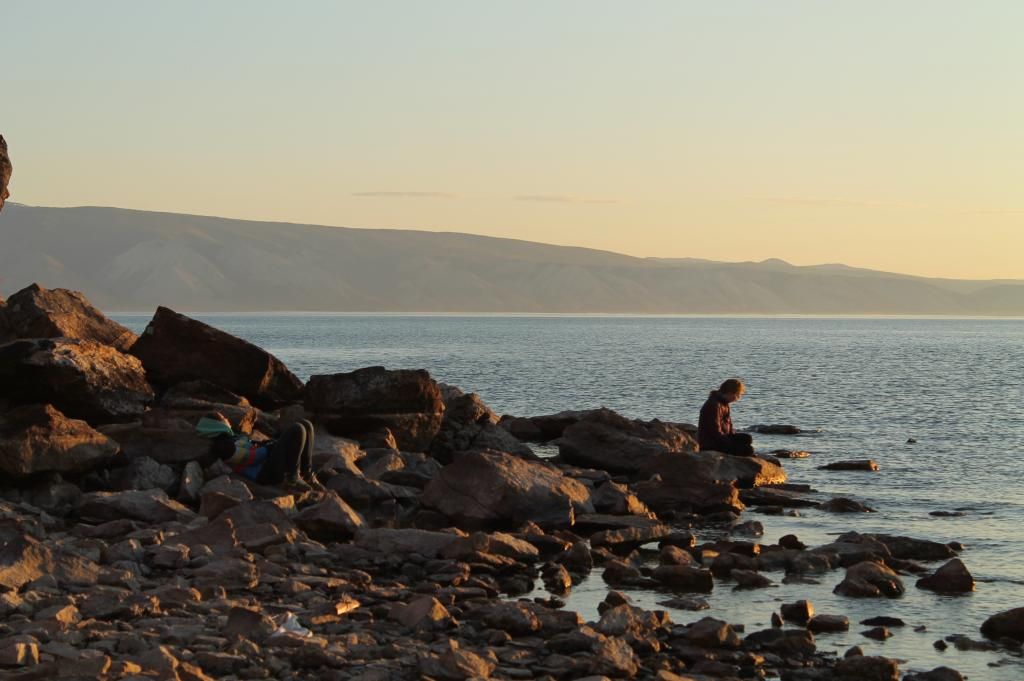
Although we were exhausted when we got there, we decided to wake up very early the next morning to see the sunrise over the island.


Kaylin on the rocks.


We sat on the rocks and watched the sun spill out over this sacred lake. I’m not sure if I’ll ever get to see Olkhon again, but it’s certainly got a special place in my memories.

Yanzhima's Rock

If you read Lily’s blog, then you’re already familiar with the beauty of the Barguzin Valley.

These snow-capped mountains are unforgettable.


Driving through this stretch of land, you might chance upon herds of horses, a winding stream or two, or, as we did, a newly-built datsun.

According to our guide, a few years ago, an image of the dancing goddess Yanzhima was discovered on a rock in this area (Yanzhima is the goddess of fertility in the Buryat Buddhist tradition). Childless couples began flocking to this area, praying for fertility. When the area saw an increase in child births, the area was declared sacred and a datsun was soon built.
Since then, Yanzhima’s rock has gained much attention and attracts thousands of hopeful couples. Countless toys have been placed on the rock as offerings to the goddess.

Visiting sacred places, I always get the feeling that they’ve always been there, perhaps for thousands of years. Seeing this datsun, however, shows that sacred places are still springing up, perhaps a result of a very active religious community.

Our Heroes Made of Clay

After getting back onto our bus after the tour of МЧС, Diane wouldn’t tell us where we were going next, only that it was a surprise. And it was! We were invited into a ceramic shop to make our own clay figurines.

The cabin-like entrance to the ceramics shop.

The cabin-like entrance to the ceramics shop.


First, we were given a brief demonstration of how a clay wheel works, shaping a lump into something symmetrical, such as a vase or the bases for our clay figurines. In high school, I took an art class that was exclusively about how to make ceramics using a clay wheel, and it was one of my favorites. Even during breaks from Carleton, I like to make little clay characters and animals. I would have loved a chance to try out their wheel (it was slightly different from the wheels I’ve used) but we had our clay heroes waiting to be born.
Making a vase has never seemed so easy!

Making a vase has never seemed so easy!


Next we were led over to the premade bases – or rather, bodies – for our clay heroes.
Getting started.

Getting started.


We were guided through the initial steps of making indents for the legs and head and attaching arms.
Gisell putting finishing touches on her Siberian girl.

Gisell putting finishing touches on her Siberian girl.


Before getting too engrossed, we were told to have a character in mind. I chose a dragon. I learned some neat techniques for detail work:  a metal tube bent at one end in the shape of a tear-drop was perfect for decorating my dragon with scales.
My dragon.

My dragon.


All of our heroes are unique:  we’ve got babushkas (Russian grandmas) and dedushkas (Russian grandpas), beautiful Russian girls, a shaman, a penguin and a nerpa (Baikal seal). Can you spot them all?
Here they are in all their glory.

Here they are in all their glory.


Clay is my favorite medium and this was one of the best surprises I could have asked for. Thank you to Diane and everyone who made this possible!

Sporting Around Ulan-Ude

In Russia, and particularly in Siberia, I have noticed sports facilities and locals dressed up in sporting outfits. Perhaps this simply isn’t something I’ve noticed at home, and this isn’t just a Russia/Siberia thing. However, I think it’s interesting and would like to mention a few places and things we’ve seen in Siberia.
During one of our tours through Ulan-Ude, we drove past a huge, red sports complex. It’s one of the largest sports complexes in Eastern Siberia.

The big, red sports complex in Ulan-Ude. Picture from http://survincity.com/2011/07/in-ulan-ude-opened-one-of-the-largest-sports/.


The entire complex is 36,000 square meters, nearly nine square acres. It has multi-purpose stadiums, rooms for archery, martial arts, and even an Olympic-sized swimming pool.

The complex’s pool. Picture from http://survincity.com/2011/07/in-ulan-ude-opened-one-of-the-largest-sports/.


Not far from Ulan-Ude, we visited the Ivolginsky Datsan, a Buddhist university monastery that was opened in 1945 (see Dilara’s Three Faiths blog and Almeda’s Dog Blog). When we first arrived and then again later on, our attention was brought to the datsan’s outdoor stadium.
Colorful seats!

And the seats were colorful, trust me!


Unfortunately, I don’t have a better picture nor could I find one on the internet. I don’t know what the Buddhist monks do in their airy stadium, but it sure looks like it’d be fun!
Like in Moscow, even Ulan-Ude had citizens proudly donning their track suits. A few of us have considered buying matching track suits embroidered with “RUSSIA” until we noticed the price tags. But I still wouldn’t mind having the kurtka (light jacket) part of the track suit. Anyways, I mentioned earlier that even though we’ve noticed nice sports facilities and track suits around in Siberia and Russia, maybe we simply don’t notice our gyms and people at home. Either way, it’s fun to watch out for different types of sports complexes and track suits!

Giving to Baikal: The Good and the Not-So-Good

Lake Baikal is comprised of an amazing array of ecosystems – a freshwater sea, an island, and mountains. However, pollution threatens to disrupt these delicate relations. Tourists and local residents visit sacred sites, leaving garbage behind, whereas worshipers try to leave their mark in a more environmentally friendly manner.


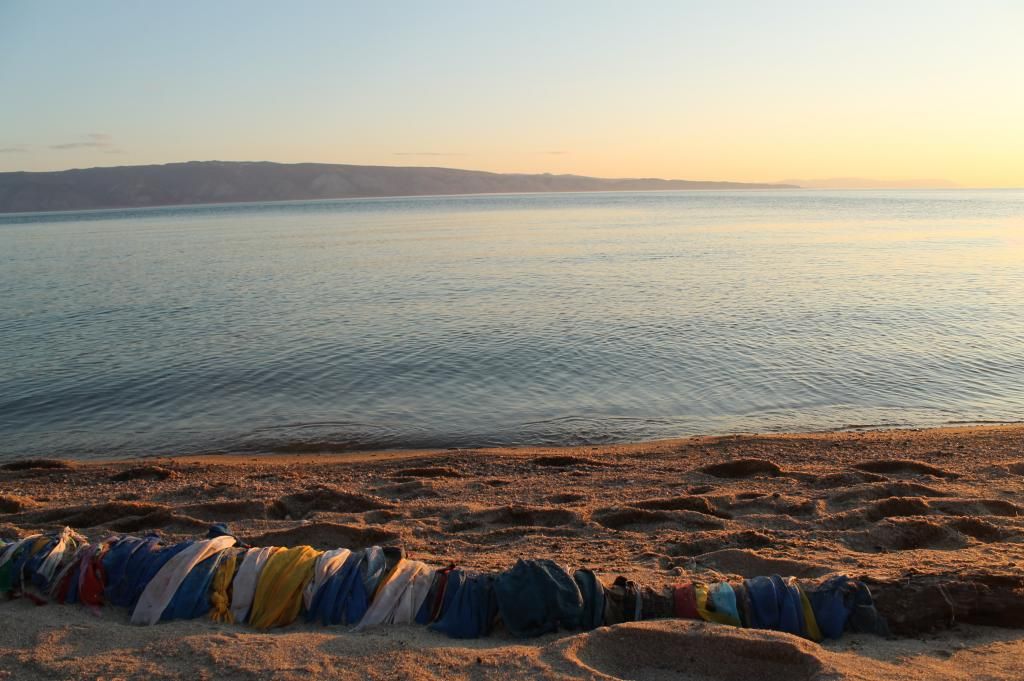
One of the key ideas of shamanic ritual is to give back to nature. A modern circuit of the Baikal area will inevitably expose visitors to some of the most beautiful natural scenes in the world, along with special spiritual places marked by bright scarves, called ‘himurin’. These spiritual places receive gifts from those following shamanic customs of giving back to nature.  Passersby wishing to show respect frequently stop at the side of the road and sprinkle water or vodka on the ground of a spiritual place.  Alternatively, when we cook outdoors, we will give a portion of the food, whether leftovers or scraps, back to nature.
Ritual poles, called serge, decorated with himurin.

Ritual poles, called serge, decorated with himurin.

Like any area inhabited by humans, however, Baikal is in danger. Spending more time here exposes the issues threatening the lake, such as the open-air dumps, and the factories pumping out chemicals that can stream into the water. Where people once left offerings of food and milk, now the ground is littered with garbage. The lake cries out with a critical question: just what are we giving back to Baikal today?
The view from one of the many sacred cliffs on Olhon Island.

The view from one of the many sacred cliffs on Olhon Island.

The shamanic practice of leaving offerings represents the most basic concept of conservation: when we take something from nature, give back something that will contribute. Sprinkling water or leaving decomposable gifts will promote further growth on that spot, ensuring its beauty for future visitors.  While our modern movements for conservation are only decades old, these shamanic practices have lasted for thousands of years.


Along with the breathtaking views and hopeful rituals, though, we have noticed something sad. At overlooks, beaches, and picnic spots all around the lake, we found piles of litter ranging from empty vodka bottles to rusty wrenches and broken bricks.  Some residents and visitors here may continue shamanic rituals of giving back, but that conscientious attitude is not always shared by all people around Baikal.


Lake Baikal is renowned for its ability to cleanse itself, but how long can this last? No one knows exactly how much Baikal can handle, but everything we put into the lake or its watershed brings us closer to that limit. Open air dumps leave plastic bags blowing in the wind, and hardly a street can be found without empty bottles.  Even inside the Pribaikalsky National Park, signs of littering or abandoned construction accompany every scattered table or gazebo.  The mark of human habitation can be found almost everywhere with a close look.
Garbage on the shore of Baikal.

Garbage on the shore of Baikal.

But humans give back the worst indirectly, for most of the pollution in the lake itself comes from industrial waste.  The Baikalsk Paper Mill has attracted environmentalist attention for failing to keep up to water contamination limits.  Likewise, the many factories on the Selenga River, Baikal’s largest tributary, release a huge variety of harmful chemicals into the water.


Nearby residents and factories may be the main concern, but we realize that as visitors to the lake, we are also part of the problem. Since we come to appreciate Baikal’s magnificent beauty and learn about it, we want to make sure we can give back and keep it pristine for future visitors.


What can we, as tourists, do to fix this pollution problem?
  • Leave our picnic sites cleaner than we found them, making sure our candy wrappers don’t get taken by the wind
  • Make an effort to stay on established trails whenever possible
  • Collect only dead wood for fires, or even better, bring our own firewood
  • Avoid driving around when we can walk

A small group of Carleton students can’t possibly solve all the problems facing the lake, but we can do our best to minimize our impact.

We love Baikal!

We love Baikal! Photo: Rada

Expectations

Once I arrived at our home stay, I really didn’t know what to expect. Our surrounding in Ulan Ude were not what I was expecting of Siberia, which seemed – before this trip – to have an ingrained image of snow-caped forests of evergreens and permafrost. As we stepped into our home stay with Ksenia and started to get a hold of our surroundings in their two bedroom apartment Polina, Ksenia’s five year old daughter, poked her head into the room where we were unpacking. She was naturally curious about the three really tall people that had entered her home. After a little bit of skittishness and some pushing by her mother, she introduced herself. After this we played a wonderful fairy tale board game with her, which she won, naturally.
 
A day later, when we headed to their dacha, Polina grabbed my hand and started leading me away towards the forest just outside their fences. I asked where we were headed, and she said we were going to find a dog. We noticed a older couple moseying along and Polina waved and said hello, and they did the same. However, after wandering around for a while it was fairly clear that we weren’t going to find a dog. To make matters worse, when I asked her if she knew the way back, she said that she had forgotten. Whoops.

IMG_0908

See that forest? We were lost in that. I was slightly concerned.


I, being fantastically awful with directions, needed to find our way home to the dacha that I had only seen once in my life for a few fleeting moments. For a second I was terrified, but then realized that we couldn’t have walked that far. After a bit of adventure, running through the forest, and a touch of, “Wait, is this the right way?”, we eventually climbed over the logs just outside the fence of the dacha and dashed back in.
 
Sometimes, all one needs is a leap of faith to get to know someone, and then there’s a bit of getting lost on the way, but it ends up being a pretty great ride. Getting the chance to do that on a trip to Siberia after a chance meeting in a home stay and then getting lost in the woods was the last thing I was expecting, but I wouldn’t have had it any other way.
IMG_0903