Red Square on Victory Day

After our adventures at Patriarch’s Ponds, Gretchen, Almeda, and I visited Red Square. It being May 10, the day after Victory Day, we watched workers take down the huge, metal-framed structures built for the holiday.

Taking it all down.

Taking it all down.


Returning to class Monday, at least two, maybe three, of our professors told us that it would have been better for us to watch the parade on Red Square on TV instead of craning our necks, standing on our tiptoes, and watching from a different part of the parade route. But for us, the goal was to experience the festivities in person and not through a screen. After all, we can always look online and see what we may have missed! And yes, I was curious:  how had Red Square had looked like the day before, on Victory Day? The weather was perfect and the streets were packed. However, the following day was overcast, threatening to rain, and the streets were deserted.
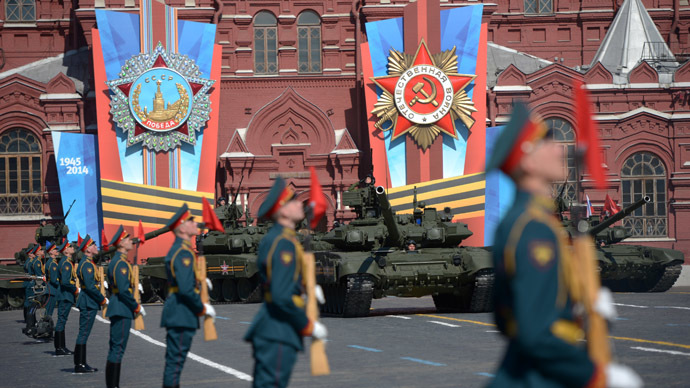
Here are a few comparison pictures:

From http://rt.com/news/157780-wwii-victory-parade-red-square/.


kaspersDSCF2449
http://rt.com/news/157780-wwii-victory-parade-red-square/

The view above Red Square. From http://rt.com/news/157780-wwii-victory-parade-red-square/.


The view in front of GUM, a shopping center.

The view in front of GUM, a shopping center.

Red Square filled with people. From http://pbs.twimg.com/.

On Wednesday (May 21) I traveled back to Park Pobedy, Victory Park, to visit the Museum of the Great Patriotic War. It was sunny and uncomfortably warm, and as with Red Square on May 10, Park Pobedy was deserted except for a few people playing in the fountains.

May 21

May 21st. Not a holiday. All this open space was filled on Victory Day!

May 9th, Victory Day on Park Pobedy.

May 9th, Victory Day on Park Pobedy.

Victory over Loss

On Victory Day, I attempted to explore the area around the Kremlin in the hope of entering Red Square.  Although this didn’t work, it did put me in the right place for a very different opportunity: there was almost no line for the student tickets to the Bolshoi Theater.  But why not?  On a beautiful day and the great national holiday, who thinks of going to the theater?

Extra lights on Theater Square were set up for Victory Day.

Extra lights on Theater Square were set up for Victory Day.


The ballet was Bayaderka, “The Temple Dancer.”  The show is set in Southeast Asia (I thought India, though I have read Cambodia) and presents a host of internal conflicts between the leading characters.  A Prince and Dancer are in love, though the Prince is quickly betrothed to the Raja’s daughter, the Princess.  The Raja, having heard of the Dancer’s skill, hires her to perform at her love’s wedding to another woman.  The High Brahmin of the temple where the Dancer lives lusts after her and challenges even the Raja when displeased.  The Dancer and Princess in turn try to kill each other for love of the Prince.  The Princess triumphs, killing the Dancer by treachery in the second act.
Dancers in white represent the spirits of the departed in the rocky World of Shadows.

Dancers in white represent the spirits of the departed in the rocky World of Shadows. Royal Swedish Ballet, 2007.


The third act proceeds in the ‘World of Shadows,’ with the spirit of the Dancer meets the Prince while he is in a trance.  Their dances together are a marvelous display, confirming that neither ever had intended to be separated, and while in the real world the mortals continue their struggles, the lovers’ spirits escape their pain.
In this liberation they have won the only happy ending in the story, a victory of their own.  Fitting to the holiday, this play challenges how victory is won: the immoral victory of the Princess ended only in her shame when she could not have the Prince.  The victory of sincere love and faithfulness frees the heroes.  This message patterns after the bittersweet triumph of Victory Day: the Soviet Union overcame a terrible time of shadows cast by the misdeeds of a conflict clearly dividing right from wronged.
Victory Park monument to St. George, Russia's favorite saint of victory over evil.

Victory Park monument to St. George, Russia’s favorite saint of victory over evil.


My Victory Day experience probably was not at all typical or even expected! But I feel that I too won this day, and even got to catch the fireworks at the end.

A Contrast: Victory Park Before and During May 9

One day, while I was still at my home stay, I decided it might be a good idea to wander around for a bit on the metro, and then just get off somewhere. I didn’t make it far before I decided that a station called Victory Park was the place I should go.
 
IMG_0223
After doing some wandering about the very empty park, I headed back home and went to sleep. I didn’t think about it at the time, but this is where a large amount of the festivities surrounding Victory Day were to take place.
 
The change was dramatic. The plaques that stated the years of World War II, so blank and imposing on the day that I had taken the photos in April, were covered in flowers.
 
IMG_0036IMG_0608
Not only that, but there were so many people there. There must have been thousands of people in sight at any given time in the park, which was in stark contrast to my last visit, where there was virtually nobody there.
 
IMG_0033IMG_0615
Eventually, I realized that Victory Park, while a fantastic park during the day, became something more than that during Victory Day. It became a symbol of Russian military might, of victory, and of the willpower of the Russian people. Nothing could have made that more clear than the thousands of people that I saw there that day. Such a presence just made me feel a part of a larger movement. In honor of that, I decided to grab a flag and join in the spirit.
 
10336732_698611100194706_7270930571125768963_n

We Remember

One of the things I’ve noticed during my time here is how much Russians care about their deceased loved ones.  This was evident around Easter, when the weather started getting nice and everyone was out in the cemetery raking leaves and laying flowers on graves.  I saw the same spirit again on Victory Day.
Out on the streets and especially at Park Pobedy [Victory Park], there were many people walking slowly around, carrying portraits above their heads, much like one would carry holy books and icons in a religious procession.

“Russian servicemen and cadets march with portraits of relatives who took part in World War II during a parade in Vladivostok.” –Courtesy of the Moscow Times.


Most of the pictures appeared to be armed forces enrollment photos, and there were names and little descriptions underneath.  They were grandfathers, uncles, fathers, sons and brothers that had served in World War II, or as it’s called in Russian “the Great Patriotic War” or “the Great Fatherland War”.  Sometimes I’d see passersby stop and ask the picture-carriers about their relatives.
A parade in St. Petersburg.  Photo (c) AP/ Dmitry Lovetsky

A parade in St. Petersburg. Photo (c) AP/ Dmitry Lovetsky


While strolling Belyi gorod (“White City” – a district in NW Moscow) after Victory Day, Almeda, Sahree, and I encountered a board on which people were invited to post tributes to their loved ones.
Thanks to Almeda for the photo.

Thanks to Almeda for the photo.


As you can see, many memorials were shared.  Wars are often talked about in terms of numbers, but doing so is dangerous; it removes the human element from the conflict.  Seeing displays like this and the pictures on Victory Day remind one of how many individual stories actually comprise an event like World War II, the size and destruction of which are beyond all sense and reason.  Reflecting upon such a tragedy, as opposed to trying to push it out of the public consciousness, has brought Russians together, and their annual tribute is the most touching event I’ve ever been a part of.

May 9th

When we set out the morning of May 9th to celebrate Victory Day, the holiday that commemorates the Red Army’s victory over the Nazis in World War II (called the Great Patriotic War by most Russians), I didn’t really know what to expect. Once we had been walking around Moscow for a while, I couldn’t help but draw comparisons with my experiences of Independence Day in Boston and of Bastille Day in Paris. There were a lot of similarities – the massive crowds of people, the ice-cream, jets flying overhead, patriotic emotions, music, fireworks, and of course a sunburn.

Jets paint the Russian flag across the sky

Jets paint the Russian flag across the sky


What stood out to me the most about Victory Day was the huge amount of respect that Russians give to their veterans. It’s a common practice to carry a poster with the photo and name of a relative who served. Veterans go out in uniform. Signs in the metro read something along the lines of, “Today we stop, we remember, we feel proud.” My favorite moment during the course of the day was when I saw a little boy giving a veteran a traditional red carnation, and noticing that the boy’s eyes were all lit up and that his mouth was agape in awe. I think that this really shows the nature of Victory Day, the immense amount of pride that Russians have for their military, and the respect that youth have for older generations.
A choir dressed in period-uniforms, carrying red carnations and singing "Katyusha"

A choir dressed in period-uniforms, carrying red carnations and singing “Katyusha”


We finished off the day by watching the Salute (fireworks) in Sparrow Hills, right on the river.


Nationalism, World War II & the Military

The concept of nationalism comes up quite often when you study political science, and I thought about it a lot during Victory Day on May 9th in Russia. Russia is a place that has an extremely complicated past with nationalism, and you can see that aspects of tsarist and communist regimes were incorporated by the current government in order to build a nation that corresponds to 21st century Russia. The outpouring of love and enthusiasm for Russia as a country was something I have never witnessed anywhere else. People wore World War II hats with hammer and sickle buttons while waving the current flag of Russia with the added double-headed eagle emblem reminiscent of the tsarist time. People, from children to the elderly, along Tverskaya Street in central Moscow were screaming “РОССИЯ!!!” at the top of their lungs while singing old war songs (example below!). To me, the Russian sense of nationalism seems to contradict itself historically and politically, and I still cannot wrap my head around how Russians have managed to embrace different parts of their vast history and build their current sense of national identity.

The new flag that I will be bringing home.

The new flag that I will be bringing home.


Overall, I found the military strength of Russia to be crucial to the sense of nationalism Russians feel. I might have thought that perhaps due to the current political situation concerning a certain neighbor of Russia, but my hope is that I get to better understand what Russian nationalism means in my last couple weeks here. I have a feeling those in Siberia might have a different sense of nationalism than those in Moscow.
Russia knows how to put one a beautiful firework show. From the large bridge over the Moscow River in Sparrow Hills, we saw the most jaw-droppingly beautiful night ever.

Russia knows how to put one a beautiful firework show. From the large bridge over the Moscow River in Sparrow Hills, we saw the most jaw-droppingly beautiful night ever.


Fireworks going up from the Kremlin and Park Pobedi.

Fireworks going up from the Kremlin and Park Pobedi.

In Honor of Victory

Across cultures, it is common to attribute victory in battle to supernatural forces. Russia is no exception to this: many of the most prominent churches in Russia were built “в честь победы,” or “in honor of victory.”

St Basil's on Red Square was ordered by Ivan the Terrible in 1555 to commemorate Russia's capture of Kazan and Astrakhan.

St Basil’s on Red Square was ordered by Ivan the Terrible in 1555 to commemorate Russia’s capture of Kazan and Astrakhan.


Kazan Cathedral in St Petersburg is associated with Russia's defeat of Napoleon in 1812.

Kazan Cathedral in St Petersburg is associated with Russia’s defeat of Napoleon in 1812.


This practice has such a long history that I probably shouldn’t have been surprised when I saw the Cathedral of George the Victorious at Victory Park on Victory Day (is that enough victory yet?). The cathedral is a truly stunning building, shaped like the twelfth-century churches we saw in Vladimir and Suzdal, but with thinner walls and larger windows for a modern touch. Because of the generally secular atmosphere of this holiday, I hadn’t expected to find a church at the park in the center of the celebrations, but there it was.
image
The cathedral was built in the 1990s to commemorate the fiftieth anniversary of the end of the second world war, as part of Victory Park’s memorial complex. I later learned that a memorial synagogue and mosque were also built nearby.

Photo from Wikimedia Commons


Photo from Wikimedia Commons


One of the most powerful things about Victory Day for me was how fresh and recent the war seemed. Most holidays I’ve experienced celebrate events that no living person remembers, like American independence or the birth of Jesus, and they lack the sense of modernity I felt on Victory Day in Moscow. The religious buildings in Victory Park connect this uniquely modern holiday to Russia’s ancient roots.

A Time For Dancing

Victory Day is perhaps my new favorite holiday. The streets of Moscow fill with people bearing orange and black ribbons, waving flags above the crowds. Everyone comes out of their hiding place to celebrate the day that Russia ended the Second World War.

IMG_2909

Our view of the parade


IMG_2929
The blini stand had a sign outside of it that read: “Сколько хотите, столько заплатите–Pay as much as you want, so long as you pay.” We confusedly fumbled with our rubles and, in keeping with the tradition of Minnesota nice, were perhaps a little too generous. We walked at a leisurely pace to Kuznetsiy Most’, where I payed 50 rubles for a sweet, carbonated drink from an old Soviet soda water machine. With my stomach full and thirst satisfied, I wandered the street to observe the festivities.

A family celebrating Victory Day


There were cries of laughter as children chased each other along the cobble-road. Someone actually smiled at me as they handed me a black-and-orange-striped ribbon. We passed a group of young men with horns and a drum kit. We were part-way down the street when we heard a familiar blaring of horns. We immediately turned back and joined the crowd that was now forming.
Katyusha is a song that was introduced to us back at Carleton, when the thought of going to Moscow was more a lofty consideration than reality. The song itself was composed in 1938, just before WWII. Katyusha wanders among the apple trees and thinks of her beloved, sending him a song of her love. Of all the wartime songs written during the era, soldiers were fond of this song, even nicknaming the BM-8, BM-13, BM-31 “Katyusha” rocket launchers. The song remains a token of the past, still known today even among the younger generations.
As the band played this lively song, a child began to dance. An older woman seized his hands and danced with him. Afterwards, she shouted “It’s Victory Day! We must all dance, we must all celebrate!” Unfortunately, my camera died at this point. As the next song started, she pulled people in, urging everyone to dance, including myself (I would like to note that she was supernaturally strong). Although I could feel my Carleton awkward seeping through, I couldn’t help but smile at her spirit and happiness.

Who Owns Victory Day?

The first parade celebrating the Soviet Union’s defeat of Nazi Germany was held on June 24, 1945 and even then the question of ownership was central. Who was responsible for the victory? Did it belong to Marshals Zhukov and Rokossovsky, who led to the parade? To Stalin, who was head of the vanguard party of the proletariat, and who had intended to lead the parade? Or to the entire Soviet Union and its peoples?

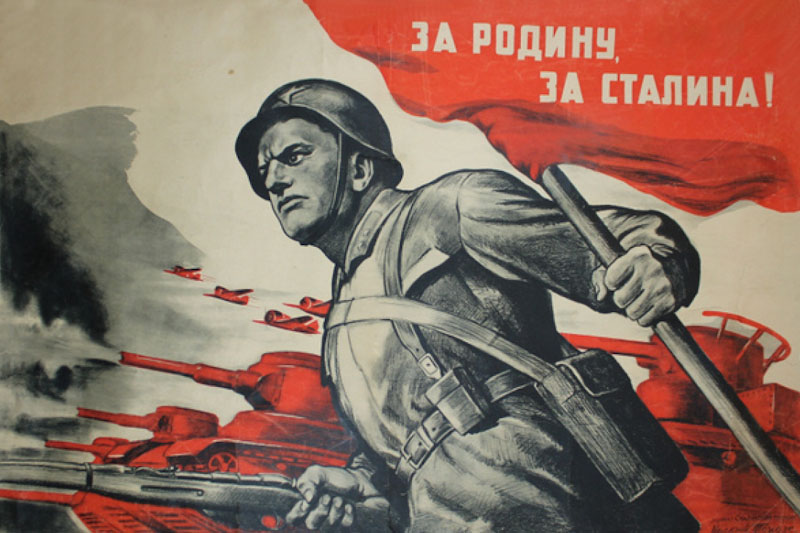
For the Motherland, For Stalin!

Wartime poster urging people to fight “For the Motherland, For Stalin!”

We won

“We Won!
Glory to our great people, victorious people!”

As of 2014, this question has become far more complicated. The country which fought in World War II (known as the Great Patriotic War in Russia) had dissolved into 15 separate states and each adopted a varying way of commemorating the date. The date itself is even subject to change depending on relations with Russia, the ‘big brother’ of the Soviet Union. The Baltic nations started commemorating the victory on May 8th, along with Western Europe, soon after declaring their independence, and Ukraine recently followed in their footsteps after the Russian annexation of Crimea.

Flowers

Flowers on Poklonnaya hill.


In Moscow, there are many claims to the victory. Judging by the flowers and thanks they receive, I believe that most Russians would agree that the direct responsibility for the victory belongs to the veterans of the Great Patriotic War, but their numbers are dwindling and Victory Day is growing bigger and bigger. The dead can be honored, but the holiday seems too spirited, festive, and patriotic to be significantly dampened by the memory of the 27 million Soviet citizens lost to the war. Walking about the streets of Moscow, it seems as though people have attached the victory to supra-individual groups and ideals that have longer life-spans than the average human.
Church of St. George

The Church of St. George, built on Poklonnaya Hill for the 50th anniversary of the victory. A memorial mosque and synagogue have also since been built on the hill.

CPRF

Representatives of the Communist Party of the Russian Federation march along Teatralnii Proezd.

Russia’s claims to the holiday are, perhaps, dominant with the tricolor and the ribbon of St. George, the traditional defender of Moscow and Russia, ever present. The flag of the Red Army and the copies of the victory banner accompany almost every tricolor in a juxtaposition that serves to reconcile Russia’s past with its present. The banners of the Communist Party of the Russian Federation and various Komsomol groups also bore a heavy presence around the city and in the people’s parade. Rarer, but still noticeable is the claim of the church. A man was wandering around the Bolshoi Theater with a sign saying “Jesus Christ was victorious in 1945” and pealing bells could be heard in the city center. And then at Victory Park a man announced over the loud speakers that this day belongs to Russia’s Children, the future defenders of the country. This had a bit of an ominous ring to it, particularly in light of recent events, but it seems to most accurately reflect what I noted about the celebrations. At least among the majority of people I noticed, Victory Day is not a day to reflect “with tears in your eyes” (as the song suggests), but rather a day to  embrace a glorified past and to march towards the future.