
Three Faiths

For a while, I couldn’t understand how someone could practice three different religions and somehow be okay with it. After having spent only two weeks in Siberia, I still do not quite understand how the Buryat are so accepting, but I guess I’ll try to explain to you what I took from my experience.

The Ivolginsky Datsan near Ulan Ude. Photo Credit: Gisell Calderon

The Ivolginsky Datsan near Ulan Ude.
Photo Credit: Gisell Calderon


It appears to me that over the course of many years pre-dating the arrival of Christianity in Siberia, the native population was able to integrate Shamanism and Buddhism, and you can see how well these two religions have managed to work together. On our last day in Ulan-Ude, we saw a Shaman priest practicing and helping a family at a Buddhist holy site. In fact, Shamans such as Valentin Vladimirovich, who we had the pleasure of getting to know on Ol’khon, see Shamanism as a universal and accessible religion by all since it only requires your respect and dedication to your ancestors and nature. They find that Shaman ideals and beliefs do not actually require anything that is contradictory to other world religions.
Another datsan near Ulan-Ude, more recently built.  Photo Credit: Gisell Calderon

Another datsan near Ulan-Ude, more recently built.
Photo Credit: Gisell Calderon


What was difficult for me to initially understand is the Buryat ability to integrate Buddhism/Shamanism with Russian Orthodoxy. I learned on this trip that Buddhism is a monotheistic religion: there is one main god with smaller gods. I thought that Buddhist belief could translate to how Christianity sees God and His angels. I think the Buryat see it as practicing the same religious ideals, but calling it different names.
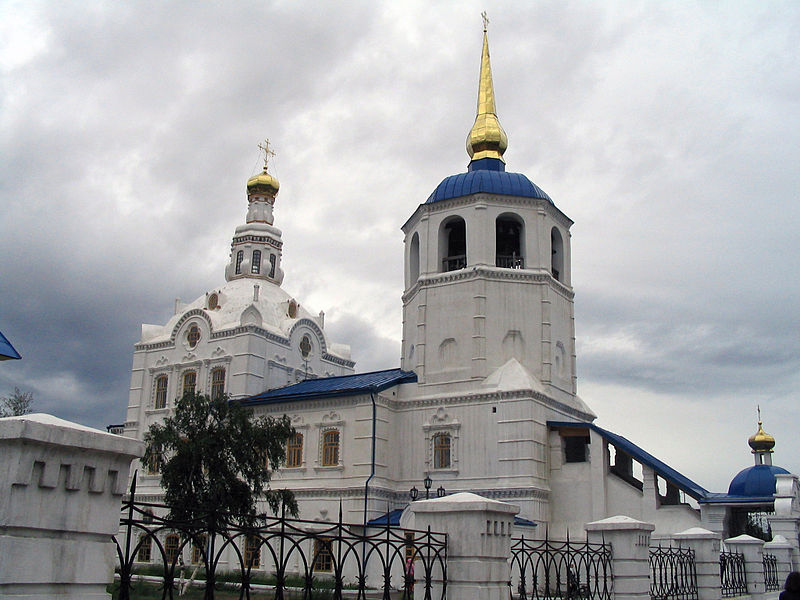
Odigitrievsky Cathedral in Ulan-Ude


For me, that weirdly makes sense, and I kind of understand how the people of Buryatia do not have a problem with being baptized and praying at datsans. I find it to be wholesome and highly tolerant. I think that the world has much to learn from the Buryat. Siberia is a place where traditional religions of the east and west can merge and coexist in unity. And that is rare.

I saw a baby ocean!

The lake is literally moving, and no, I’m not misusing the word “literally”. Back home, one of my most cherished friends in college is currently a geology major, and I never quite understood his interests in “rock” and “earth” until I visited the Baikal Museum (formerly known as the Limnological Museum) in Listvyanka near Irkutsk the other day.
When we arrived to the Baikal Museum, we were greeted by the extremely knowledgable Tatyana Serafimovna, who gave us one of the most eloquent and informative tours I’ve had in Russia in perfect British English. After days of heavy travel, no one in the group was really in the mood for a tour of a museum, but with Tatyana’s help, I actually had a wonderful time. Tatyana Serafimovna had actually not worked in the museum in the past three years, but still managed to remember every single detail about every exhibit. As a result of her vast amounts of knowledge, I loved the museum, especially the very first exhibit.
The first exhibit, dedicated to the geology of Baikal, describes the formation of Siberia and its famous lake throughout millions of years of Earth’s geological formation.

A cool internet picture of the coast of Lake Baikal.


A couple of things that I didn’t know:
  1. A part of Siberia used to be its own continent, called (you guessed it!) Siberia, a couple hundred million years ago. The old continent was hit by the moving Indian subcontinent (the same one that created the Himalaya Mountains), which eventually led to a small crack in the ground to form and fill up with water. Back then it was a little pond. Over the years, the crack opened up more and more, and the lake gained its astonishing depth: 1642 m.
  2. Even today the lake is being pulled apart by the plates it is situated on, called the Baikal Rift Zone. In fact, it moves on average about 1 cm a year. In the book we are reading for class, the author, Peter Thompson, notes that some scientists think of Baikal as a baby ocean.

    Geographical map of the plates surrounding Baikal.

  3. Unsurprisingly, there is a lot of seismic activity in the area, most of which go unnoticed by the local population. In the museum, we saw a computer monitor displaying and recording the seismic activity of the region through seismographs located in the cellars of the museum. The monitor showed constant tiny movements on all three planes (north/south, east/west, and vertical).

The museum pretty much blew my mind. Who would have guessed that a little pond would one day became the world’s largest container of freshwater and maybe in the future a massive ocean?
 
Here is some extra information online:

Repression: Lost Connections

Buryatia is a land whose people are deeply connected to its many religions. For someone to come in one day and announce that the government has outlawed all religion within the entire country is cause for buddhists and shamans alike to rebel and fight back. During the Stalinist period, particularly in the time frame of the Great Purges, many religious believers such as shamans and lamas were arrested and fell to illness and eventual death while serving their sentences at brutal labor camps. In the book we are reading for class, The Shaman’s Coat, Anna Reid, the author, notes that up until the creation of the USSR, there were over 700 openly practicing shamans in a part of Buryatia. After the 1930s, the number plummeted to zero.
The degree of oppression the Buryat faced was not something I could particularly understand until I saw a monument in Ulan-Ude to those who suffered during the Purges. Many were practicing shamans or lamas. Buddhists temples, like Russian Orthodox churches, were also destroyed or started serving anti-religious purposes. The Buryat rapidly lost their places of  worship. You can see in the picture below that the monument has many parts. The first thing that catches your attention is the large statue of the mother and her child standing together in garments of the 1930s. Their faces look blank, sad, and soulless. They do not have mouths, symbolizing repression and the loss of essential freedoms. No one was allowed to practice religion, and everyone was too scared to open their mouths and voice their opinions. Barbed wire surrounds the pair giving an prison-like atmosphere to the viewer. The mother and child feel trapped in a vast and beautiful land. Behind them hangs the tablets with the names of those who lost their lives or went missing due to Stalin’s harsh and brutal policies. The monument is titled “За что?”, which translates to “For what?”, as in why did people have to suffer so much?

The mother and child set against a dreary background. Photo Credit: Kaylin Land

The mother and child set against a dreary background.
Photo Credit: Kaylin Land


The monument really conveys the impact of repression on the Buryat. Stalin tried to cut the spiritual bonds that the Buryat had with their land and their religion, and they are still recovering to this day to regain lost years.
For what? List of names of people who suffered under Stalin.  Photo credit: Kaylin Land

For what?
List of the names of people who suffered under Stalin are under the sign.
Photo credit: Kaylin Land

A City of Clashing Pasts

Moscow’s architecture is kind of offsetting to me and says much about its long and complicated past. On one hand, there are these beautiful neighborhoods in central Moscow that remind you of the 18th and 19th centuries. Russians have tried to preserve 19th century Moscow as much as possible, and it is always strange to me when I can still see the very buildings in which famous writers such as Gogol, Pushkin, and Bulgakov lived. On the other hand, every time I try to take a picture of these beautiful buildings, I always end up getting a small shot of a tall Soviet era building or a factory of some sort. You can see it clearly in the picture below. I tried to take a shot of the buildings near the Moscow River, and while they looked beautiful in the afternoon sun, the Soviet-style tall building in the middle right side contrasted too strongly with the classical style buildings (I am not a huge fan of Soviet era architecture). In another picture, there were a factory’s smokestacks.

The picture with smokestacks.

The picture with smokestacks.


The picture with the tall Soviet building in the background.

The picture with the tall Soviet building in the background.


When I went to visit Andreevsky monastery in Kitai Gorod (check it out below!), it was almost laughable how strange the area was. Here was a beautiful and quaint monastery belonging to the 17th century and next to it were trolleybus wires, cars, Soviet buildings, a metro station, and cars. I was thrown off a little bit, and it goes to show how much Moscow has expanded over the years. We don’t have anything like this is the United States. Moscow is a city that has chunks representing every century since the late 1100s, and now it supports a melting pot of architecture.
Andreevsky Monastery

Andreevsky Monastery


When I first arrived here, I really did not like the clashes in architecture in Moscow; however, after visiting St. Petersburg and seeing how 19th century/classical its architecture is, I learned to love the crazy, bustling, and diverse city that is Moscow, Russia. And even though I still don’t like Soviet era architecture, I can’t imagine a Moscow without its little old churches, former communal apartments, and classical (with sprinkles of gothic) style buildings.

Active from Day to Night

I haven’t played badminton since I was ten. It can be super fun to play if there is no wind, but then again, there is almost always wind, so it’s just one of those sports that always irritated me. Imagine my surprise when I saw people playing badminton in the wide spaces of the main university building and in the courtyards of the dormitories. The thing that gets me is that students play badminton for HOURS here. They laugh loudly, look embarrassed after missing the birdie, but laugh it off and serve again.

Medvedev and Putin test their skills in badminton. Putin sizes up Medvedev’s badminton capabilities, while Medvedev analyzes his racket.


And it’s not just badminton. Every night a large group of students gathers into a circle and hits a volleyball around until three in the morning. I am baffled by Russian students’ commitment to non-seriously staying active until the wee hours of the morning. Rollerblading and bike riding are also huge here, as are scooters. In fact, scooters are the vehicles of choice for getting to class. I see students carrying fold up scooters in the academic buildings on campus all the time. A week ago I even saw an adorable elderly couple, a babushka and a dedushka, slowly riding scooters together along the university streets.

Even Putin and Medvedev ride bikes!


Like everything else, leave it to Russians to make scooters look cool again after their disastrous downfall in the U.S. in the early 2000s. Now I want a scooter, too.

Seeing Familiar Faces…

Two nights ago I happened to run into someone in the elevator, whom I hadn’t seen since my first week in Moscow. When I first moved into my room, only one of my electric plugs worked. One of them sparked every time I plugged something into it, and the other two were just plain dead. On my third night in Moscow, a kind electrician in his late 60s knocked on my door, and I naturally freaked out.

The Russian electrical outlets found in my room.


Believe it or not, we don’t learn how to communicate with electricians in Russian 204. My confidence in my Russian was lacking at best, and when the nice man realized I was a foreigner, he did not treat me any differently. I was somehow successful in explaining to him that one of the plugs had sparks coming out of it (I didn’t know the word for sparks, so I said “little lights”, and the man helped me out by telling me the correct Russian word) and that I needed the other two plugs to work since a refrigerator was scheduled to arrive in a couple of days. Afterwards, the man and I had a pleasant conversation about where I was from and why I chose to come to Russia. He seemed confused as to why I chose to come to Russia and found my ethnic background very interesting. He told me he would come back and install the new plugs. Sure enough in two days, everything worked perfectly well. I never saw him again until a couple days ago in the elevator. He is a quiet man so as I smiled at him in greeting, he actually remembered me and nodded in my direction with a hint of a smile. He is probably the world’s nicest electrician. He never judged me for my poor Russian and even helped me speak better. It’s moments like that when I am thankful for my time here. Russians are some of the sweetest people in the world.

Realizing Improvement

When my conversational Russian language teacher, Irina Vladimirovna, got up to express her amazement with our work and improvement for the past seven weeks at our goodbye party, I nearly cried. It was hot in the room, it smelled like good tea and cake, and one of the best teachers I ever had was telling me and my classmates that we had improved beyond her expectations.

We had just finished performing our final skits and poetry recitations to our teachers and praktikanti and carried in our hands certificates that would be permanent reminders of our success here in Moscow. I did not tear up (How? I still don’t know). I had a rough time here for a couple weeks where I was absolutely convinced that I had not improved in Russian at all, but now I know that’s not true. It takes me a while to not be shy and just talk, but once I get started, it becomes easier and easier to speak. I used to be able to understand barely anything anyone told me, and now I can understand Russian 50% of the time. I know when I am making phonetic errors, and I eventually catch my grammatical mistakes. I have decided that I will be speaking with my dad’s Ukrainian best friend over the summer to keep up my Russian until I can take Chekhov in the fall trimester.
At our little good-bye party, you really felt the joys of Russian culture. We loudly sang great Russian songs accompanied by guitar (I have attached two of my favorite Soviet songs below), heated up pots and pots of hot water for tea, and felt no qualms about eating a second slice of cake. Russians love to celebrate and to make you feel at ease. If you make the effort to do something, they will always try to help and put in the same amount of effort as well. I have had fabulous and truly gifted professors here. And while I did not tear up at the party, I am tearing up a little bit now.

An Immigrant City

Not tipping in Moscow has been mentally draining, especially when you know the gap in income in Russia. The CIA World Factbook reports that Russia ranks 49th in the world in terms of its GINI index. I guess to be fair, the U.S. ranks 40th, which is not that much better.
I am not by any means a rich American. I come from a family of poor immigrants who are still struggling to make it in America, and so I sympathize frequently with immigrants and those in poor living conditions. Despite my economic background, I am not overjoyed that I don’t have to do things like tip here. I feel a little guilty about it, and our group tips waiters and waitresses who are nice to us. Poverty in Moscow somehow looks a lot worse than poverty in the States, and the presence of the immigrant population in Russia is overwhelming. Sometimes Russians, very similar to Americans, are weary of foreigners. Many of the drivers of the marshrutkas (small van buses) are from the Caucasus, and you realize that Moscow is as much an immigrant city as Chicago is, if not more. There is not much of a presence of a middle class in Russia (and this might just be my misperception!), in the same sense as in America, and so I think the poverty I see sometimes in the streets and especially on the metro hits me a little more than I am used to back home.
I am more than a little worried about what will happen with the income inequality here as the Russian economy slows down.
 
Here is an article I found online that sheds some light on the situation and has good information on the current population of Moscow.

Lullabies at the Kremlin

I had never seen a ballet my entire life, and I can now say I had the pleasure of seeing the ballet, the Sleeping Beauty, with live orchestral music by Tchaikovsky in the Kremlin Palace in Moscow. The ballerinas were superb. I am someone who took only nine weeks of ballet when she was 9 years old and does not know much about it in general, but you would have had to be blind not to notice the difficulty of the moves the ballerinas and ballerinos were doing. They were always in synch, jumping several feet in the air, and holding their positions for minutes on point-toe. All with smiling faces and grace.

In the Kremlin Palace.

In the Kremlin Palace.


The magnitude of the Kremlin Palace.

The magnitude of the Kremlin Palace.


However, I was left more in awe of the orchestral music of Tchaikovsky. It was beautiful. In fact, a couple of us, myself included, found it to be so lulling that despite our best efforts, we wanted to just shut our eyes and listen to the music. The violins, the harpist, and the flutes were amazing and played great sequences. I think that if there hadn’t been a live orchestra, the ballet would simply not have been the same. You could see how well the ballet dancers and the orchestra had practiced together and integrated each move perfectly with each note played by the orchestra. I think my goal from now is going to be to listen to more Russian composers of the 19th and 20th.
Also, taking pictures of the live performance was not allowed, so I am attaching a link with a Sleeping Beauty soundtrack.

Напитки: Drinks

Just like how Americans treasure OJ in the morning and water fountains in parks, Russians also have their certain set of preferences for everyday (nonalcoholic) drinks. I took water for granted until I came here and realized that water fountains are not necessarily considered a public good and you have to pay for bottled water. You would think that Russians would carry around reusable water bottles, but they do not (there isn’t much recycling here either for the bottles—I saw my first recycling bin today after 7 weeks…). Buying water bottles here is the preferred choice, and even then, more people prefer carbonated water to still water.

The brand of water I normally buy in 5L bottles.


Also, juice seems to trump water, too. In fact, lemonade here is also not your typical “lemonade”. It is often carbonated and not made with lemons. My friends and I are always thrown off in restaurants when they present my flavor options of “лимонад” (pronounced: limonad) as kiwi, cherry, orange, etc. In the heat of a humid, sunny 80 degree Moscow, I am craving some homemade lemonade more than ever.

Русский лимонад (Russian limonad)


Finally, tea trumps all beverages in Russia period, even in the sweltering heat. Like the Russian students we were eating with in the cafeteria in the Economics building, my classmates and I drank some sweetened black tea.
Funny aside story: Americans are insanely easy to spot here. I couldn’t stop laughing when I saw a different group of Americans bring in a jug of water to the dining hall while eating dinner and pour water into their tea cups.