Final Day

Goodbyes are hard. After a boat tour on the Moskva River, our group parted ways on the trusty Moscow Metro, where we tightly embraced and waved prolongedly through the windows to each other as our train cars pulled away. Only Chet, Almeda, Sahree, and I remained, but the four of us were determined to make the most of our last day in Moscow, and that we did.
In the morning, Chet and I met up with James, a fellow Moscow holdout, at Izmailovsky Market. From a distance, Izmailovsky resembles a bizarre Renaissance Festival storefront.

Photo from http://jdombstravels.com/wp-content/uploads/2013/09/Jdombs-Travels-Izmailovo-Market-1.jpg.


Inside, it strongly reminded me of the quaint country flea market near my grandma’s old house, where I spent many a Saturday morning as a child. The spirit of routine and camaraderie amongst the shop keepers was uncannily similar. I can’t count how many times at Izmailovsky I saw grizzled old men shuffling from booth to booth, shaking their fellow vendors’ hands and shooting the breeze. I wondered how many sellers used Izmailovsky as their primary source of income. I also pondered whether they grew tired of trying to explain prices to non-Russian-speaking tourists every day. I imagine they do.
I left with far more souvenirs than my suitcases have room for, but the prices really spoke to me. I bought two wooden dolls, which I had been wanting this entire trip, from a woman who hand paints them herself. We got to talking and covered all the usual pleasantries, like where I was from and what I thought about the difficulty of the Russian language. Chet, James, and I somehow managed to meet up multiple times, and we eventually left the market, but not before I bought a Russian flag off the front of one stand and finally obtained the crown jewel of my souvenir collection: a track suit.
In the early evening, the four of us met up with Taya to stroll around the Kremlin one last time. Although we weren’t able to get into the Manege’s new exhibit for free, we did cover all the usual tourist bases. We watched one final changing of the guard at the Tomb of the Unknown soldier and witnessed a new stage on Red Square being put up for Russia Day – sadly, we won’t get to see the finished preparations.
There's always something going on at Red Square.

There’s always something going on at Red Square.


Having wandered across a bridge overlooking the Kremlin, we ate a delicious supper at Grabli.   We became a bit turned around on the way to the metro and ending up facing the Kremlin again. We crossed the bridge, crossed the famous square, listened to an old man singing songs that we actually knew, and said farewell to that part of the city… for now, anyways.
IMG_8526
Goodbyes are hard, but when you remember that the people and places you left are still there, waiting for you to return someday, they become a little easier. And the set of wonderful things you left behind on the way to your new adventure are the ones that will greet you when you arrive home.

The Borsch Strikes Back

I said I would do a follow up to my borsch blog, so here it is. Enjoy!
Cold borsch at Cafe Stolle, St. Petersburg

IMG_3455

Pre-smetana stir.


Post-smetana stir.  It was a remarkably neon shade of pink.

Post-smetana stir. It was a remarkably neon shade of pink.


My Kazakhstani friend Dilya first told me about the wonders of cold borsch. Although we didn’t get to eat it together as planned in Moscow, I was able to try it in St. Petersburg. As advertised, it was chilly and just generally intriguing. Beets remain the primary ingredient of cold borsch, but it usually contains radishes and other hard vegetables. Yogurt or other milk products hold everything together. At least one hard-boiled egg lay beneath the violet surface of my borsch. It was good, but in a different way, and Edward had to help me finish it. The last cool thing: cold borsch actually has its own word in Russian, svekol’nik (свекольник). It’s not as popular in Moscow though, so I didn’t run into it much there.
Homemade dorm borsch in the Glavnoe Zdanie
IMG_4264
With Almeda and Sahree spearheading the effort, our group made a (huge) batch of homemade borsch after everyone was back in the dorm. You can read extensively about it here. We bought the usual things: several beets, potatoes, and onions.  In the process, we finally learned how to buy produce at Ashan.  The group couldn’t eat the whole batch, so leftovers were served more than once. As the Russians will swear, it really was better the second time around. Svetlana, one of our dorm ladies, was just thrilled to hear that we had finally cooked something by ourselves.
Mumu borsch, various locations around Moscow
b8
I ate Mumu borsch several times, so it deserves a mention. Mumu, in my opinion, is over-priced and overrated. Their borsch is too salty, like all their food, and ridiculously difficult to eat. Why are enclosed bowls even made? How am I supposed to dig the last five spoonfuls of soup out of my dish? I usually try tipping it (to little avail) and often end up spilling on myself in the process. Mumu borsch seems much more manufactured than the kind one would receive prepared at a restaurant. In my opinion, this is because they toss a little cardboard boat of meat into the soup right in front of you as soon as you order. I suppose this is to eliminate the need for two pots of borsch: that is, a meaty one and a vegetarian one. Anyway, Mumu borsch works in a pinch, but there are better varieties to be found.
Spicy borsch, Mini Hotel, Khuzhir, Olkhon Island
After a strong headache, weak nausea, and general tiredness after arriving on Olkhon, I contend that this borsch single-handedly revived me. I had no desire to eat, but from the first bite I knew it was a special borsch. I had never eaten one with so much hot, spicy flavor, but it was a fantastic combination. As I recall, it was light on beets and instead utilized other hearty vegetables like large pieces of potatoes and long onions. It was incredibly delicious and made me feel 110% better than I did when I sat down at the table.
Last borsch, Cafe Gribli, Moscow
b10
I knew I couldn’t leave Moscow without a last bowl of borsch. After my ten week love affair with the dish, it’s become such a normal part of my dining routine. I don’t know what I’ll do without it. Gribli’s borsch was possibly a little scant on the beef, but that may be because it’s self-serve, and I didn’t scoop to the bottom of the pot. On the plus side, the smetana (sour cream) was also self-added. In general, this borsch was most worthy, and I ate my final Russian meal with great company.

Nerpa Blog

Shockingly, no one in our group has written a full blog about nerpas, the famous freshwater Baikal seals. Given our fascination and adoration with these cute little creatures, a more comprehensive look at their remarkable properties and our interactions with them is required.
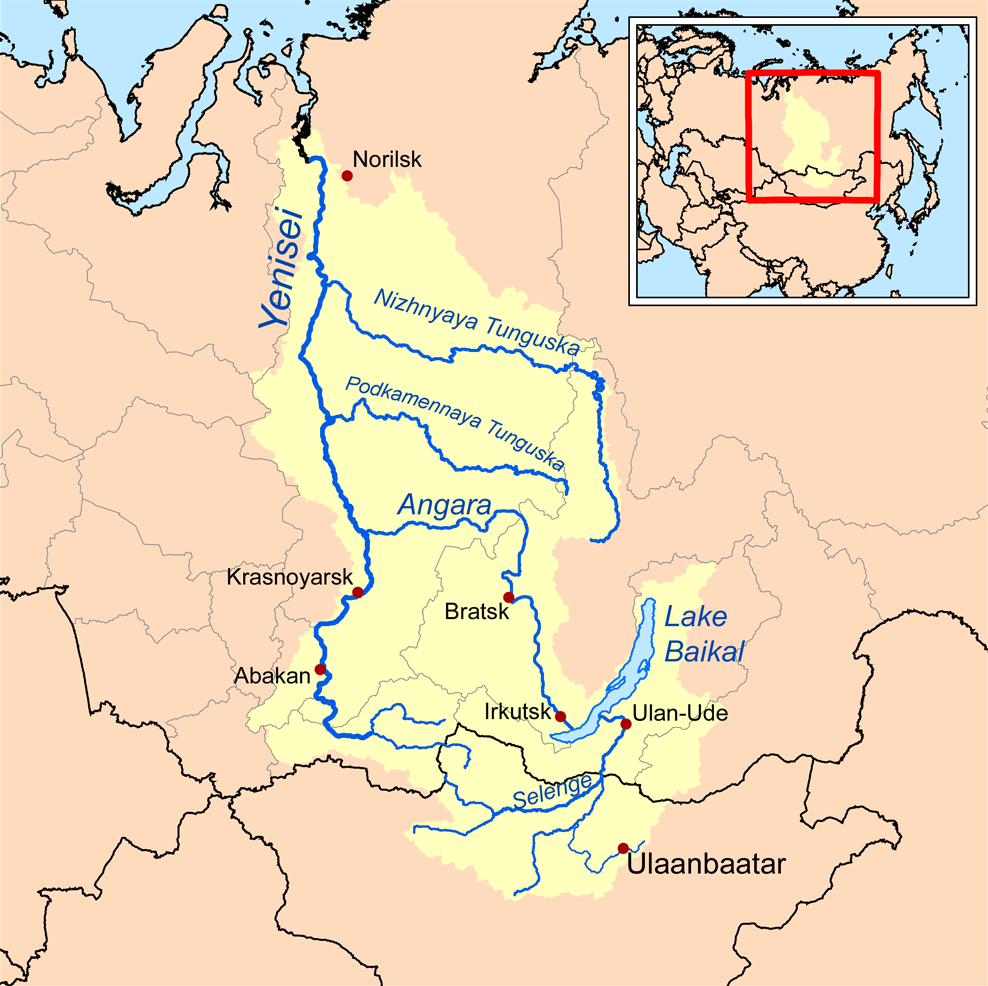
Nerpas are unique for being the only species of exclusively freshwater seal in the world. They live in the deep, cold waters of Lake Baikal, but it’s uncertain just how they arrived in this landlocked body of water. Some ecologists think nerpas swam south down the Yenisei-Angara River system, while others think they arrived much earlier, when Baikal was joined with an ancient inland sea.

That’s a long way for a little nerpa to swim. Photo from Wikimedia Commons.


Nerpas migrate within the lake’s banks every year. In the summer, they enjoy lounging on the rocky Ushkany Islands or on more southern shoreline. During winter, they migrate northward to find thicker ice, on which they give birth to their young.
Nerpas have unusually large eyes compared to other pinnapeds. They’re small, round, and ball-like, as we found out when visiting the Baikal Limnological Museum near Irkutsk. Nerpas appear to have no neck, and they’re almost entirely round when free floating. They stretch out a bit once they start swimming, but only about to the shape of a well-inflated football.

So round! Photo: http://wikifaunia.com/wp-content/uploads/2013/01/Foca-del-lago-Baikal.jpg


Seeing a mama and baby nerpa in the museum’s aquarium was great, because it offered us the chance to gaze upon their minute physiological details up close. The museum also featured a “Nerpa cam”, which we viewed upstairs after our tour. The footage streams from one of the nerpas’ favorite hangout spots, the Ushkany Islands, which I mentioned earlier. We turned into giggling children as we watched one lazy, fat nerpa lying on its side and seemingly hitting another seal with its flipper, over and over again.  Eventually he calmed down and resumed his nap.  Sadly, I can’t seem to find the stream online, but if I do, I’ll add the link here.
Little did we know, our encounters weren’t over yet. For the first time since this program has been in operation, the group saw a wild nerpa. High on a cliff overlooking the clear blue water, our guide excitedly pointed out a small speck in the distance. Everyone rushed over to the cliff’s edge to look. Bobbing in the gentle ripples was a little seal, watching us and listening to the excited squeal of our voices.
DSCF5922

What’s that in the distance?
Photo credit: Sahree Kasper


DSCF5923

Wait… could it be??
Photo credit: Sahree Kasper


DSCF5924

IT REALLY IS!!
Incredibly marvelous photo credit: Sahree Kasper


We all stayed that way for a couple minutes, until the nerpa decided he or she needed to get back to work. Even as the seal swam away, we could still see it for several seconds – such is the clarity of Baikal’s water. It was an honor to experience the nerpa’s company, and it was a highlight for many members of our group.
Interesting source and further reading: http://scienceblogs.com/tetrapodzoology/2010/06/15/most-inconvenient-seal/

The Other Side of War

When we first arrived in Ulan-Ude, one of the first things I noticed as we drove through town was a healthy display of Victory Day banners and billboards. I was a little surprised, to be honest – it didn’t occur to me that the Great Patriotic War could have possibly affected small-town Siberia.
Indeed, the battles of World War II never reached Buryatia – the Pacific Front, as it concerned the Soviet Union, consisted of a few land grabs. On Russia’s Western Front, the Nazis came within miles of Moscow, sieged Leningrad, and fought a horrific battle at Stalingrad, but Buryatia remained safe several time zones away.
Siberia became a safe haven for the Soviet Union during that time. Entire factories were picked up and transported eastwards across the rail lines to keep them out of Nazi hands. Wounded soldiers, too, found themselves in the safe embrace of the steppe. With this influx of new arrivals, even regular citizens were brought face to face with the war effort. In Ulan-Ude, for example, every school was converted to a temporary hospital. Imagine how startling and strange it would be as a young student to see your school overwhelmed by injured soldiers from far-flung places.
br1
This memorial, which we saw on our first day in town, commemorates the Great Patriotic War. Each pillar symbolizes a different year in the conflict. The first year, 1941, was marked by extreme difficulty, such as the near-capture of Moscow and the beginning of the Siege of Leningrad. As a testiment to the great hardships of this year, its pillar is leaning heavily, seemingly about to collapse. 1942 was also a very trying time, so it, too, tips sideways. But the tide began to turn as the war went on. The Nazis were eventually pushed back, and this is reflected in the straight, steadfast pillars that represent 1943 and 1944.
We encountered World War II again on our last evening in Ulan-Ude, when we found ourselves in the Philharmonie, a Soviet-era theater on the city’s main square. The building was beautiful inside, decorated with mouldings of hammers and sickles, bundles of grain, and other communist motifs.
br2
We came to view a (new) play, presented by local actors and featuring performers from around the area. The production told the story of a group of nurses at a Buryat military hospital during the war and showed how intimately the far-off battles affected these women’s lives. One struggles with the distance separating her from her lover on the front lines. Others meet and fall in love with wounded soldiers from far corners of the Soviet Union, people they would never otherwise have met.
br3
Seeing the war from the perspective of these nurses, it was much easier to understand the extreme scale of World War II and the Soviet Union. In this small city more than 2500 miles from Moscow, people of different races, cultures, and traditions were thrown together by the same war, as citizens of the same nation. It’s easy to see the differences between eastern and western Russia, but seeing the role of Ulan-Ude in the war was a good reminder of the strong ties that keep the people of Russia connected.
Other sources: Rada, our amazing Buryatia tour guide

That Time I Got Married in Siberia

In this episode: All the family members who regularly read our blog anxiously check to make sure that their student didn’t accidentally get hitched in Siberia.  But don’t worry, Mom and Dad, I’m sure we’ll all laugh a lot about this someday.
The second leg of our tour of cultures yesterday was Tarbagatai, a town primarily inhabited by Semeisky, Russian Orthodox Old Believers.  Back in 1666, the Great Schism (Raskol in Russian) cleft the Russian Orthodox Church in two, after over a decade of debate about reforms passed by Patriarch Nikon.  In an attempt to become closer to their Greek Orthodox counterparts, Nikon enacted hundreds of pages of liturgical changes, such as altering the sign of the cross from two fingers to three, changing the spelling (at that time) of Jesus’s name, and allowing icons to be painted upon a greater variety of surfaces, as opposed to just wood.

Left: Old Believer sign of the cross technique. Right: Russian Orthodox (Pravoslavny) hand position.


Understandably, not everyone agreed with the new set of practices.  Old Believers, fewer in number, emerged notably scathed from the Raskol; they were  given trouble during the time of Peter the Great (he personally cut the long beards of his courtiers), and have been historically persecuted throughout the centuries.  Some Old Believers fled or were exiled to Siberia, and here, small pockets of them have remained.
Our first stop in Tarbagatai was lunch – cabbage rolls, soup, pork and mashed potatoes, bread and jam: almost every single item on the table was homemade, save for the salt and sugar if I heard correctly.
IMG_6559
After lunch, a group of traditional Semeisky singers entered the room and began serenading us with fast, fun songs.  Their style is fascinating in that each member of the ensemble sings a musically distinct part.  Imagine how a 10-person choir must sound!
After a couple songs, the beautiful female singer said they were going to need a model for the next part.  It was the Russian version of, “May I have a volunteer?”, a question that makes my blood run cold in the states.  I was at the end of the table, and we happened to make eye contact.  She pointed at me, and I was like, “Me?” just to make sure.  I  got up and joined them.  We made introductions and then she began dressing me in traditional Semeisky clothing, in beautifully colorful and soft fabrics, all hand-sewn.
IMG_6805
As we went layer by layer, I found out I was being dressed in the clothing a young lady wears as she’s going out to be married.  By now, the male singers had long since lost interest and left the room, but I saw one of them pop in and grab Edward out of the group.  Sure enough, Edward burst through the door not long after, also dressed in traditional garb, and bowed deeply.
The rest of the “ceremony” was all silliness; we sang and danced, and the whole group played a hug-and-cheeck kissing game involving a pillow and a carefully-selected partner.  I like to think that we all became a little closer after that.
IMG_6667

Chet being a good sport and going with the flow.


Anyways, I have to laugh now, because I realize that the duck charms I bought a couple hours earlier at the Buddhist Dat-san  worked; the lady who sold them to me said if you put them near the place you sleep, you’ll meet a nice man and get married.  Well, I hadn’t even placed them yet and I still wound up in a wedding ceremony.  I’m not superstitious, but after my time in Buryatia, I’ll probably be a little bit stitious.
IMG_6750
 
Sources: http://en.wikipedia.org/wiki/Old_Believers
http://www.uutravel.ru/en/routes/welcome-semeisky-old-believers-ulan-ude-tarbagatai-ulan-ude-bolshoi-kunalei
http://en.wikipedia.org/wiki/Peter_the_Great

The Kremlin Regiment

Gisell and I are both very fond of the soldiers here in Moscow, and we both really wanted to write about them, so to spread the joy, here’s a joint blog from us about the Kremlin or Presidential Regiment.
In Moscow, as in Arlington National Cemetery, there is a very famous Tomb of the Unknown Soldier.  The American memorial is a large stone cube, which a soldier marches around at all times; Russia’s monument is an eternal flame flanked by two soldiers from the Kremlin Regiment.   Located just outside the Kremlin Wall, the World War II memorial commemorates fallen Soviet soldiers, and an eternal flame, lit from the eternal flame in St. Petersburg, burns in front of it.  To the right of the flame extends a red marble wall, inscribed with the names of Hero-Cities of the Soviet Union during World War II; that is, where major battles were fought.
As in D.C., tourists in Moscow flock to watch the tomb’s guards, especially the hourly changing ceremony.   Two soldiers come from off-right [seriously, I’m not even sure where they come from, it’s so far off] and march with high kicks towards the Tomb.  The previous two soldiers take the same route back, accompanied by an officer in the middle who oversees the change.

Becoming a member of the Presidential Regiment is contingent upon several rigorous qualifications


The Kremlin Regiment has various functions; in general, they’re tasked with the protection of the President and treasures in and around the the Kremlin.  This includes guarding Lenin’s Mausoleum, the Tomb, the Kremlin Arsenal (which hosts a huge collection of Imperial paraphernelia), as well as simply funneling tourists inside the walls and around the premises on carefully-marked crosswalks.
The Regiment also perform a spectacular show on Sundays in the Kremlin on Cathedral Square.  They march on foot, parade on horses, and do really impressive spinning and tossing maneuvers with guns, which they fire at the end.  The show is called the Razvod Karaula (kah-rah-OOL-ah), the Changing of the Guard, and was one of my favorite things from the entire trip.

Further reading:
http://rbth.com/society/2013/07/30/presidential_regiment_commander_reveals_kremlin_secrets_28499.html

Looking for Lenin

While pondering what to write this blog about, I realized that Vladimir and Suzdal have something in common, beyond being extremely old and filled with beautiful places of worship.  Both, even little Suzdal, contain monuments to Vladimir Ilych Lenin.
Before jumping to conclusions, it’s important to note that Vladimir the city was named after its founder, Vladimir Monomakh, a “Great Prince” of Kievan Rus who was also the father of Yuri Dolgoruky, the founder of Moscow.  Monomakh, who controlled both Vladimir and Suzdal in the early 12th century, fought lots of battles in this part of Russia, which lies east of Moscow.  I bring this up because Vladimir wasn’t subject to one of your standard Soviet-era place renamings.  St. Petersburg, for example, went from Sankt-Peterburg to Peterburg to Petrograd to Leningrad.  But the name Vladimir has nothing to do with Vladimir Ilych Lenin.
But Vladimir did strike me as a very Soviet town; the city was heavily industrialized in the 1920s and therefore probably had a roaring proletariat scene.

IMG_0289

Our group with Comrade Lenin.


This monument to Lenin was only a couple blocks from our hotel, and I was impressed by its size and craftsmanship. Here, Lenin looks out over apartment buildings and small shops.
In Suzdal, on the other hand, I had to laugh when I found the Lenin monument because he’s positioned on a square staring directly at a church.
vs1

A more modest-sized Lenin.


Lenin was highly critical of religion, calling it the “opium of the people.”  Suzdal, with its many beautiful places of worship, was of course subject to the Soviet anti-religious movements of the 1920s and 30s.  Over a dozen of its churches were destroyed, but thankfully others were merely converted to other functions.  Suzdal’s main street is still named after Lenin, but the Spirit is back, and it’s perfectly legal.
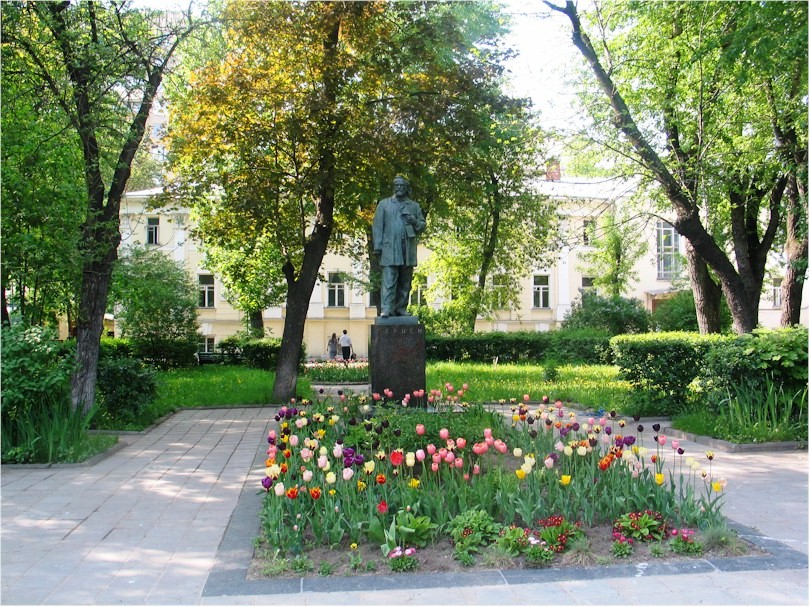
And like with the Mausoleum, I wonder what will become of all these Lenin monuments scattered across Russia.  Any city worth its salt has a Lenin statue, but what purpose are they currently serving?  If any of them are looking to unload a small statue, Almeda and I have a sweet Parish double next year…
Sources:
http://en.wikipedia.org/wiki/Vladimir_II_Monomakh

Catherine Palace, II

Author’s note: Dilara has already written an excellent blog about this palace, but I’ll focus on some other aspects of the residence.
My impressions of the Catherine Palace in Pushkin (formerly known as Tsarskoe Selo) could be summed up in one word: GOLD!!  After our weekends in Suzdal and then St. Petersburg, I became convinced that all the gold in the world is actually housed in Russian museums, palaces, and churches, but I digress.  The Catherine Palace not only has a rich, interesting history, but is also incredibly beautiful.
p1
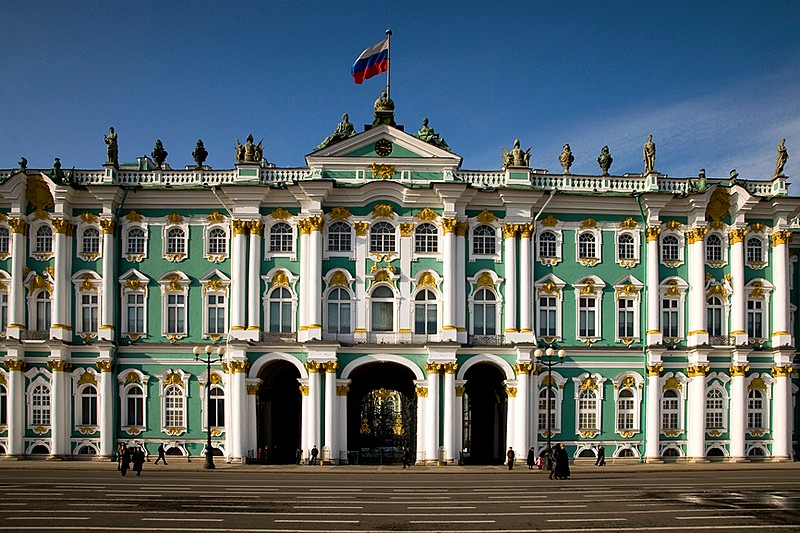
The palace is built in the Northern Baroque style.  As I understand it, Northern Baroque is distinguished from other Baroque styles by its prominent turquoise and light blue color scheme, which is usually offset with white columns and gold or brown accents.  The Hermitage Museum / Winter Palace is another famous example of Northern Baroque.

The Winter Palace in St. Petersburg, photo from http://www.saint-petersburg.com/images/virtual-tour/hermitage3.jpg.


Both the Catherine and Winter Palaces were built by the famous Italian architect Rastrelli.  To say Rastrelli left his mark on St. Petersburg would be an understatement.  Almeda and I had a game in Petersburg: whenever we found a building we thought might be a Rastrelli [that is, topped with numerous unnecessary statues on the roof or featuring a Northern Baroque color palette], we’d find out for sure, shout “RASTRELLI!” and then tap the other on the shoulder.  It was our version of “Slug Bug.”
Catherine, for whom the palace is actually named, came to find the place gaudy, instead preferring clean Neoclassicism.  The Empress Elizabeth was the real mastermind of the project, and before her death, she had even made plans with Rastrelli to up the decoration even more.  Though the facade is lovely now, all of the brown accents were actually plated gold, and it was probably quite a sight back in the day.
p3
The most interesting thing about the Catherine Palace, in my opinion, is that it was taken over by Nazis during World War II and thoroughly ransacked.

The German Army was not kind to the lavish building. Photo from tsarselo.ru.


Photo from tzar.ru.


Being there today and not being aware of that story, you’d never guess that all that was left of the Catherine Palace was some rough foundation and sections of missing roof and smoldering ruins.  The polished parquet floors and gold gilding on the walls shine impeccably, and almost all of the rooms are in order.  A painstaking restoration continues to this day, room by room.
p2

The Grand Ballroom has been restored fully.


A treasure from the original palace was the “Amber Room”, with its walls, decorated with designs made from different shades of amber in mosaic style.  Incredibly, the team in charge of restoration had only a few black-and-white photographs and a watercolor painting of the room to base their new design off of.

The whole room is made of shining, liquid gold amber. Photo from http://www.guide-guru.com/files/File/amber_room_3(1).jpg.


While in the palace, I was pondering the idea of “authenticity.”  In recreating the Amber Room, the artists stuck to the same, traditional methods as the original.  But the fact remains that the walls are all different, all new.  Much of the palace is new, but that doesn’t really detract from the experience of it.  And if you leave something “original”, even with good, minimal upkeep, it will decay.  So my question: should we be striving for preservation or restoration?  In this case, restoration was the only option, but it’s interesting food for thought when visiting other historical landmarks in Russia and across the world.
Sources:
http://en.wikipedia.org/wiki/Catherine_Palace
Information given by our excellent tour guide, Valerii.

Massolit

Yesterday, on our last full day in Moscow, Taya, Almeda, and I spent the afternoon looking around more of the places mentioned in Mikhail Bulgakov’s The Master and Margarita.  I’m a big fan of the book, so I have no qualms writing another Bulgakov blog.

My travel companions.

My travel companions on the staircase in Griboedov’s.


We found the Griboedov House (named after a famous writer, whose name unrelatedly translates to “mushroom eater”), home of Massolit, on Tverskoi Boulevard, which is split by a lovely strip of parks and greenery.

Looking into the complex’s courtyard. Photo from http://www.masterandmargarita.eu/en/04mappen/gribojedov.html.


In the book, Griboedov’s was this really cool dining hall with live jazz bands and a generally hopping atmosphere.  On the second floor of Griboedov’s were the rooms and offices of Massolit, a fictional writer’s union which the late Berlioz was head of.  Several other unfortunate characters work for Massolit, and two of Woland’s henchmen pay Griboedov’s a visit at the end of the novel.
The building, sometimes known as the Herzen House due to its being the birthplace of Russian writer Alexander Herzen, is now home to the Gor’kii Literary Institute, a place for aspiring writers to study and hone their craft.
mm1
It was really hot yesterday; we stuck to the shade as much as possible.  A fence and gates blocked us off from the courtyard on the side facing the boulevard, but we made the long, hot trek around the block to go inside.
mm2
The hallways were pretty narrow and dark, and honestly fit the book’s first description of Massolit pretty well.  I could imagine luxurious offices behind all the doors.  Now though, as one would expect, you’ll find classrooms here.
mm3
It’s always a pleasure to go inside some of the random buildings you encounter across Moscow.  They’re usually not what you’d expect, but incredibly interesting.
 
Further reading/sources:
http://www.masterandmargarita.eu/en/04mappen/gribojedov.html

A Night at the Theatre

During my time here, I’ve been to several theatrical events: two operas, a ballet, and a handful of plays.  The last category gave me the most grief but was also the most educational. Listening to a play in another language made me realize some things about the craft of acting itself.  Even though I did a lot of theatre in high school, I somehow failed to notice that actors speak slowly and with great pronunciation.  The Russian language is filled with letters (particularly vowels) that sound different depending on which syllable of a word is stressed.  And consonants can often become a jumbled mess when a native speaker is breezing through a conversation.  At the theater, however, highly-trained actors carefully enunciate every syllable and tend to speak much, much slower than your average street encounter.  How convenient for a foreigner visitor!  It also turns out that the language of facial expressions is universal, and good physical comedy is always funny, even if you don’t perfectly understand the context. One of the most interesting things about attending theatre in Russia is the curtain call; that is, when everyone takes their bows.  Here, the cast will usually come out in related pairs or groups (as in the states), but then they proceed to take several bows, run off stage, come back on stage, bow again, and so on and so forth.   Family members and friends are often waiting in the front row to deliver their performers flowers, so as they take their final bow, you can try to guess whose spouses came to watch that day. Following are short synopses of two plays I saw that weren’t group activities. Братья – Theatre Gogol’.  About four dysfunctional brothers and the misfortunes that befall them upon moving from their home village to the big city to find work.  One of the brothers makes it big as a boxer, but at the cost of his prostitute girlfriend and sanity.

The main character and his lady friend; photo (c) Gogol’ Center.


Ветер шумит в тополях – State Academic Theatre imeni Bakhtangova, on the Arbat.  Taya, Kaylin, and I were very fortunate to nab tickets to this one, since it was officially sold out.  I bought a pair of tickets for about 1/4 face value, and Taya’s was given to her for free by a man standing outside the theatre.  Kaylin and I had a tough time understanding the dialogue because the three main characters were old men in a nursing home, and one of them mumbled something fierce.  The theatre is beautiful though, definitely worth a visit.

The old men. Photo (c) Gosudarstvennyi teatr Bakhdangova.


День палтуса – Содружество актеров Таганки.  This was probably my favorite play of all; it’s a comedy about a woman whose husband is working in Peru.  In the meantime, she’s having an affair with two different married men.  Things get all tangled up and both men and their wives, as well as her best friend and her friend’s drunk husband end up in the woman’s house.  The two ladies pretend that they’re operating a clinic so that the wives don’t find out.  In the end, everyone decides to stop cheating and goes home to his or her spouse.