Hammers and Sickles and Stars, Oh My!

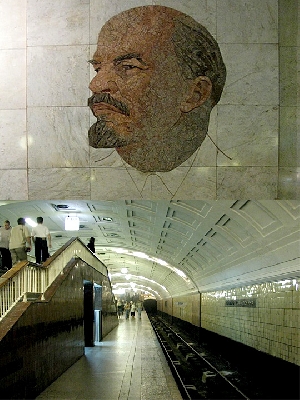
When I first got here, I was surprised for some reason to see that a lot of Soviet symbolism remains in Moscow. This is especially evident in the metro, where hammer-and-sickle emblems and portraits of Lenin still decorate many stations, which have names like “Revolution Square,” “Partisan,” and “Komsomol.”

One of many statues of good Soviet people decorating the Revolution Square station. It's supposed to be lucky to rub the dog's nose as you pass.

One of many statues of good Soviet people decorating the Revolution Square station. It’s supposed to be lucky to rub the dog’s nose as you pass.


I found this enormous statue in the Partizanskaya (partisan) station.

I found this enormous statue in the Partizanskaya (partisan) station.


One of the largest Lenin profiles I’ve seen in the metro is at the station Biblioteka Imeni Lenina, or Lenin Library. Photo from mosgid.ru.


This shouldn’t have been surprising, given that the Russian Federation is less than thirty years old, and it would be foolish and wasteful to try to remove all traces of seventy years of Soviet rule. It isn’t uncommon to find communist symbols even on government buildings. The stars on top of the Kremlin towers are a good example. Installed in 1937, the stars are of varying sizes up to 12 feet across, and are made of red glass.
The Kremlin's Spasskaya tower, with its red star on top.

The Kremlin’s Spasskaya tower, with its red star on top.


After the Soviet Union collapsed, some people wanted to remove the stars. In the end, though, it was decided that they were a great achievement of art and engineering, and so they stand there to this day.

Graffiti

Vinzavod (or Winzavod)
For the Night at the Museum, a world-wide event in which museums and art galleries open their doors for free, I was with Lily and Dilara at Vinzavod. The buildings of Vinzavod used to be part of a winery and some of the mechanical structures inside have been left as decoration to add an interesting atmosphere. There are even galleries in old wine cellars! Lily and Dilara covered much of what we saw, and I would like to bring attention to the graffiti. As far as graffiti goes, perhaps what is there is not anything special, but since I rarely see any graffiti at home in Northfield, all graffiti stands out to me. Sometimes graffiti is vandalism, and sometimes it is art. The graffiti at Vinzavod is part of the latter. In fact, the whole area is dedicated to Viktor Tsoi, the now deceased leader of Kino, a soviet rock band.

Some of the graffiti we saw at Vinzavod.

Some of the graffiti we saw at Vinzavod.


Bulgakov Museum
On Wednesday (May 21) the praktikantki took us on a tour of Bulgakov’s House, now a museum. Bulgakov is the author of The Master and Margarita, a book we read for class. On the way up to the floor of the museum, the walls were covered with renditions of characters from the book.
Behemoth – a cat that acts like a human.

Behemoth – a cat that acts like a human.


Another rendition of Behemoth. In the beginning of the book, Behemoth boards a trolley while standing on two feet and even holds out his payment to the cashier, but she refuses him, yelling that no cats are allowed. Behemoth decides to hang on the outside of the trolley, getting a free ride. “С котами нельзя!” “Cats are not allowed!”

Another rendition of Behemoth. In the beginning of the book, Behemoth boards a trolley while standing on two feet and even holds out his payment to the cashier, but she refuses him, yelling that no cats are allowed. Behemoth decides to hang on the outside of the trolley, getting a free ride. “С котами нельзя!” “Cats are not allowed!”


A depiction of Woland, the devil, with Behemoth’s paw prints nearby.

A depiction of Woland, the devil, with Behemoth’s paw prints nearby.


The Patriarch’s Ponds Area
On Sunday (May 11), Gretchen, Almeda and I set out to visit Patriarch’s Ponds, which is the opening setting of Bulgakov’s book. We found this interesting line drawing on our way there:
“Sorry” has been misspelled as “Sory”. Notice that another passerby made a correction, adding another “r”.

“Sorry” has been misspelled as “Sory”. Notice that another passerby made a correction, adding another “r”.


And today with Chet and Natasha, we took a look at a free library box (give a book, take a book) near on the bank of the Patriarch’s Ponds.
kaspersDSCF3258 kaspersDSCF3259

It’s the same artist! How neat is that?

The Arbat
On the Arbat, a place visited by many tourists as well as Russians, there is a wall dedicated to graffiti.

Gisell and I striking a pose in front of this awesome wall.

Gisell and I striking a pose in front of this awesome wall.


Kolomenskoye
On the boat (see Almeda’s post), we saw some noteworthy graffiti.
Looks pretty intense. It reminds me of the graffiti we saw at Vinzavod.

Looks pretty intense. It reminds me of the graffiti we saw at Vinzavod.


Petersburg
Here are a few more interesting photos:
Does this count as graffiti? No matter, as long as it’s interesting.

Does this count as graffiti? No matter, as long as it’s interesting.


And to end this post, here is our dramatic mathematician:
I wish I could be that cool.

I wish I could be that cool.

Sweet, Sweet Honey

After our tour of Suzdal and learning that it is famous for its honey, I bought a half-pint for 200 rubles (just over $5). There had been other honey sellers nearby, but a friendly old man convinced me to buy his.

Part of the souvenir market in Suzdal.

Part of the souvenir market in Suzdal.


He asked where I was from, and then I told him that I was studying at Moscow State University. He smiled and briefly told me about one of his relatives currently studying there. Then he continued, showing me pictures of his beehives and telling me about another delicacy he was selling – to me, it looked like a crunchy bar made of bees. Maybe it wasn’t meant to eat. I’m not sure. I managed to buy the honey that I wanted, thanking him, and then we bid farewell.
The honey is delicious. At Ashan I bought some crunchy-breads, hoping they would be like toast. They were strange. Then I realized they were lemon-flavored. To make them into a real treat, I spread honey on them and dare I say it? They were amazing! Magic honey.
Almeda agrees: they're lip-smackin' good!

Almeda agrees: they’re lip-smackin’ good!


A few days ago on Monday (May 19), Chet, Almeda, Gretchen and I visited Kolomenskoe Park (sound familiar? Read this!). We spotted a few signs for honey.
Only 50 meters!

Only 50 meters! (photo: Almeda)


And then another.
Getting there!

Getting there!


Finally the stand!
Hurrah!

Hurrah!


But wait – it’s closed.
The sign in the window says closed: закрыто (zakryto).

The sign in the window says closed: закрыто (zakryto).


And so ends the quest to find honey. (Never fear, I still have some!)
On our way out of the park, we found a stand selling medovukha, a drink made of honey.
Medovukha - made from all that honey goodness.

Medovukha – made from all that honey goodness.


Since we had tried some in Suzdal, we decided not to lug around a bottle on such a hot day.
It turns out that Kolomenskoe sells honey products because it used to have bee-keeping farms. Today, a few of the wooden beehives still stand.
The Three Little Beehives.

The Three Little Beehives.


While planning my blog about honey, I was excited to find another place besides Suzdal that has been known for its honey. Honey tastes better when there’s a story behind it.

The King of Satyricon

There’s nothing I love more than an evening at the theater, especially when it comes to Shakespeare. I didn’t know what to expect, however, when we went to the Satyricon Theatre to watch an adaptation of King Lear—Shakespeare in Russian is an intimidating thought.
The play was magnificent. There was blaring, circus-like music playing at all the right moments, robotic dancing between scenes, and strange costuming (King Lear’s servant, for example, wore a black overcoat with nothing but a leotard underneath). It perfectly captured the King Lear’s descent into the world of dementia.
What I was most impressed with, however, was the performance of the leading actor, Konstantin Raikin.
Raikin as King Lear

Raikin as King Lear

Lera, our Russian friend, had mentioned that he was good. But I had no idea that he was this good. Just to give you an idea: Raikin was awarded the Meritorious Artist of Russia in 1985, People’s Artist of Russia in 1993, the Order of the Merit for the Fatherland, and a national theater Golden Mask. And to top it all off, he is the director of the Satyrikon Theater.
konstantin-raikin
We watched King Lear a week ago and I am still starstruck. It is definitely a performance I will never forget.

A Week of Spectacles

This week must be our fancy week. On Sunday, we went to the Kremlin Palace to watch a ballet adaptation of Sleeping Beauty. Formerly the tsar’s Moscow residence, the Kremlin Theatre serves as a venue for operas, ballets, and concerts, acting as a second stage for the Bolshoi.

Our handsome group at the Kremlin Palace Theatre


It was only fitting, then, that we go to the Bolshoi Theatre as well. Located just across the street from the Kremlin, this theater is world-famous and tickets for “good seats” can be very expensive. However, if you’re willing to arrive early enough to place your name on a waiting list, you might find a place in the nosebleed section for a very good price. On Tuesday, we were able to get tickets for 100 rubles (about 3 US dollars). The opera, The Tsar’s Bride, was the first that I’d ever seen and did not disappoint, although it did require a bit of craning of the neck.

“НЕУДОБНОЕ МЕСТО” literally means uncomfortable seat. At least they’re honest.


Success!


On the highest balcony of the Bolshoi.


The Most Interesting Subway Car in the World

As our group was leaving the Bolshoi Theater in Moscow after seeing a production of Царская Невеста (The Tsar’s Bride) by Rimsky-Korsakov, Лера (read: Lera) decided it might be fun to walk about for a little bit instead of going into the nearest subway station. As we walked along the city, we got a chance to see the Kremlin lit up at night, which was a pretty fantastic sight.
However, I got a bit tired, and decided to hop in the metro a little earlier than some of the group, who continued walking a bit further. As we walked into the station, a red subway car pulls up (as you can see from my metro video here, this is not their usual color).
026-060
This particular subway car was made in honor of the 75th anniversary of the Красная Стрела (Red Arrow), which is a sleeper train that has been going between Moscow and St. Petersburg since 1931. The only interruption of service for the train was from 1941 to 1943 during the Siege of Leningrad.

The Red Arrow in the 1930's and now.

The Red Arrow in the 1930’s


56cd0905f021fa3483f1080a86e_prev

A more recent photo of the Red Arrow sleeper train


Notably, the train gained its famous color in 1962, and later, in 1965, the operators of the train began playing “The Hymn to the Great City” whenever the train leaves St. Petersburg at 23:55.

However, it gets better. There was a dog in the metro with us! I managed to pet him a bit and prevent him from getting his head stuck in the door, which I felt to be a success on my part. As we pulled into each metro station, the dog would come up to the door and sniff for a little bit, as if pondering whether that was his stop.
Man's best friend

Man’s best friend in the Moscow Metro


Unfortunately (perhaps fortunately), as two men left at Sportivnaya (Sports) metro station, the dog left with them, which inclines me to believe that this was not one of the famous stray dogs that wanders about the Moscow metro at night. However, the combination of the dog and the subway car made for an interesting subway trip, to be sure.

And The Bells Kept Ringing…

One afternoon after class, I went with an MGU student, Olga, to Beliy Gorod, or, White Town. This district encompasses the central region of Moscow that contains the Kremlin, Bolshoy Theatre, and other cultural giants.
We came upon a beautiful yellow church, large and filling the Bolshaya Nikitskaya Street.

The Greater Church of Christ’s Ascension was built in the beginning of the 19th century under Prince Potemkin. It was in this church that Alexander Pushkin married Natalia Goncharova. In 1931, the church was shut down and the iconastasis burned. The church was re-opened in 1990 for worship.
We lazily walked through the courtyard. As Olga explained the history of the church, a cat lounged in the sun, old women sat on the benches and fed birds, the breeze swept through the grass—in short, it was a beautiful day. And then the bells started ringing.
We thought nothing of it and continued walking at our same leisurely pace. But the bells kept ringing… and ringing… and ringing. Confused, I checked my watch: it was about 4:23pm, an arbitrary time for the bells to be tolling. Olga wondered if she had perhaps forgotten about a holiday. We looked around for any evidence of special processions. Nothing.
We stood in front of the church and listened for a while longer. There were no signs of stopping, so we continued down the sidewalk, the sound of bells fading away behind us.

A Contrast: Victory Park Before and During May 9

One day, while I was still at my home stay, I decided it might be a good idea to wander around for a bit on the metro, and then just get off somewhere. I didn’t make it far before I decided that a station called Victory Park was the place I should go.
 
IMG_0223
After doing some wandering about the very empty park, I headed back home and went to sleep. I didn’t think about it at the time, but this is where a large amount of the festivities surrounding Victory Day were to take place.
 
The change was dramatic. The plaques that stated the years of World War II, so blank and imposing on the day that I had taken the photos in April, were covered in flowers.
 
IMG_0036IMG_0608
Not only that, but there were so many people there. There must have been thousands of people in sight at any given time in the park, which was in stark contrast to my last visit, where there was virtually nobody there.
 
IMG_0033IMG_0615
Eventually, I realized that Victory Park, while a fantastic park during the day, became something more than that during Victory Day. It became a symbol of Russian military might, of victory, and of the willpower of the Russian people. Nothing could have made that more clear than the thousands of people that I saw there that day. Such a presence just made me feel a part of a larger movement. In honor of that, I decided to grab a flag and join in the spirit.
 
10336732_698611100194706_7270930571125768963_n

The Lion and the Puppy

In a side street in the center of Moscow stands a quiet, yellow house of two stories. Past the gate and through the door, you’ll find the house once belonged to the great Lev Tolstoy.

Leo Tolstoy

Leo Tolstoy at his summer residence in Yasnaya Polyana


Tolstoy is regarded as one of the greatest novelists of all time. Included in his repertoire are his most famous works, War and Peace and Anna Karenina, as well as numerous short stories, plays, essays and autobiographies.
His home is filled with his belongings, including his furniture, drawings, and photographs of the years he spent in Yasnaya Polyana with his 13 children. It is easy to imagine Tolstoy spending his winters here, toiling over Death of Ivan Ilyich, among other works.
As I explored the house, I came across a room filled with illustrations and children’s books. Upon closer inspection, I saw that they had all been written by Tolstoy. I then realized that I didn’t know anything about this literary giant.
Seeing a lack of schools in the country side, Tolstoy had opened a school for peasant children so that they could learn to read, write and draw. With a lack of quality schoolbooks, Tolstoy undertook the task of writing them himself. One book in particular caught my interest.
 The Lion and the Puppy
This story is about a caged lion that befriends the puppy that is intended for his meal. You can read it for yourself here. And, if you’re interested, you can read the Russian text. It is quite short and includes an introduction explaining Tolstoy’s endeavor to educate children. I highly recommend reading. You might, like myself, learn a thing or two about Tolstoy.

Boats!

I’m sure that by now my friends are getting pretty tired of hearing me talk about boats. Boats, especially tall sailing ships, really bring out my sense of adventure. Like Chet, I loved seeing the Aivazovsky paintings at the Tretyakov gallery and at the Russian Museum in St Petersburg.

Russian Squadron on the Raid of Sevastopol, Ivan Aivazovsky. I loved the traditional favorites, of course, but I liked this painting because of its detail. If you look closely, there are tiny sailors standing in the rigging of all of the ships.

Russian Squadron on the Raid of Sevastopol, Ivan Aivazovsky. I loved the traditional favorites, of course, but I liked this painting because of its detail. If you look closely, there are tiny sailors standing in the rigging of all of the ships.


I was also intrigued by the huge, strange monument to Peter the Great that stands by the Moscow river. Almost 100 meters tall, it depicts an oversized Peter standing at the helm of a stylized sailing ship, looking out over Moscow. The monument, built in 1997, was designed by the artist Tsereteli, who also designed several other statues in Moscow and elsewhere. You can read more about the statue here. While the boat is appropriate (Peter worked tirelessly to make Russia a naval power in the early 18th century) its location in central Moscow is somewhat odd, since Peter hated Moscow, and spent as little time here as possible.

Moscow’s boat-themed monument to Peter the Great. Photo by Alexander Leo Phillips.


While I haven’t yet found a chance to ride on a sailing ship here in Russia, I have been on a couple of boats. As I mentioned in an earlier post, we had the opportunity to take a tour of the canals of Saint Petersburg, which was amazing. Then, yesterday I got to go on another boat, this time on the Moscow River.
He's on a boat.

He’s on a boat.


It was a hot day, and we had been walking in the park at Kolomenskoe for a few hours. We were getting pretty tired, and we were thinking about what to do next when we spotted a sign advertising hour-long rides down the river. We bought ice cream, then got on board.
It was a great day for a boat ride!

It was a great day for a boat ride!


It was a beautiful day for a river cruise. Once we got moving there was a nice breeze, and the sunlight sparkled on the (slightly smelly) water. For a while, we rode past the park, with forests and fields on either side.
Our view of Kolomenskoe Park.

Our view of Kolomenskoe Park.


We went under a couple of train bridges, and soon we were surrounded by rows of apartment blocks rather than trees. Seeing all those apartment buildings reminded me of just how many people call Moscow home.
Apartment blocks like these are a common sight in Moscow, which has a population of around 12 million.

Apartment blocks like these are a common sight in Moscow, which has a population of around 12 million.


Even though it wasn’t a sailing ship, I had a great time on the riverboat. My next project is to go on another ride down the Moscow River, this time at night, to experience the city lights. Until then, maybe I’ll try to stop talking about boats. Maybe.
Chet staring majestically into the distance, wondering if I'm done talking about boats yet.

Chet staring majestically into the distance, wondering if I’m done talking about boats yet.