The Beloved Not-Good Apartment

Today we got to see apartment No. 50 on Sadovaya Street.

the door to the not-good apartment

the door to the not-good apartment


This is where author Mikhail Bulgakov lived, and a very important place in his novel The Master and Margarita. The devil and his entourage take over the apartment, which already has a reputation as a place from which people disappear, and make its reputation even stranger by using it as their headquarters for spreading chaos in Moscow. The author refers to No. 50 as the nekhoroshaya kvartira, or the not-good apartment.
Gretchen and I standing in No. 50's stairwell. Thanks to our praktikantka Olya for taking the photo!

Gretchen and I standing in No. 50’s stairwell. Thanks to our praktikantka Olya for taking the photo!


The graffiti that covers the stairwell’s walls shows the deep connection that people have with this place, with Bulgakov, and with The Master and Margarita. You can see several versions of each of the main characters, quotes from the novel in Russian and in English…
OLYMPUS DIGITAL CAMERA

Woland 


OLYMPUS DIGITAL CAMERA

A version of Queen Margarita


OLYMPUS DIGITAL CAMERA

Behemoth getting on the tram


OLYMPUS DIGITAL CAMERA

Natasha and Nikolai Ivanovich


portraits of Bulgakov…
OLYMPUS DIGITAL CAMERA
plus your typical “I was here” graffiti. Stepping inside the stairwell gave me the feeling that I was in a special place.
Before even entering the apartment itself, I felt just how loved No. 50 on Sadovaya Street has become.

Three Hours

If you want to create a feature-length film in just one take, the beautiful State Hermitage of St. Petersburg is probably the best place to do it. Commissioned by Catherine the Great in the mid-1700s, the museum is one of the largest in the world and houses thousands of paintings, sculptures, furniture, and more.
In fact, on December 23, 2001, Alexandr Sokurov did just that. A camera ran without stopping for 90-minutes straight (after a few start-overs), following the unnamed narrator of his masterpiece, Russian Ark, as he wanders from room to room in the Hermitage. This 2-kilometer path presents 3 centuries of Russia’s history, taking the viewer on a journey through Russia’s past.
When I first saw this film, I was taken aback by the beauty of the Hermitage. As the camera wound through various rooms, stumbling across balls, receptions, and past Russian rulers, it seemed as if there were no end to this magical realm.

The larger-than-life narrator of Russian Ark

The larger-than-life narrator of Russian Ark


We were fortunate enough to experience the State Hermitage for ourselves in early May. I’m a realist. I wasn’t expecting the same Hermitage of Sokurov’s tale–I am fully aware of the post-production magic that often goes on with most major motion films. However, upon climbing the same Jordan staircase featured in the film, I immediately realized that I hadn’t given the Museum enough credit. Built during a time when St. Petersburg had to prove its worth in the European world, the Hermitage is grand, beautiful and boasts an impressive collection of artwork. We spent 3 hours in the Hermitage, almost as much time as it took Sokurov to film Russian Ark. Following our Marquis-analog tour guide, we looked at paintings and frescoes, imagining a time when the Hermitage was filled not with tourists, but with Russian officials and nobility.

 
Additional Reading:
“Art’s Fading Sway: Russian Ark by Alexander Sokurov.'” The White Review, n.d. http://www.thewhitereview.org/art/arts-fading-sway-russian-ark-by-aleksandr-sokurov/
“The ‘Russian Ark’ Project of the State Hermitage and Aleksander Sokurov.” Hermitage Museum, n.d. http://www.hermitagemuseum.org/html_En/13/hm13_2_002.htmlhttp://www.thewhitereview.org/art/arts-fading-sway-russian-ark-by-aleksandr-sokurov/
“Era of Catherine the Great: 18th Century.” Hermitage Museum, n.d. http://www.hermitagemuseum.org/html_En/03/hm3_6_4.html

Adventures into the Underground: The Moscow Metro

So it was. It was our first day here in Moscow, and we were to be riding the metro all day, in an attempt to become more familiar with it. Due to jet lag and general lack of sleep, I did find that it was a bit difficult to understand at first, especially as we were weaving through crowds, looking at the design of various stations, and making transfers across the metro on the VERY LOUD subway cars.
 
After our trek on the metro we headed back to our dorms, and tried to get some rest.
Eventually, after a few trips, I started to get how the metro functioned, and how I could get from place to place. It became a necessity soon afterward, and is easily one of the most efficient methods to get around the city.
 
Not only that, but the web that is the Moscow Metro often becomes so much a part of one’s mental map of the city that the scale of the city shrinks, and getting from point A to point B becomes defined by how many stops on the metro are required get there. Occasionally, I notice the actual, much larger, scale of the city. One of these instances came when a group of us got lost somewhere between Парк Културы and Фрунзенская metro stations. Suddenly, the distance between stations on the same line seemed a bit longer than it did within the safety of the metro.
 
Another instance of a similar vein occurred during the time I rode a bike with Kaylin and some Kazakhstani students to Victory Park, which you can read about here.
 
However, sometimes these realizations overemphasize the scale of this city, particularly when getting closer to the city center, where there are more metro stations around and about. It is a very short walk to get to the Old Arbat from the Kremlin, for example, and the fact that I often traverse through the metro to these places separately means that the distance between them was distorted in my mind before I tried the walk there.
 
As of now, my mental map has become somewhat of a potpourri of random places, all connected by a web, but not necessarily connected to each other on the surface. It’s really a strange feeling, and definitely not something you experience in smaller towns in the United States.
 
Also, as a bonus, here’s a video of a typical trip through the metro! Enjoy!
 

Hospitality

Russia is famous for its amazing hospitality and incredible treatment of guests, in a way that makes a humble Midwesterner blush.  I experienced this spirit several times, but I’d like to highlight two instances where I was really overwhelmed by kindness, notably from two non-Russian cultures.
Living in the dorm has been great, because our floor is inhabited by some really cool people.  A large group of students from Kazakhstan lives on 7th with us, and they’ve kindly taken us under their wing.  They’re always willing to stop and chat, asking how we are and helping us with homework if we don’t understand something.  Interestingly, I bonded with my friend Diliya over English.  I helped her with an application letter and from then on, we were buddies.  Her birthday took place a couple weeks ago; unfortunately I missed the first get-together, but she invited me to a second celebration in her room with some of her oldest friends.  I was out on an excursion but she said that I should come any time, even if I was late.  Taking that to heart, I went over to her room as soon as I got back, and was immediately greeted by a room full of people.  I presented my measly offering of chocolates in a bag I had brought from Minnesota.  Red as a beet, I took a place at the table, and the festivities continued.  Diliya made sure I always had juice, and my plate was loaded up with cookies, cake, and other sweet treats.  The evening consisted of sing-along songs (which Diliya looked up the words to so that I could participate in the ones I didn’t know) and games.  I tried to express my gratitude in a toast to the hostess, and I hope I was able to convey even one-fourth of it.  Everyone there showed me great kindness, and I was honored to be a part of her after-birthday celebration.

It turns out you can fit a lot of people in a little dorm room.  Photo credit: Diliya

It turns out you can fit a lot of people in a little dorm room. Photo credit: Diliya


I also had the immense pleasure of being a guest at the home of our beloved language assistant Diana, where three of us met with her mother Natalia, grandmother, and friend Ira.  The ladies had prepared a “light” [their words] feast for us; the Russian New Year special “selyodka pod shuboi” (herring under sliced carrots, eggs, eggplant, held together with mayonnaise), delicious meat topped with tomato slices and cheese, mashed potatoes, bread, salmon, sliced meats and cheeses, vegetables… it was incredible.
The "small" feast.

The “small” feast.


We wanted to help clean up, but Natalia and Ira wouldn’t hear it.  The five of us (and Mira, the fluffiest, most beautiful dog in Moscow) bundled up our dessert cakes and had a picnic in the forest near their home.
d2

Mira


There, we talked about politics and ruminated on life, then packed up and went back to the house to have tea.  Many-course meals are a Russian tradition that I could certainly get used to at home.  Even though it was getting late, our hosts didn’t utter a word about us leaving, and they would have let us stay all night.  Natalia walked us back to the metro and we all embraced warmly, our hearts and souls utterly refreshed after such a lovely day.
The three of us with Natalia and Mira.

The three of us with Natalia and Mira.


I hope that when I get older and have a place, I’ll be able to receive guests with such skill and good-naturedness.

A Tale of Two Clocks

I’ve been impressed by two clocks residing in Moscow:

  • The first is the Temple of Glory in the Armory Museum

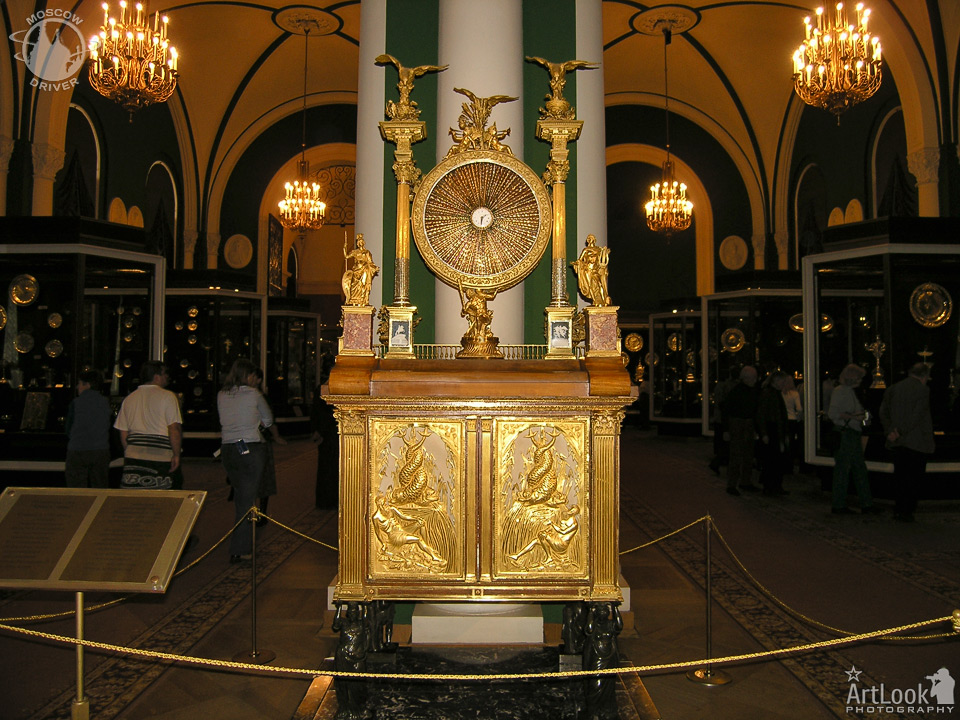
On Monday, May 5 (the same day that we got back from St. Petersburg!) we were given a tour of the Kremlin’s armory. We saw elaborate royal clothing and carriages, snazzy crowns, and gifts given to the royal family, such as golden tableware and my favorite – a chiming clock. It was gifted to Catherine the Great by Michael Maddox, who moved from England to Russia when he was twenty. The clock, Храм Славы (temple of glory), was completed in 1703. Although it is not functioning today, the clock would chime and play music to revolving figurines and flowers, different depending on the hour. (even though this is in Russian, my source is from here http://kraeved1147.ru/chasyi-m-medoksa-hram-slavyi/). Photography in the Armory was prohibited, but I managed to find this photo:

Michal Maddox’s clock to Catherine the Great, Temple of Glory. 1703. From http://www.moscow-driver.com/


  • And the second is:  Kremlin Chimes and clock

Each time I have visited to Red Square or the Kremlin, I love listening to the distinct melody of the Кремлёвские куранты (Kremlin Chimes).

The time kept by the clock is the official time of Moscow. The clock and its chimes are housed in the Spasskaya Tower http://en.wikipedia.org/wiki/Spasskaya_Tower, the main tower of the Moscow Kremlin, towering over Red Square.

St. Basil’s Cathedral is on the left and Spasskaya Tower is on the right. From the wikimedia commons.


Somewhere between 1491 and 1585, the clock was added to the Spasskaya Tower and since then, it has been rebuilt multiple times. The clock’s face is just over 20 feet (6 meters) in diameter and the minute hand is nearly 11 feet (3 meters), impressively big. The clock lets out a short chime every fifteen minutes and a longer tune on each  I find the scale of both of these clocks impressive – Spasskaya Tower’s clock is huge and the Maddox’s clock is very intricate.

Realizing Improvement

When my conversational Russian language teacher, Irina Vladimirovna, got up to express her amazement with our work and improvement for the past seven weeks at our goodbye party, I nearly cried. It was hot in the room, it smelled like good tea and cake, and one of the best teachers I ever had was telling me and my classmates that we had improved beyond her expectations.

We had just finished performing our final skits and poetry recitations to our teachers and praktikanti and carried in our hands certificates that would be permanent reminders of our success here in Moscow. I did not tear up (How? I still don’t know). I had a rough time here for a couple weeks where I was absolutely convinced that I had not improved in Russian at all, but now I know that’s not true. It takes me a while to not be shy and just talk, but once I get started, it becomes easier and easier to speak. I used to be able to understand barely anything anyone told me, and now I can understand Russian 50% of the time. I know when I am making phonetic errors, and I eventually catch my grammatical mistakes. I have decided that I will be speaking with my dad’s Ukrainian best friend over the summer to keep up my Russian until I can take Chekhov in the fall trimester.
At our little good-bye party, you really felt the joys of Russian culture. We loudly sang great Russian songs accompanied by guitar (I have attached two of my favorite Soviet songs below), heated up pots and pots of hot water for tea, and felt no qualms about eating a second slice of cake. Russians love to celebrate and to make you feel at ease. If you make the effort to do something, they will always try to help and put in the same amount of effort as well. I have had fabulous and truly gifted professors here. And while I did not tear up at the party, I am tearing up a little bit now.

An Immigrant City

Not tipping in Moscow has been mentally draining, especially when you know the gap in income in Russia. The CIA World Factbook reports that Russia ranks 49th in the world in terms of its GINI index. I guess to be fair, the U.S. ranks 40th, which is not that much better.
I am not by any means a rich American. I come from a family of poor immigrants who are still struggling to make it in America, and so I sympathize frequently with immigrants and those in poor living conditions. Despite my economic background, I am not overjoyed that I don’t have to do things like tip here. I feel a little guilty about it, and our group tips waiters and waitresses who are nice to us. Poverty in Moscow somehow looks a lot worse than poverty in the States, and the presence of the immigrant population in Russia is overwhelming. Sometimes Russians, very similar to Americans, are weary of foreigners. Many of the drivers of the marshrutkas (small van buses) are from the Caucasus, and you realize that Moscow is as much an immigrant city as Chicago is, if not more. There is not much of a presence of a middle class in Russia (and this might just be my misperception!), in the same sense as in America, and so I think the poverty I see sometimes in the streets and especially on the metro hits me a little more than I am used to back home.
I am more than a little worried about what will happen with the income inequality here as the Russian economy slows down.
 
Here is an article I found online that sheds some light on the situation and has good information on the current population of Moscow.

Lullabies at the Kremlin

I had never seen a ballet my entire life, and I can now say I had the pleasure of seeing the ballet, the Sleeping Beauty, with live orchestral music by Tchaikovsky in the Kremlin Palace in Moscow. The ballerinas were superb. I am someone who took only nine weeks of ballet when she was 9 years old and does not know much about it in general, but you would have had to be blind not to notice the difficulty of the moves the ballerinas and ballerinos were doing. They were always in synch, jumping several feet in the air, and holding their positions for minutes on point-toe. All with smiling faces and grace.

In the Kremlin Palace.

In the Kremlin Palace.


The magnitude of the Kremlin Palace.

The magnitude of the Kremlin Palace.


However, I was left more in awe of the orchestral music of Tchaikovsky. It was beautiful. In fact, a couple of us, myself included, found it to be so lulling that despite our best efforts, we wanted to just shut our eyes and listen to the music. The violins, the harpist, and the flutes were amazing and played great sequences. I think that if there hadn’t been a live orchestra, the ballet would simply not have been the same. You could see how well the ballet dancers and the orchestra had practiced together and integrated each move perfectly with each note played by the orchestra. I think my goal from now is going to be to listen to more Russian composers of the 19th and 20th.
Also, taking pictures of the live performance was not allowed, so I am attaching a link with a Sleeping Beauty soundtrack.

Напитки: Drinks

Just like how Americans treasure OJ in the morning and water fountains in parks, Russians also have their certain set of preferences for everyday (nonalcoholic) drinks. I took water for granted until I came here and realized that water fountains are not necessarily considered a public good and you have to pay for bottled water. You would think that Russians would carry around reusable water bottles, but they do not (there isn’t much recycling here either for the bottles—I saw my first recycling bin today after 7 weeks…). Buying water bottles here is the preferred choice, and even then, more people prefer carbonated water to still water.

The brand of water I normally buy in 5L bottles.


Also, juice seems to trump water, too. In fact, lemonade here is also not your typical “lemonade”. It is often carbonated and not made with lemons. My friends and I are always thrown off in restaurants when they present my flavor options of “лимонад” (pronounced: limonad) as kiwi, cherry, orange, etc. In the heat of a humid, sunny 80 degree Moscow, I am craving some homemade lemonade more than ever.

Русский лимонад (Russian limonad)


Finally, tea trumps all beverages in Russia period, even in the sweltering heat. Like the Russian students we were eating with in the cafeteria in the Economics building, my classmates and I drank some sweetened black tea.
Funny aside story: Americans are insanely easy to spot here. I couldn’t stop laughing when I saw a different group of Americans bring in a jug of water to the dining hall while eating dinner and pour water into their tea cups.

Vinzavod

I wouldn’t say I am big on modern/contemporary art, and I think it might be because I am not someone who necessarily expresses herself visually. I tend to vocally voice my opinion, and it is hard for me to understand artists’ depictions of certain events, feelings, or thoughts. I also don’t really understand why some artists’ works are highly valued, while others are not, but if you ask me, some of the work at Vinzavod should be sold for thousands—minimum. I don’t know why Vinzavod stuck with me the way that it did, or why I liked it so much. Perhaps it was the area’s history and the vibrancy of the Muscovites who hung out in the area. It is a former wine factory, which is where it gets its name, and currently houses multiple art galleries (it’s not a typical “museum”, but more indoor-contemporary-art/outdoor-festival kind of deal) and people are expected to graffiti its walls (look below for some typical and some not-so-typical graffiti). I actually thought the graffiti was really interesting and showed the difference in the urban art of America and Russia. I see it so often in Chicago that I sometimes don’t even notice it, but the graffiti in Russia has more realistic pictures of people than the more cartoonish pictures I see in Chicago. One is not necessarily better than the other, but they are different. 

A view of the grounds.

A view of the grounds.


Some cool graffiti.

Some cool graffiti.


Other cool graffiti.

Other cool graffiti.


Graffiti on pipes!

Graffiti on pipes!


My favorite graffiti piece!

My favorite graffiti piece!


The art in the galleries also caught my attention. This one painting that really stuck with me (picture below!) showed a couple, who were naked in-between white sheets. They were looking at each other in silent sadness, while also staring off in into space. I thought it was a very profound statement on the artist’s view of love and relationships. There was also an artist who used photographs, Photoshop, and other tools in order to portray traditional Russian tales (picture also below).
All in all, I was very impressed by Russian contemporary art and the area of Moscow it strategically chose to house the works of its gifted artists. If you ever in Moscow, it is most certainly a place you must visit!
My favorite piece! I thought I had taken a picture of the name of the artist to remember, but my camera blurred everything, and now I can't really read the name of the artist. But whoever you are, artist, you are talented!

My favorite piece! I thought I had taken a picture of the name of the artist to remember, but my camera blurred everything, and now I can’t really read the name of the artist. But whoever you are, artist, you are talented!


One of the coolest pieces I saw depicting a Russian fairytale.

One of the coolest pieces I saw depicting a Russian fairytale. Also artist unknown.