Red Square on Victory Day

After our adventures at Patriarch’s Ponds, Gretchen, Almeda, and I visited Red Square. It being May 10, the day after Victory Day, we watched workers take down the huge, metal-framed structures built for the holiday.

Taking it all down.

Taking it all down.


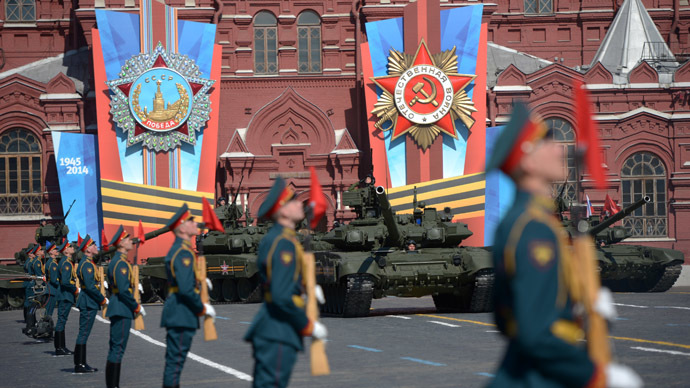
Returning to class Monday, at least two, maybe three, of our professors told us that it would have been better for us to watch the parade on Red Square on TV instead of craning our necks, standing on our tiptoes, and watching from a different part of the parade route. But for us, the goal was to experience the festivities in person and not through a screen. After all, we can always look online and see what we may have missed! And yes, I was curious:  how had Red Square had looked like the day before, on Victory Day? The weather was perfect and the streets were packed. However, the following day was overcast, threatening to rain, and the streets were deserted.
Here are a few comparison pictures:

From http://rt.com/news/157780-wwii-victory-parade-red-square/.


kaspersDSCF2449
http://rt.com/news/157780-wwii-victory-parade-red-square/

The view above Red Square. From http://rt.com/news/157780-wwii-victory-parade-red-square/.


The view in front of GUM, a shopping center.

The view in front of GUM, a shopping center.

Red Square filled with people. From http://pbs.twimg.com/.

On Wednesday (May 21) I traveled back to Park Pobedy, Victory Park, to visit the Museum of the Great Patriotic War. It was sunny and uncomfortably warm, and as with Red Square on May 10, Park Pobedy was deserted except for a few people playing in the fountains.

May 21

May 21st. Not a holiday. All this open space was filled on Victory Day!

May 9th, Victory Day on Park Pobedy.

May 9th, Victory Day on Park Pobedy.

Victory over Loss

On Victory Day, I attempted to explore the area around the Kremlin in the hope of entering Red Square.  Although this didn’t work, it did put me in the right place for a very different opportunity: there was almost no line for the student tickets to the Bolshoi Theater.  But why not?  On a beautiful day and the great national holiday, who thinks of going to the theater?

Extra lights on Theater Square were set up for Victory Day.

Extra lights on Theater Square were set up for Victory Day.


The ballet was Bayaderka, “The Temple Dancer.”  The show is set in Southeast Asia (I thought India, though I have read Cambodia) and presents a host of internal conflicts between the leading characters.  A Prince and Dancer are in love, though the Prince is quickly betrothed to the Raja’s daughter, the Princess.  The Raja, having heard of the Dancer’s skill, hires her to perform at her love’s wedding to another woman.  The High Brahmin of the temple where the Dancer lives lusts after her and challenges even the Raja when displeased.  The Dancer and Princess in turn try to kill each other for love of the Prince.  The Princess triumphs, killing the Dancer by treachery in the second act.
Dancers in white represent the spirits of the departed in the rocky World of Shadows.

Dancers in white represent the spirits of the departed in the rocky World of Shadows. Royal Swedish Ballet, 2007.


The third act proceeds in the ‘World of Shadows,’ with the spirit of the Dancer meets the Prince while he is in a trance.  Their dances together are a marvelous display, confirming that neither ever had intended to be separated, and while in the real world the mortals continue their struggles, the lovers’ spirits escape their pain.
In this liberation they have won the only happy ending in the story, a victory of their own.  Fitting to the holiday, this play challenges how victory is won: the immoral victory of the Princess ended only in her shame when she could not have the Prince.  The victory of sincere love and faithfulness frees the heroes.  This message patterns after the bittersweet triumph of Victory Day: the Soviet Union overcame a terrible time of shadows cast by the misdeeds of a conflict clearly dividing right from wronged.
Victory Park monument to St. George, Russia's favorite saint of victory over evil.

Victory Park monument to St. George, Russia’s favorite saint of victory over evil.


My Victory Day experience probably was not at all typical or even expected! But I feel that I too won this day, and even got to catch the fireworks at the end.

Planning an Event

Planning a study abroad event is not easy.  But considering how many students (and praktikantki) had expressed a desire to go to the Bolshoi Theater, I was happy to use my knowledge of student tickets to oblige!  So here’s a rough guide to planning such an event.
1. The first step was getting the idea, talking to people, gauging interest.
2. The second step was to choose a date.  Thank you Lera for help with that!
3. The third part was spreading the word.  I sent an email to our students, and Diane helped contact our prantikanty.  Thank you Diane!
4. I asked for help with signing up for student tickets.  The first part begins with getting on the list at the Bolshoi, which is admittedly a fairly sketchy process of talking to the random youth with a folded piece of paper.  Thank you to everyone who helped sign us up!

And here we are in line for tickets!

And here we are in line for tickets!


5. Check that everyone knows when to come for tickets.  I felt confident that we double-checked with everyone but Olga.
6. Complication.  Something has to wrong.  Sahree tried calling me a few times and I called back; neither of us could connect to the other through the Metro.  But no problem- we got everyone together, in line, and ready on time to go so we all got our tickets. Great job, everyone!
7. Go to the show! Enjoy!
8. Take silly pictures afterward.
Look!  The ruble bill and the real thing!  So similar I can almost feel the rush of those powerful horses!

Look! The ruble bill and the real thing! So similar I can almost feel the rush of those powerful horses!


It was a little hectic to try coordinating such a group of people when we all had our own plans for the day.  I hoped that everyone could come, then that they knew when to come, and finally that everyone would make it. It also proves that one can’t do it alone- my words of gratitude should show that planning only works when everyone works together to make it happen.

When All Goes Wrong, Just Dance

Shostakovich struggled all his life for approval from the Soviet powers, falling in and out of favor.   Svetly Ruchei “Bright Stream” was a piece that should only have secured Stalinist approval, but was pulled from the repertoire in under a year.  Written in 1935, this light comedy hits home a powerfully Soviet message everywhere, messages of plentiful harvests, a richer society, and a happy lifestyle for common people.

The New Stage of the Bolshoi Theater.

The New Stage of the Bolshoi Theater.


The primary set is designed entirely from shocks of wheat and a variety of fruits and a parade of giant produce introduced the final scene.  Food was visible in every scene as if to convince the audience it could never be far from them.  This message might well have been needed following years of 1931-3 blight and famine in Ukraine that led to the death of millions.
The first act clearly evoked a rural town, yet also made clear that all its residents are not only literate, but well-supplied with material goods.  The audience met the leading characters as they exchanged gifts to greet each other.  Packages, household wares, and a phonograph give the impression that the Soviet style of life has greatly improved the material wealth of those working the land.  The dance moves of pairs or trios of dancers specifically evoked machine operations such as oil derricks or machine assembly lines, again emphasizing Soviet productivity.
The popular cello adagio may be found here, showing the playful romantic nature of the ballet.
It was very light and very enjoyable!

It was very light and very enjoyable!


As with most Soviet period stories, the ending is happy: despite a plot comprised mainly of the characters teasing or pranking one another, everyone is happy with their lives of love and plenty.  All leading women end paired with a man and everyone can celebrate their plentiful harvest together- if the audience did not sympathize in their own lives, they could at least enjoy the idealized boons of Soviet life.

The World's Smallest Spellbook

There’s a sort of irony to the fact that large, cultural promotions like Night of the Museums are targeted toward young adults, especially university students.  More than that, we are the target of advertising for concerts or shows that incorporate trendy modern art styles or European diction.  It does make sense, as academics are most likely to be interested in these opportunities and the industries may as well get customers hooked at a young age.  The trouble is that we are people who have trouble affording most of these concerts or exhibitions!
 

The wonderful ID "ticket" that allows access to campus buildings and student discounts!

The wonderful ID “ticket” that allows access to campus buildings and student discounts!


Enter the Student ID (studenticheskij bilet).  This tiny item works magic.  That’s the only way to describe it: upon entering a museum, the price may likely be cut in half or less just for being a student (eg. the Tretyakov Galleries, where the normal 450p entry fee for foreign guests may be reduced to 150p for a student).  Some museums and historic sites, such as the Ryabushinsky House and Bulgakov’s residence, do not even charge students for entry.  And my particular favorite trick is how the Student ID card can turn an ordinary 100p bill into a ticket for the splendid theater it displays!
ID + 100 = Bolshoi Ticket, just like that!  Plus a lot of waiting, but I can't show that so easily.

ID + 100 = Bolshoi Ticket, just like that! Plus a lot of waiting, but I can’t show that so easily.


Carrying this ID around the city greatly reduces the cost of most cultural opportunities and opens many more doors than just the buildings on campus!

A City of Clashing Pasts

Moscow’s architecture is kind of offsetting to me and says much about its long and complicated past. On one hand, there are these beautiful neighborhoods in central Moscow that remind you of the 18th and 19th centuries. Russians have tried to preserve 19th century Moscow as much as possible, and it is always strange to me when I can still see the very buildings in which famous writers such as Gogol, Pushkin, and Bulgakov lived. On the other hand, every time I try to take a picture of these beautiful buildings, I always end up getting a small shot of a tall Soviet era building or a factory of some sort. You can see it clearly in the picture below. I tried to take a shot of the buildings near the Moscow River, and while they looked beautiful in the afternoon sun, the Soviet-style tall building in the middle right side contrasted too strongly with the classical style buildings (I am not a huge fan of Soviet era architecture). In another picture, there were a factory’s smokestacks.

The picture with smokestacks.

The picture with smokestacks.


The picture with the tall Soviet building in the background.

The picture with the tall Soviet building in the background.


When I went to visit Andreevsky monastery in Kitai Gorod (check it out below!), it was almost laughable how strange the area was. Here was a beautiful and quaint monastery belonging to the 17th century and next to it were trolleybus wires, cars, Soviet buildings, a metro station, and cars. I was thrown off a little bit, and it goes to show how much Moscow has expanded over the years. We don’t have anything like this is the United States. Moscow is a city that has chunks representing every century since the late 1100s, and now it supports a melting pot of architecture.
Andreevsky Monastery

Andreevsky Monastery


When I first arrived here, I really did not like the clashes in architecture in Moscow; however, after visiting St. Petersburg and seeing how 19th century/classical its architecture is, I learned to love the crazy, bustling, and diverse city that is Moscow, Russia. And even though I still don’t like Soviet era architecture, I can’t imagine a Moscow without its little old churches, former communal apartments, and classical (with sprinkles of gothic) style buildings.

Hammers and Sickles and Stars, Oh My!

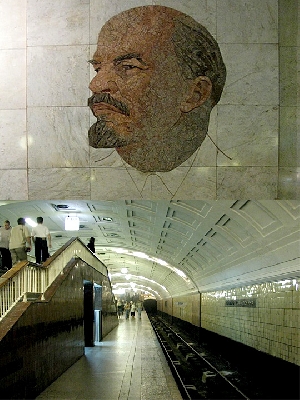
When I first got here, I was surprised for some reason to see that a lot of Soviet symbolism remains in Moscow. This is especially evident in the metro, where hammer-and-sickle emblems and portraits of Lenin still decorate many stations, which have names like “Revolution Square,” “Partisan,” and “Komsomol.”

One of many statues of good Soviet people decorating the Revolution Square station. It's supposed to be lucky to rub the dog's nose as you pass.

One of many statues of good Soviet people decorating the Revolution Square station. It’s supposed to be lucky to rub the dog’s nose as you pass.


I found this enormous statue in the Partizanskaya (partisan) station.

I found this enormous statue in the Partizanskaya (partisan) station.


One of the largest Lenin profiles I’ve seen in the metro is at the station Biblioteka Imeni Lenina, or Lenin Library. Photo from mosgid.ru.


This shouldn’t have been surprising, given that the Russian Federation is less than thirty years old, and it would be foolish and wasteful to try to remove all traces of seventy years of Soviet rule. It isn’t uncommon to find communist symbols even on government buildings. The stars on top of the Kremlin towers are a good example. Installed in 1937, the stars are of varying sizes up to 12 feet across, and are made of red glass.
The Kremlin's Spasskaya tower, with its red star on top.

The Kremlin’s Spasskaya tower, with its red star on top.


After the Soviet Union collapsed, some people wanted to remove the stars. In the end, though, it was decided that they were a great achievement of art and engineering, and so they stand there to this day.

Active from Day to Night

I haven’t played badminton since I was ten. It can be super fun to play if there is no wind, but then again, there is almost always wind, so it’s just one of those sports that always irritated me. Imagine my surprise when I saw people playing badminton in the wide spaces of the main university building and in the courtyards of the dormitories. The thing that gets me is that students play badminton for HOURS here. They laugh loudly, look embarrassed after missing the birdie, but laugh it off and serve again.

Medvedev and Putin test their skills in badminton. Putin sizes up Medvedev’s badminton capabilities, while Medvedev analyzes his racket.


And it’s not just badminton. Every night a large group of students gathers into a circle and hits a volleyball around until three in the morning. I am baffled by Russian students’ commitment to non-seriously staying active until the wee hours of the morning. Rollerblading and bike riding are also huge here, as are scooters. In fact, scooters are the vehicles of choice for getting to class. I see students carrying fold up scooters in the academic buildings on campus all the time. A week ago I even saw an adorable elderly couple, a babushka and a dedushka, slowly riding scooters together along the university streets.

Even Putin and Medvedev ride bikes!


Like everything else, leave it to Russians to make scooters look cool again after their disastrous downfall in the U.S. in the early 2000s. Now I want a scooter, too.

The Canals of St. Petersburg

As we were walking about St. Petersburg, I noticed how many canals there were across the city. It truly is difficult to walk around that city without going across a bridge at some point because of all the canals.

James floating along the Neva

James floating along the Neva


The fact that all of the canals had to be constructed, as opposed to already existing before the construction of the city, was truly baffling to me, and demonstrated one of the significant contrasts between St. Petersburg and Moscow, and “intentional city” versus a sprawling one.
 
However, there was an unintentional element about these particular canals. Peter the Great originally intended for boats to be the primary form of transport around the city, as one could notice with the special entrance in the Church of the Savior on Blood, and the Peterhof palace, which is most grand when approached by sea.
 
Unfortunately, as the city developed after his death, the canals ended up becoming a less prominent feature of the city, and most people ended up using roads on land to traverse the city. Now the canals are mostly used for boat tours, like this one!


As a result, before taking the tour I noticed the canals mostly as a passing feature, as I was mostly walking along them or above them on the hundreds of bridges that span these canals in St. Petersburg.
 
This perspective was flipped when I was on a boat tour along the canals of the city. It was cold that day, and as we passed under the many bridges that I had been walking over during my stay here, and I began to notice all of the entrances onto the street that were unused, and connected the dots.
 
This city was meant to be traversed by water. Unfortunately, that does not really happen much anymore.

Graffiti

Vinzavod (or Winzavod)
For the Night at the Museum, a world-wide event in which museums and art galleries open their doors for free, I was with Lily and Dilara at Vinzavod. The buildings of Vinzavod used to be part of a winery and some of the mechanical structures inside have been left as decoration to add an interesting atmosphere. There are even galleries in old wine cellars! Lily and Dilara covered much of what we saw, and I would like to bring attention to the graffiti. As far as graffiti goes, perhaps what is there is not anything special, but since I rarely see any graffiti at home in Northfield, all graffiti stands out to me. Sometimes graffiti is vandalism, and sometimes it is art. The graffiti at Vinzavod is part of the latter. In fact, the whole area is dedicated to Viktor Tsoi, the now deceased leader of Kino, a soviet rock band.

Some of the graffiti we saw at Vinzavod.

Some of the graffiti we saw at Vinzavod.


Bulgakov Museum
On Wednesday (May 21) the praktikantki took us on a tour of Bulgakov’s House, now a museum. Bulgakov is the author of The Master and Margarita, a book we read for class. On the way up to the floor of the museum, the walls were covered with renditions of characters from the book.
Behemoth – a cat that acts like a human.

Behemoth – a cat that acts like a human.


Another rendition of Behemoth. In the beginning of the book, Behemoth boards a trolley while standing on two feet and even holds out his payment to the cashier, but she refuses him, yelling that no cats are allowed. Behemoth decides to hang on the outside of the trolley, getting a free ride. “С котами нельзя!” “Cats are not allowed!”

Another rendition of Behemoth. In the beginning of the book, Behemoth boards a trolley while standing on two feet and even holds out his payment to the cashier, but she refuses him, yelling that no cats are allowed. Behemoth decides to hang on the outside of the trolley, getting a free ride. “С котами нельзя!” “Cats are not allowed!”


A depiction of Woland, the devil, with Behemoth’s paw prints nearby.

A depiction of Woland, the devil, with Behemoth’s paw prints nearby.


The Patriarch’s Ponds Area
On Sunday (May 11), Gretchen, Almeda and I set out to visit Patriarch’s Ponds, which is the opening setting of Bulgakov’s book. We found this interesting line drawing on our way there:
“Sorry” has been misspelled as “Sory”. Notice that another passerby made a correction, adding another “r”.

“Sorry” has been misspelled as “Sory”. Notice that another passerby made a correction, adding another “r”.


And today with Chet and Natasha, we took a look at a free library box (give a book, take a book) near on the bank of the Patriarch’s Ponds.
kaspersDSCF3258 kaspersDSCF3259

It’s the same artist! How neat is that?

The Arbat
On the Arbat, a place visited by many tourists as well as Russians, there is a wall dedicated to graffiti.

Gisell and I striking a pose in front of this awesome wall.

Gisell and I striking a pose in front of this awesome wall.


Kolomenskoye
On the boat (see Almeda’s post), we saw some noteworthy graffiti.
Looks pretty intense. It reminds me of the graffiti we saw at Vinzavod.

Looks pretty intense. It reminds me of the graffiti we saw at Vinzavod.


Petersburg
Here are a few more interesting photos:
Does this count as graffiti? No matter, as long as it’s interesting.

Does this count as graffiti? No matter, as long as it’s interesting.


And to end this post, here is our dramatic mathematician:
I wish I could be that cool.

I wish I could be that cool.