Shadow of the Gulag

One day I was in the center of the city and decided to get away from it, heading in the direction of Taganskaya Station to meet our group there.  This wandering took me circuitously through the region of Kitai-Gorod.  It was a nice walk and nice day, but due to the casual nature of the place today, I never quite grasped what lie there until looking for information (and translation) later.

The Lubyanka Building as it was originally made for an insurance company.

The Lubyanka Building as it was originally made for an insurance company.


Passing through Lubyanka Square actually brought me closer to the legendary, fearful KGB than I even would have hoped.  Meaning “Committee for State Security,” this group acted as the defence, intelligence, and secret police branch of the Soviet Union regime from 1954-1991, today broken up into other organizations such as the Inter-republican Security Service.  The Lubyanka Building had been the central headquarters of the secret since its creation as the Cheka.  For nearly a century this place would inspire fear in passers-by, doubt at whatever is foreign or dangerous, anxiety about being dragged in and imprisoned inside the building.
A simple but powerful memorial for those many victims; flowers appear like this on most memorials year round.

The Solovetsky Stone, a simple but powerful memorial for those many victims; flowers appear like this on most memorials year round.


But today the square feels like just another part of the city.  A monument 2002 monument placed on the square provided a simple reminder of past ills, a stone with a plaque honoring victims of the Gulags.  Reading about it connected a few dots in my head, for I have heard of undesirable monuments being moved, changed, or hauled away (not unlike various victims of the KGB in the past).  Many Russians today balance pride and shame in a miraculous way, bearing fond memories of the Soviet state while remembering, or perhaps trying to forget, its flaws.  Some of the statues of Soviet leaders currently standing in a tight cluster near one developing area of Muzeon Park southwest of the center have caused long conflicts, continuing even today.  The legacy of government oppression remains a dark side to the security and hope of a peaceful and safe life that the KGB was meant to provide.  2012 protestors chose this site as a place to hold an anti-Putin rally, connected his former KGB service to oppressive leadership.
The KGB Crest.

The KGB Crest.  Since I neglected to take pictures that day, pictures in this post appear courtesy WikiCommons.


I have had the chance to speak with several older Russians, all of whom remember the bitter past of Soviet enforcement: each one knew or was related to a victim of Stalin’s purges.  It is with respect to painful memories like these that many want to remove connections to their perpetrators.  This does not mean forgetting, for who can forget the loss of family or friend with no warning, that lifestyle of fear?  Instead, the goal is to remove the honor associated with monuments, to draw a contrast between those great Russians worth remembering, and those who are remembered with infamy.
Information found at the following sites, having located the place per Google Maps:
http://ru.wikipedia.org/wiki/Здание_органов_госбезопасности_на_Лубянке
http://en.wikipedia.org/wiki/KGB

Looking for Lenin

While pondering what to write this blog about, I realized that Vladimir and Suzdal have something in common, beyond being extremely old and filled with beautiful places of worship.  Both, even little Suzdal, contain monuments to Vladimir Ilych Lenin.
Before jumping to conclusions, it’s important to note that Vladimir the city was named after its founder, Vladimir Monomakh, a “Great Prince” of Kievan Rus who was also the father of Yuri Dolgoruky, the founder of Moscow.  Monomakh, who controlled both Vladimir and Suzdal in the early 12th century, fought lots of battles in this part of Russia, which lies east of Moscow.  I bring this up because Vladimir wasn’t subject to one of your standard Soviet-era place renamings.  St. Petersburg, for example, went from Sankt-Peterburg to Peterburg to Petrograd to Leningrad.  But the name Vladimir has nothing to do with Vladimir Ilych Lenin.
But Vladimir did strike me as a very Soviet town; the city was heavily industrialized in the 1920s and therefore probably had a roaring proletariat scene.

IMG_0289

Our group with Comrade Lenin.


This monument to Lenin was only a couple blocks from our hotel, and I was impressed by its size and craftsmanship. Here, Lenin looks out over apartment buildings and small shops.
In Suzdal, on the other hand, I had to laugh when I found the Lenin monument because he’s positioned on a square staring directly at a church.
vs1

A more modest-sized Lenin.


Lenin was highly critical of religion, calling it the “opium of the people.”  Suzdal, with its many beautiful places of worship, was of course subject to the Soviet anti-religious movements of the 1920s and 30s.  Over a dozen of its churches were destroyed, but thankfully others were merely converted to other functions.  Suzdal’s main street is still named after Lenin, but the Spirit is back, and it’s perfectly legal.
And like with the Mausoleum, I wonder what will become of all these Lenin monuments scattered across Russia.  Any city worth its salt has a Lenin statue, but what purpose are they currently serving?  If any of them are looking to unload a small statue, Almeda and I have a sweet Parish double next year…
Sources:
http://en.wikipedia.org/wiki/Vladimir_II_Monomakh

Catherine Palace, II

Author’s note: Dilara has already written an excellent blog about this palace, but I’ll focus on some other aspects of the residence.
My impressions of the Catherine Palace in Pushkin (formerly known as Tsarskoe Selo) could be summed up in one word: GOLD!!  After our weekends in Suzdal and then St. Petersburg, I became convinced that all the gold in the world is actually housed in Russian museums, palaces, and churches, but I digress.  The Catherine Palace not only has a rich, interesting history, but is also incredibly beautiful.
p1
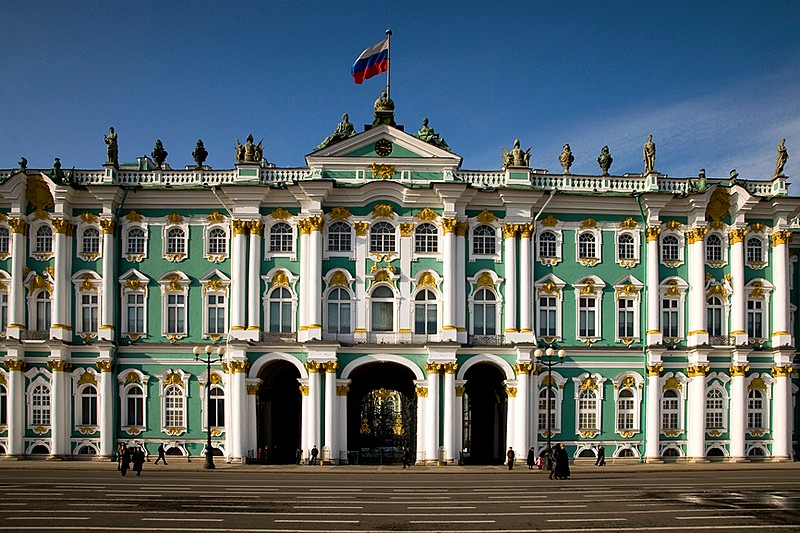
The palace is built in the Northern Baroque style.  As I understand it, Northern Baroque is distinguished from other Baroque styles by its prominent turquoise and light blue color scheme, which is usually offset with white columns and gold or brown accents.  The Hermitage Museum / Winter Palace is another famous example of Northern Baroque.

The Winter Palace in St. Petersburg, photo from http://www.saint-petersburg.com/images/virtual-tour/hermitage3.jpg.


Both the Catherine and Winter Palaces were built by the famous Italian architect Rastrelli.  To say Rastrelli left his mark on St. Petersburg would be an understatement.  Almeda and I had a game in Petersburg: whenever we found a building we thought might be a Rastrelli [that is, topped with numerous unnecessary statues on the roof or featuring a Northern Baroque color palette], we’d find out for sure, shout “RASTRELLI!” and then tap the other on the shoulder.  It was our version of “Slug Bug.”
Catherine, for whom the palace is actually named, came to find the place gaudy, instead preferring clean Neoclassicism.  The Empress Elizabeth was the real mastermind of the project, and before her death, she had even made plans with Rastrelli to up the decoration even more.  Though the facade is lovely now, all of the brown accents were actually plated gold, and it was probably quite a sight back in the day.
p3
The most interesting thing about the Catherine Palace, in my opinion, is that it was taken over by Nazis during World War II and thoroughly ransacked.

The German Army was not kind to the lavish building. Photo from tsarselo.ru.


Photo from tzar.ru.


Being there today and not being aware of that story, you’d never guess that all that was left of the Catherine Palace was some rough foundation and sections of missing roof and smoldering ruins.  The polished parquet floors and gold gilding on the walls shine impeccably, and almost all of the rooms are in order.  A painstaking restoration continues to this day, room by room.
p2

The Grand Ballroom has been restored fully.


A treasure from the original palace was the “Amber Room”, with its walls, decorated with designs made from different shades of amber in mosaic style.  Incredibly, the team in charge of restoration had only a few black-and-white photographs and a watercolor painting of the room to base their new design off of.

The whole room is made of shining, liquid gold amber. Photo from http://www.guide-guru.com/files/File/amber_room_3(1).jpg.


While in the palace, I was pondering the idea of “authenticity.”  In recreating the Amber Room, the artists stuck to the same, traditional methods as the original.  But the fact remains that the walls are all different, all new.  Much of the palace is new, but that doesn’t really detract from the experience of it.  And if you leave something “original”, even with good, minimal upkeep, it will decay.  So my question: should we be striving for preservation or restoration?  In this case, restoration was the only option, but it’s interesting food for thought when visiting other historical landmarks in Russia and across the world.
Sources:
http://en.wikipedia.org/wiki/Catherine_Palace
Information given by our excellent tour guide, Valerii.

Massolit

Yesterday, on our last full day in Moscow, Taya, Almeda, and I spent the afternoon looking around more of the places mentioned in Mikhail Bulgakov’s The Master and Margarita.  I’m a big fan of the book, so I have no qualms writing another Bulgakov blog.

My travel companions.

My travel companions on the staircase in Griboedov’s.


We found the Griboedov House (named after a famous writer, whose name unrelatedly translates to “mushroom eater”), home of Massolit, on Tverskoi Boulevard, which is split by a lovely strip of parks and greenery.

Looking into the complex’s courtyard. Photo from http://www.masterandmargarita.eu/en/04mappen/gribojedov.html.


In the book, Griboedov’s was this really cool dining hall with live jazz bands and a generally hopping atmosphere.  On the second floor of Griboedov’s were the rooms and offices of Massolit, a fictional writer’s union which the late Berlioz was head of.  Several other unfortunate characters work for Massolit, and two of Woland’s henchmen pay Griboedov’s a visit at the end of the novel.
The building, sometimes known as the Herzen House due to its being the birthplace of Russian writer Alexander Herzen, is now home to the Gor’kii Literary Institute, a place for aspiring writers to study and hone their craft.
mm1
It was really hot yesterday; we stuck to the shade as much as possible.  A fence and gates blocked us off from the courtyard on the side facing the boulevard, but we made the long, hot trek around the block to go inside.
mm2
The hallways were pretty narrow and dark, and honestly fit the book’s first description of Massolit pretty well.  I could imagine luxurious offices behind all the doors.  Now though, as one would expect, you’ll find classrooms here.
mm3
It’s always a pleasure to go inside some of the random buildings you encounter across Moscow.  They’re usually not what you’d expect, but incredibly interesting.
 
Further reading/sources:
http://www.masterandmargarita.eu/en/04mappen/gribojedov.html

What's that eerie sound?

While our group was wandering about the Musical Museum in Moscow,  we heard an eerie sound….
 
It turns out that the sound was coming from a theremin. There was a man playing it, and it was particularly strange because there was absolutely no contact between him and the instrument. It was surreal. Naturally, I had to know how it worked.

The thereminist and a child attempting to play the theremin.

A child attempting to play the theremin. 


Originally created by the Russian inventor Ле́в Серге́евич Терме́н (Léon Theremin), the theremin uses two antennas to sense the proximity of the player’s hands, which then controls oscillators for frequency and volume. All one needs to do is move his/her right hand relative to the right antenna to change pitch, and move his/her left hand relative to the left antenna to change the volume.
 
Near the beginning of the 20th century, Russian researchers were attempting to create proximity sensors. This eventually led to Theremin’s patent of the instrument itself in 1928. Often, the instrument has been used in soundtracks for horror films, leading to its association with an eerie sound.
 
Here’s an example of how it is played, courtesy of Léon Theremin himself:
 

Shivering in Anticipation of the Winter Palace

It was incredible (although initially underwhelming) to first behold the grand Winter Palace: it was the legendary place so frequently put forward by old friends as a dream, the most beautiful place in the world.  It appeared again in high school when learning of the last days of the Tsar’s family, mentioned as the opulent seat of Romanov power.  And perhaps my expectations were too high, at least for the facade.

The facade itself is very wide and entirely identical.  My first impression was not 'wow!' but whimsical.

The facade itself is very wide and entirely identical. My first impression was not ‘wow!’ but whimsical.


At only three stories, it appeared shorter than most buildings in Petersburg, and the entire front showed the same repeated patterns of Baroque style and mint-toothpaste-colored paint.  I was hoping that it would just be the clouds that prevented the true color and gilding from standing out, and waited until we got inside to see the Hermitage.
The courtyard began to change my mind, but I was still not really convinced that this was a grand palace, the place from which a powerful family could hold sway over the broad expanse of Russian domain and snatch a place among the great rulers of Europe.
add text

It still all looks the same!  But one does begin to get the impression, “This is a big building.”


That impression did not arrive until we actually entered the museum and arrived at the Jordan Staircase.  The mere amount of gold was impressive, but what caught me was the magnificent effect of the space: the extensive gilded woodwork all hand-carved, the enormous mirrors making the stair swallow its guests, the massive ceiling mural, and solid marble columns that provided a stern and impressive backdrop.
Wow!

Wow!


It caught my breath in a way that made me realize it is not just a figure of speech.  For the next few hours, passing from hall to hall of carefully carved wood floors, elaborate gilding, soaring ceilings, tall windows and mirrors, semi-precious vases, and stunning pieces of art, I simply could not regain my breath.  It was far too much to believe that anyone could own such a place!  Truly this could be the center of an empire, where the mightiest and wealthiest rulers could rule.  The extravagant throne room only proved that this is the very seat of the empire!
If only I could have gone up to the throne!

If only I could have gone up to the throne!

Tall (brick) Tales

The Moscow Kremlin boasts nineteen towers of matching bright red brick, and each one of them has a name (except for two) and a story.  From my first trip around Red Square and the Kremlin, I picked out a few of these towers and shall share some of that history.

Spasskaya Tower and its magnificent clock, once the main entrance to the Kremlin.

Spasskaya Tower and its magnificent clock, once the main entrance to the Kremlin.


The most striking tower on Red Square is Spasskaya Tower, or ‘the Savior’s’ tower, dating back to 1491.  The name comes from a sacred icon called “The Savior Not Made by Hands,” which once hung over the main entrance of the Kremlin.  The icon was so widely revered that even the old tsars would remove their hats or dismount when passing under this gate.  Where all kinds of people once stood on even ground, all people now move by the same time: the Spasskaya became the clock with legendary chimes that sets Moscow standard time for the whole country.  This most famous tower of the Kremlin helps cast the setting of Red Square.
The "water-drawing" tower, although that apparatus is not extant.

The “water-drawing” tower, although that apparatus is not extant.


Vodovzvodnaya (yes, hard to say, isn’t it?) Tower appeared a little earlier in 1488 at the corner of the Kremlin, just outside today’s Red Square.  It stands next to the Moskva River and its name indicates “water-lifting.”  A machine for drawing water was installed in 1633 in order to keep the Kremlin supplied with water without needing to expose anyone outside the walls, a splendid defense mechanism for potential sieges.
Annunciation Tower, with the Bell Tower of Ivan the Great rising in the background.

Annunciation Tower, with the Bell Tower of Ivan the Great rising in the background.


The nearby Blagoveschenskaya Tower is special for having a varied past.  Half a century after its completion in 1488, the tower was made into the Kremlin’s prison.  But the prison was closed and a church constructed there, prompting its name, meaning “annunciation.”  This title evokes a higher calling in honor of the Church of Annunciation and its famed icon of the event.  The church, therefore, would have been but one of many inside the Kremlin, but something special for being in the wall!
Sadly, there’s no space to write about all of the towers, but they are definitely a defining feature of the city!
Information mostly learned in classes at Carleton, supplemented or checked at:
http://en.wikipedia.org/wiki/List_of_Moscow_Kremlin_towers

Buskers and Underpasses: The Music of Moscow

Virtually everywhere I’ve been in Russia there are likely to be a few street performers. Whether they’re playing the violin along the streets of Suzdal, a flute next to Catherine’s Palace in St. Petersburg, or a trumpet in a subway car, I’ve seen it all.
 
Naturally, one wonders if this sort of activity is discouraged as it is in many cities in the United States. As it turns out, there is even an association that many of these people belong to: the Moscow Union of Independent Artists. If one of the street performers is hassled, or even has to appear in court, the Union will be there to help them with any legal trouble that they may face.
 
As a result, one can see quite a few street players unabashedly playing their music for the world, and here’s a fantastic example of a violinist and a cellist doing just that in an underground street crossing:
 

The Russian National Anthem

banner_2004
A national anthem is more than just a song; it is a reflection of the ideas, history, and stories that a country considers significant. The Russian National Anthem has undergone many different iterations. Some of these we were familiar with due to our coursework at Carleton. However, the story of the Russian national anthem dates back to the early days of Kievan Rus’ and travels forward in time to present day. We learned all about the national anthem at the Glinka Museum of Musical Culture during Moscow’s Night at the Museum event. The exhibit was very well done. The majority of content was presented using video screens and audio technology because, after all, it is difficult to present music visually.

IMG_0004 t1a

An interior view of the exhibit. Photo courtesy of the Glinka museum: http://glinka.museum/news/index.php?news=22457


As visitors, we were taken on a journey through time and sound. What I enjoyed most about the exhibit was its ability to pack quite a bit of history into short segments. However, I also really liked the museum’s approach to exploring not just the history of the Russian National Anthem, but the idea of a national anthem in general. The museum linked the idea of an anthem to other patriotic symbols, such as a crest or a flag. To me, this is an apt description. When people sing a national anthem, they are doing more than just singing words on a page. There is a reason that people become emotional when signing their national anthem. It is a patriotic act (or at least it can be).
We were all caught off guard when we heard the stirring tune that Americans identify as “My Country ‘Tis of Thee,” Brits call “God Save the Queen,” and apparently was the tune of Russia’s anthem “Боже, Царя храни” (God Save the Tsar) until a different melody was employed in 1833. Instead of “let freedom ring” or “God save the Queen” this version of the song ends with (aptly) “God save the tsar.” To hear the tune, click below:

IMG_0046
A view of the outside of the museum. Photo courtesy of Glinka Museum (http://glinka.museum/news/index.php?news=22457)

At the end of the exhibit, all the viewers were invited onto a stage to be filmed while singing the anthem as part of a national project to create a virtual choir. I am not sure if we were supposed to be part of this choir or not (as foreigners). The Russian National Anthem is no easier to sing than the United States’ Anthem and I found myself jumping octaves between the verses and the refrain. Nonetheless, I am hopeful that our contribution to the choir will not be detrimental to the overall effect.


Water Quality

Everybody that I’ve met so far in Moscow and in St. Petersburg drinks bottled water instead of water from the tap. The bottles we get are in increments of liters:  I have nearly gone through four 5-liter bottles during my stay here. Ashan (they sell everying from nylons to kulich Easter bread) is the cheapest place to buy water, but it’s a bit of a hike, especially while carrying a large jug of water. Solution? If you don’t mind spending a few rubles more, the mini-marts in the Glavnoe Zdanie is much closer.

Somehow, I’ve managed to buy four different brands.

Somehow, I’ve managed to buy four different brands.


In Russian 150, I wrote a research paper about the drinking water quality of St. Petersburg but I only found one source that had been updated within the past five years. There have been water quality checks from outside sources, finding subpar results. Since then, Vodokanal (the company in charge of providing sanitized water to the city’s people) has implemented new technology and opened new water treatment plants. They assure that the water is safe to drink, but the population tends to buy bottled water despite this, perhaps out of habit.
In my paper, I did not research Moscow’s water quality, but the situation seems similar to that of St. Petersburg. At the dorms, we are told that even if the water tastes fine and we don’t get sick, there may be heavy metals (carcinogens) from the pipes webbing through the our homely monolith. We have chainiks (electric tea kettles) to boil water, but heavy metals don’t boil away.
It is impossible to know the water quality situation exactly – recent English sources are lacking and in St. Petersburg, Vodokanal does not make all of its statistics publicly available. Perhaps the water in both cities is drinkable and there are pipes (privately owned) that unintentionally add contaminants. We do as the Russians do; we drink bottled water. It is simply a safety precaution.