Delicious Fish

While I have eaten many delicious meals in Moscow, one of the best parts of my culinary experiences thus far has definitely been the fish we ate on Lake Baikal. Baikal is famous for its fish. The jelly-like golomyanka, who live in the depths of lake, are endemic to Lake Baikal and do not live anywhere else in the world. Up to thirty five percent of their body mass is made up of fatty oil. The fish can endure extreme pressure changes and are found at all depths of the lake. However, since they do not travel in packs, they are extremely difficult to catch. Thus, I did not have the opportunity to taste any golomyanka, which is not a huge problem as we were told that they are extremely difficult to prepare and must be done so properly to avoid health risks.

The golomyanka. Source: club-kayak.ru

The golomyanka. Source: club-mayak.ru


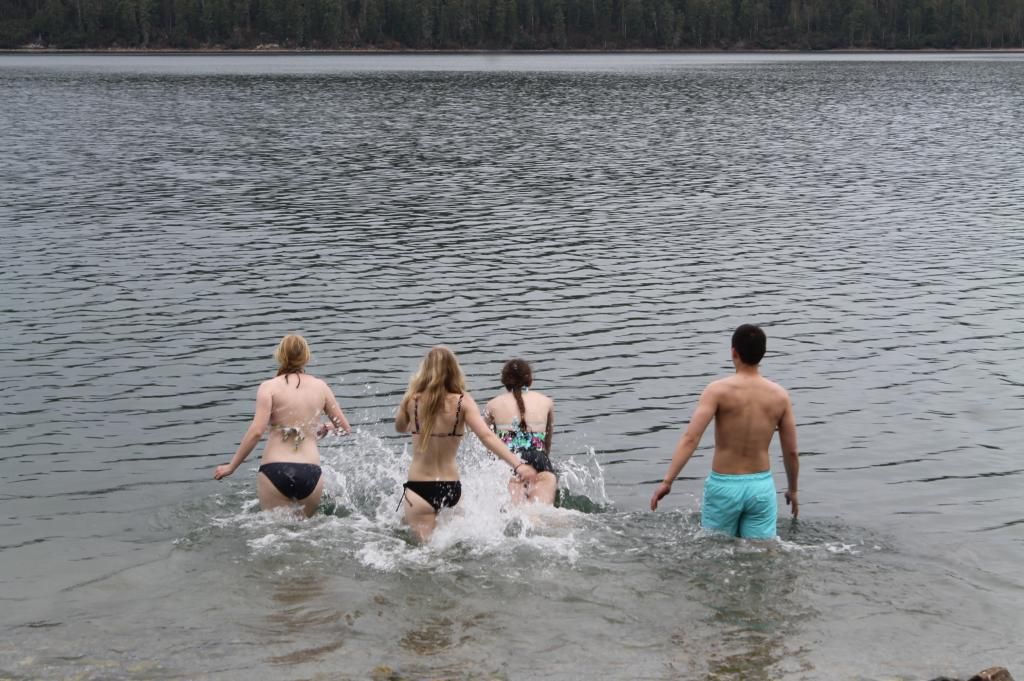
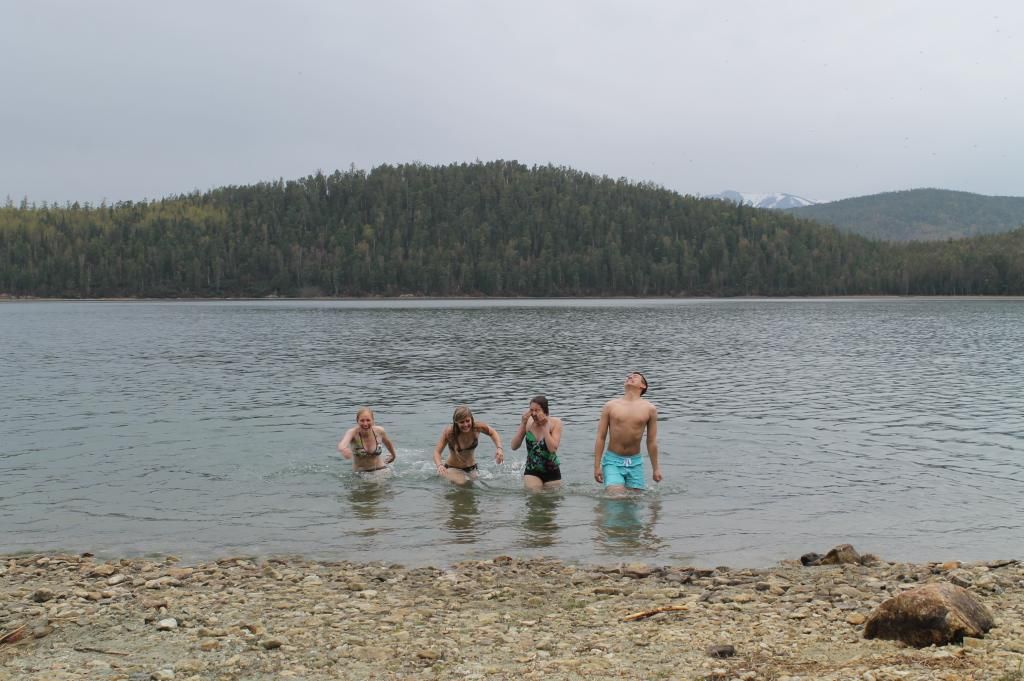
I did have the opportunity to try the delicious omul, a succulent variety of fish known for its tenderness. We had omul after a delightfully freezing dip into Lake Baikal followed by the warmth of a natural hot spring. It was truly one of most delicious meals I have had the pleasure of eating. We starting with уха (uha), a fish soup made by boiling whole fish with potatoes and onions. Our version was prepared over an open fire by our wonderful guide Evgeni Dmitrievich. We also had roasted omul, prepared by splitting open the fish, gutting them, and placing them on sticks around the fire. Evgeni Dmitrievich told us this fish was to serve as dessert. While at first I was skeptical, the delicious flavor of the fish truly was sweet. Fresh bread roasted to make toast over the open flames was the final touch to an extremely wonderful meal.
I have never even considered myself much of a fan of fish; however, the fish of Baikal will long remain in my memory as a delicious part of Russia’s culinary offerings.
Source: http://baikal.irkutsk.org/animals.htm

Faith in Practice

Lake Baikal is considered to be one of the most sacred places in the world to the Buryat people and to many Russians as well. We explored some of these places during our two week visit to Siberia. On Olkhon Island, located nearly in the middle of Lake Baikal, our hotel was next to the sacred Cape of Burhan. On a hill outcrop overlooking the cape is a row of wooden poles decorated with bright pieces of silk or cotton. These poles, known as сэргэ (sergei) in Russian after the Buryat word, are signs that there is a хозяйн or spirit-host located at a particular site. A faded sign located directly in front of the poles informs visitors who are patient enough to make out its message that trespassing on the site is strictly forbidden. Clearly most people had not read the sign because many people were walking around the sacred poles and taking pictures. This experience caused me to begin thinking about the problems associated with visiting religious sites when one is a tourist, particularly when one is of a different faith than the sites one is visiting.
The first time I encountered this issue was back in Moscow when we started visiting Russian Orthodox churches. While I have attended many church services back in the United States, going to church in Russia is a completely different experience. From the decorations to the method of worship to the smells of the incense, the churches in Russia are far from the stark stained glass windows of the church I attended growing up. I am never sure how to act at these churches. I wish to be both respectful (in showing that I understand the traditions, such as covering my head) without overstepping the boundary of being overly involved in a religious practice that is not my own.

The sergei (sacred poles). Photo credit: tripadvisor.ru

The sergei at the Cape of Burhan (sacred poles). Photo credit: tripadvisor.ru


The issue of faith in practice came up again on our tour of Olkhon Island. Our tour guide, who practices Shamanism, was very distressed at the appearance of rock cairns at many of the sacred sites on the island. These rock cairns are built over time by people adding one rock when they visit a site to slowly build a pyramid. When we first saw the pyramids, I thought they were a pretty addition to the landscape. However, our tour guide started knocking the cairns over, clearly distraught at their appearance at some of the most sacred sites. She explained to us that these pyramids are not part of Shaman tradition and that to those who practice Shamanism, every rock has its own unique spot on the earth and to move it is to perform a sacrilegious act. While to us it is perfectly natural to bend down and pick up a rock, to our tour guide this act was highly offensive. I can understand her frustration; however, I also understand the motives of tourists who helped build these pyramids. Most likely, they did not understand the traditions and felt motivated to participate in what they thought was part of the traditional way of worshipping at these sites.
The ways of showing respect vary from place to place. However, I believe that sacred sites are sacred for all, regardless of religious affiliation. Everyone can experience a holy site; it is the role of a tourist to do a little research to understand how to experience the holy (or whatever one would like to call it) in a respectful way.

Who Are the Evenki, Anyway?

Our course readings and tours in Buryatia occasionally mentioned an ethnic groups of ‘Evenks’ or Evenki.  It felt as though they appeared for contrast, a group of people against whose backdrop others gained more definition.  I only understood a little at this section of the Ulan-Ude Ethnographic Museum, and looked into closer research.
The Evenki are best known as a race of Northeast Asia who lived by their reindeer herds.  They lived nomadically, moving with the herds as they looked for food or reared calves.  They lived off the land, hunting, fishing, or gathering food, although they did not eat their reindeer.  They provided milk and transportation to the Evenki, who cared for them and kept them safe (Vasilevich 620-4).

A birch-bark home, such as the Evenki might have used.

A birch-bark home, such as the Evenki might have used, found at the Ethnographic Museum.


The Evenki made teepee-like dwellings of a variety of natural materials, such as bark or hides.  They were very conscientious about what they consumed and would keep and move the same dwelling as long as they could.  Their culture greatly valued the lives of animals and they never killed without honoring the sacrificed life.  With respect to the slain animal, they would eat the meat, save the hide, and use the sinews or bones for other tools.  The value of these creatures appeared in wooden constructions that had religious importance for their shamans.  They also used tree bark for natural cures or medicine (Reid 49).
This is a carving of a moose!  There were three moose grouped together, three being a powerful number. Shamans believe in three worlds, high, middle, and low, just like the Buryat tradition of three flames for times past, present, and future.

This is a carving of a moose! There were three moose grouped together, three being a powerful number. Shamans believe in three worlds, high, middle, and low, just like the Buryat tradition of three flames for times past, present, and future.


There are not many Evenki left today: the 2002 Russian census identified less than 36,000, with about 4,000 of whom were living in the area around Lake Baikal, although ethnographer Reid reported only half that number around the same time (36).  Russian expansion into Siberia contributed to this decline, for small pox devastated the population in the 17th Century (Reid 48).  Fur taxes and Cossack raiding, rampant through all of Siberia during its colonization, might also have been rough on a people perceived as ‘meek and mild,’ ‘more hospitable,’ or just ‘simple-minded’ (Reid 176, 124).  Cited as being unfamiliar with the October Revolution and subsequently persecuted under Stalin (Reid 160, 166), perhaps it is not too surprising that this shrinking group became somewhat overlooked.
Reid, Anna.  The Shaman’s Coat.  Weidenfeld and Nicholson, London: 2002.  Print.
Vasilevich, G. M., and A. V. Smolyak.  “Evenki.”  The Peoples of Siberia.  Ed. Stephen Dunn.  Trans. Scripta Technica, Inc. Chicago: The University of Chicago, 1964. 620-54.  Found per online text.

The Most Beautiful Place in the World

OLYMPUS DIGITAL CAMERA
Barguzin Valley has got to be the most beautiful place that I have ever seen. Snow-capped mountains stand in every direction, and take on a wonderful blue hue from a distance. The rivers and streams that run and bubble through are incredibly clean, clear, and cold, the way Siberian water should be.
There’s something that’s just perfect about it – the way the sun makes the water shimmer, the indescribable green of the trees and bushes. Even a dilapidated bridge is lovely here.

OLYMPUS DIGITAL CAMERA

Bridge over the Ina River


There’s also something ancient about it – the rocks scattered across the steppe, the unforgiving winds. As we rattled along on a dirt road through the valley chewing on serra gum*, I imagined the Mongols and Evenks who lived here a long time ago.  The name of the valley comes from the word “Bargut,” which means “wilderness,” and was the name of the Mongolian tribe that lived here. It’s said that Genghis Khan’s mother was born in Barguzin Valley. Today, 30,000 people live in this spectacular place.
OLYMPUS DIGITAL CAMERA         OLYMPUS DIGITAL CAMERA
*a natural gum made from the resin of Siberian larch trees. And yes, it does taste like chewing on a tree (in a good way).

Three Faiths

For a while, I couldn’t understand how someone could practice three different religions and somehow be okay with it. After having spent only two weeks in Siberia, I still do not quite understand how the Buryat are so accepting, but I guess I’ll try to explain to you what I took from my experience.

The Ivolginsky Datsan near Ulan Ude. Photo Credit: Gisell Calderon

The Ivolginsky Datsan near Ulan Ude.
Photo Credit: Gisell Calderon


It appears to me that over the course of many years pre-dating the arrival of Christianity in Siberia, the native population was able to integrate Shamanism and Buddhism, and you can see how well these two religions have managed to work together. On our last day in Ulan-Ude, we saw a Shaman priest practicing and helping a family at a Buddhist holy site. In fact, Shamans such as Valentin Vladimirovich, who we had the pleasure of getting to know on Ol’khon, see Shamanism as a universal and accessible religion by all since it only requires your respect and dedication to your ancestors and nature. They find that Shaman ideals and beliefs do not actually require anything that is contradictory to other world religions.
Another datsan near Ulan-Ude, more recently built.  Photo Credit: Gisell Calderon

Another datsan near Ulan-Ude, more recently built.
Photo Credit: Gisell Calderon


What was difficult for me to initially understand is the Buryat ability to integrate Buddhism/Shamanism with Russian Orthodoxy. I learned on this trip that Buddhism is a monotheistic religion: there is one main god with smaller gods. I thought that Buddhist belief could translate to how Christianity sees God and His angels. I think the Buryat see it as practicing the same religious ideals, but calling it different names.

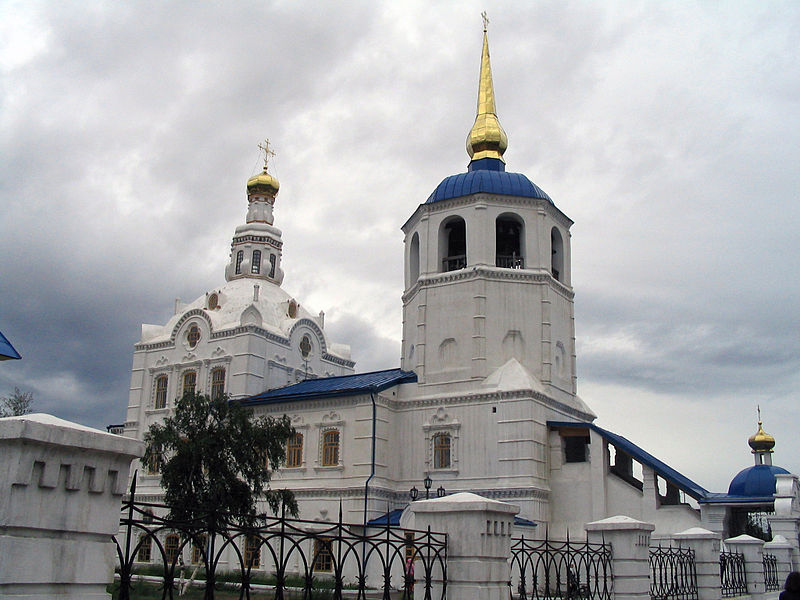
Odigitrievsky Cathedral in Ulan-Ude


For me, that weirdly makes sense, and I kind of understand how the people of Buryatia do not have a problem with being baptized and praying at datsans. I find it to be wholesome and highly tolerant. I think that the world has much to learn from the Buryat. Siberia is a place where traditional religions of the east and west can merge and coexist in unity. And that is rare.

Those Magnificent Men and their Driving Machines

We have already had several blogs dedicated to our means of transportation along the course of this trip. While in Russia we have traveled by jet, three types of boats, at least three types of trains, buses, trams, cars and vans of assorted sizes, but none of them have been quite as exciting as the UAZ (УАЗ).

UAZ

The incredibly reliable UAZ garnered the nicknames Буханка (loaf) and Таблетка (pill) due to its appearance.


The UAZ is a cross between the Volkswagen hippy van and a mountain goat. Production began in 1965 at the Ulyanov Automobile Factory (Ульяновский Автомобильный Завод), from which the vehicle draws its name, and has continued with slight modification to today. These are the vehicles found within the pages of National Geographic crawling up the mountain roads in Tibet. The UAZ is not simply a bus or a van. As a matter of fact, I was zealously corrected when I said we would be traveling by bus, and now I know why. These things cannot be stopped. They barreled 1 down roads that looked more like stormy seascapes than a dirt trail and would undauntingly charge up and down hills like intrepid little beetles.
Shore UAZ

An UAZ I found along the shore of Lake Baikal.


But it’s too easy to focus on the machine aspect of the UAZ and to ignore its human contents. The drivers of these vehicles deserve just as much attention and admiration as the engineers who designed and built the UAZ to drive through the apocalypse. My driver was a short man whose sober behavior seemed to contrast greatly with his argumentative eyes and hands that were covered in tough, suntanned skin punctuated by a series of long regular scars. Vladimir seemed to embody a combination of the stereotypes of the cunning Russian and the Russian who could kill a bear with his bare hands. Throughout the course of the six hour excursion, I heard him say three words: “здравствуйте/hello”, спасибо/thanks”, “пожалуйста/you’re welcome” with emotions ranging from quiet tenderness to quiet dismissiveness.
фото

There is a saying that in Russia there are no roads, only directions.


Regardless of whatever his backstory may be, Vladimir, like almost everyone else we have met in Siberia is an expert in his field. His lightning eye registered every change in the road, and his hands instantly directed the UAZ towards the path of least resistance. Sometimes this involved forgoing the road altogether. He was one with the vehicle, changing gears and adjusting the choke without the slightest betrayal of thought and coaxing the UAZ up extreme inclines that would have sent a less experienced driver tumbling down sideways along his unhappy cargo. Both the machine and the operator are in their element in this rugged landscape with patchy roads. But who needs roads when you have directions, a vehicle that can go anywhere, and the willpower of a hardened Siberian behind the wheel.
  1. I don’t actually know how fast we were going. The speedometer was going in laps that could match the rotational velocity of our wheels. (See video below)

Watery Gods and a Sacred Rock

OLYMPUS DIGITAL CAMERA
Father Baikal is a mighty sea. A long time ago, he was happy, and so were all of his 336 river-children – all except the beautiful Angara, who Baikal loved the most. He wanted her to marry the calm Irkut, but she wanted nothing to do with him. She had fallen in love with a strong and swift warrior river named Yenesei. One night, while Baikal was fast asleep, Angara ran away to be with her lover. Baikal awoke and became angry, stormy and rough. He broke off a chunk of mountain in a rage, and hurled it at Angara to block her path. Angara flowed into the arms of Yenesei, and Shaman Rock landed in her waters.
That’s how the legend goes. Or at least my version – like a good mythical tale it has its variations. The other day, we were able to look at Shaman Rock from the bank of the Angara River outside of Irkutsk. Shaman Rock is one of many sacred places on and around Lake Baikal, and has traditionally served as a place to make offerings to the Lake. Hearing the story of daughter Angara got me thinking about river-gods or spirits. In Buryatian legends, lakes and rivers are gods with human-like personalities and desires. It reminds me of the warring rivers of Homer’s Iliad, and of a monument that we had seen in St. Petersburg. At the base of the Rostral Columns sit Russia’s four major rivers – the Volga, the Dnieper, the Volkhov, and the Neva – in human form.
OLYMPUS DIGITAL CAMERA
It’s interesting to think of a body of water as one living organism – it breathes in and out and it moves, and it’s easy to imagine the ice-cold and beautifully clean  Baikal watershed as supernatural.
OLYMPUS DIGITAL CAMERA
 
Screen Shot 2014-06-06 at 7.37.28 AM
In my dreams of river-gods and Old Father Baikal, everything is on a gargantuan scale, so seeing Shaman Rock in person was strange. I squinted out onto the water, wondering where it was. Could that really be it? That little thing? It turns out that during the 1950s, new hydroelectric dams raised the water level and submerged most of the rock (Thomson, 171).
Thomson, Peter. “Sacred Sea: A Journey to Lake Baikal.” Oxford: Oxford University Press, 2007. 

Bad Roads are Good for Baikal

Tour guide Andrei Suknev, quoted in Peter Thomson’s book Sacred Sea, utters the above noble truth about the roads around Lake Baikal.  During his travels around the lake, Peter Thomson encountered the same kind of bone-rattling trails that we traversed a week ago at Ust-Barguzin. To our dismay, it turns out that the infrastructure is largely the same around all of Baikal.

IMG_8150

The roads aren’t THAT bad.

Yesterday, we took a whirlwind tour of the sacred sites on Olkhon, the largest island in Baikal. Before hopping in the bus, we popped a motion-sickness pill, somewhat standard procedure on these awful roads. Little did we know they would be worse than we could have ever imagined.

We climbed into two ice-cream-bar-shaped army buses, which sped, lurching, dipping, and weaving, across a system of dirt trails that cut through the forest and criss-crossed the hilly grasslands.

IMG_7883

The original Russian roller coaster


I say trails because they’re really not roads, just places where past tires, hooves, and feet have tread. Clearly, our driver was top-notch. He was driving a stick shift across extremely difficult terrain. The tall hills that offer gorgeous panoramas of Olkhon also demand the most out of vehicles on the climb up; thankfully coasting down the other side is both easy and extremely fun. We lovingly referred to our trek as the Russian roller coaster, which you can get a taste of below!

Jokes aside, it’s actually a very good thing that asphalt hasn’t reached most of the island, as well as Lake Baikal as a whole. Although the lake is massive, the ecosystem of Baikal is delicate. Scientists aren’t sure how much waste and pollution its waters can take on before environmental disaster. Tourism is increasing in the area, and it presents a new set of issues: are tourists’ contribution to the local economy justifiable when considering the waste they inadvertently generate? This is the dilemma facing tour guides like Andrei and conscientious visitors like ourselves. If the roads were improved, there would be thousands more tourists crowding the lonely cliffs of Olkhon. Although the washboard gravel is hard on passengers, it actually protects the shores of the great lake from an inundation of development and industry. And for that, we will endure the headaches and motion sickness without hesitation.

I saw a baby ocean!

The lake is literally moving, and no, I’m not misusing the word “literally”. Back home, one of my most cherished friends in college is currently a geology major, and I never quite understood his interests in “rock” and “earth” until I visited the Baikal Museum (formerly known as the Limnological Museum) in Listvyanka near Irkutsk the other day.
When we arrived to the Baikal Museum, we were greeted by the extremely knowledgable Tatyana Serafimovna, who gave us one of the most eloquent and informative tours I’ve had in Russia in perfect British English. After days of heavy travel, no one in the group was really in the mood for a tour of a museum, but with Tatyana’s help, I actually had a wonderful time. Tatyana Serafimovna had actually not worked in the museum in the past three years, but still managed to remember every single detail about every exhibit. As a result of her vast amounts of knowledge, I loved the museum, especially the very first exhibit.
The first exhibit, dedicated to the geology of Baikal, describes the formation of Siberia and its famous lake throughout millions of years of Earth’s geological formation.

A cool internet picture of the coast of Lake Baikal.


A couple of things that I didn’t know:
  1. A part of Siberia used to be its own continent, called (you guessed it!) Siberia, a couple hundred million years ago. The old continent was hit by the moving Indian subcontinent (the same one that created the Himalaya Mountains), which eventually led to a small crack in the ground to form and fill up with water. Back then it was a little pond. Over the years, the crack opened up more and more, and the lake gained its astonishing depth: 1642 m.
  2. Even today the lake is being pulled apart by the plates it is situated on, called the Baikal Rift Zone. In fact, it moves on average about 1 cm a year. In the book we are reading for class, the author, Peter Thompson, notes that some scientists think of Baikal as a baby ocean.

    Geographical map of the plates surrounding Baikal.

  3. Unsurprisingly, there is a lot of seismic activity in the area, most of which go unnoticed by the local population. In the museum, we saw a computer monitor displaying and recording the seismic activity of the region through seismographs located in the cellars of the museum. The monitor showed constant tiny movements on all three planes (north/south, east/west, and vertical).

The museum pretty much blew my mind. Who would have guessed that a little pond would one day became the world’s largest container of freshwater and maybe in the future a massive ocean?
 
Here is some extra information online:

The Cleanest Water in the World

There’s something magical about water, I think, and I’ve been fascinated by it all my life. On family trips to Lake Michigan, I was always the first one in the water and the last one out; baths were always a momentous occasion for me; and I still love going to the car wash, putting the car in neutral, and sitting back to watch the water spray over all the windows.
I’m not the only one fascinated with this mysterious force. Images of water occur over and over again in literature, representing birth and death, peace and violence, and an unchanging, sustaining, yet destructive force. It is also essential to mankind’s existence, used not only for cleaning, transportation, and manufacturing, but also (most importantly) for drinking. However, although 70% of the Earth is covered in this life-giving substance, only 3% of it is drinkable. 77% of that is frozen, and one can only imagine the effects pollution has on these numbers. There is one region in the world, however, that has held its own against these statistics.

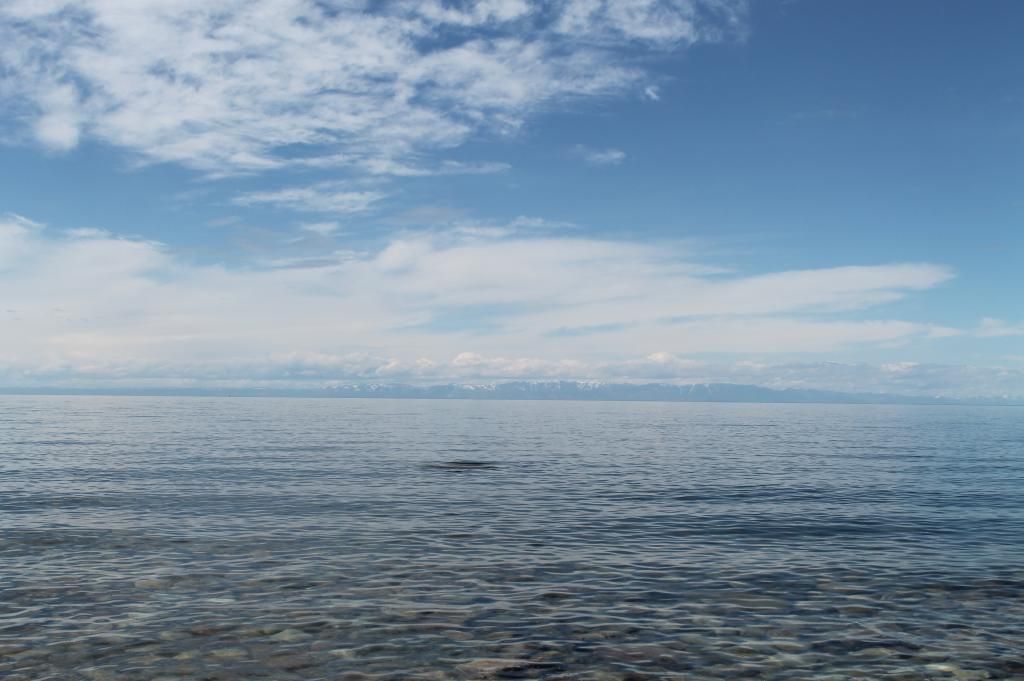
Lake Baikal is located in the southern region of Siberia, between Irkutsk and the Buryat Republic. It is the deepest lake on Earth, as well as one of the most ancient, estimated to be around 25-30 million years years old. It’s most remarkable characteristic, however, is its cleanliness. You can drink this pure water straight from the lake. This is due to a unique group of organisms, Epischura baicalensis. Belonging to the zooplankton species, these tiny animals are responsible for keeping the lake clean of impurities and are unique to Baikal—they cannot survive in any other body of water. Thousands of species inhabit this lake, most of them endemic. This includes our class favorite, the nerpa seal.
It is clear that this body of water is sacred to local inhabitants. One of our guides, Evgeny Dmitrievich, told us that most of them don’t carry bottles of water, finding no problem in drinking straight from one of the many streams that run from the lake. Another guide from the Baikal Museum proudly boasted that the people who inhabit the Baikal region live longer, healthier lives.
Because the lake is so life-giving, many myths and legends exist. For example, if you dip your hands into the lake, you will be rewarded with 1 extra year of life. Dip your feet, and you get 2 extra years. Dunking your head into the lake will grant you 5 extra years of life. Full submersion will extend your life by 25 years. That is, if the cold doesn’t kill you first.
Baikal contains 20% of the world’s unfrozen freshwater. Currently, many research projects are being conducted, studying the ecology of the lake and its creatures, trying to unravel the many mysteries of this sacred sea.

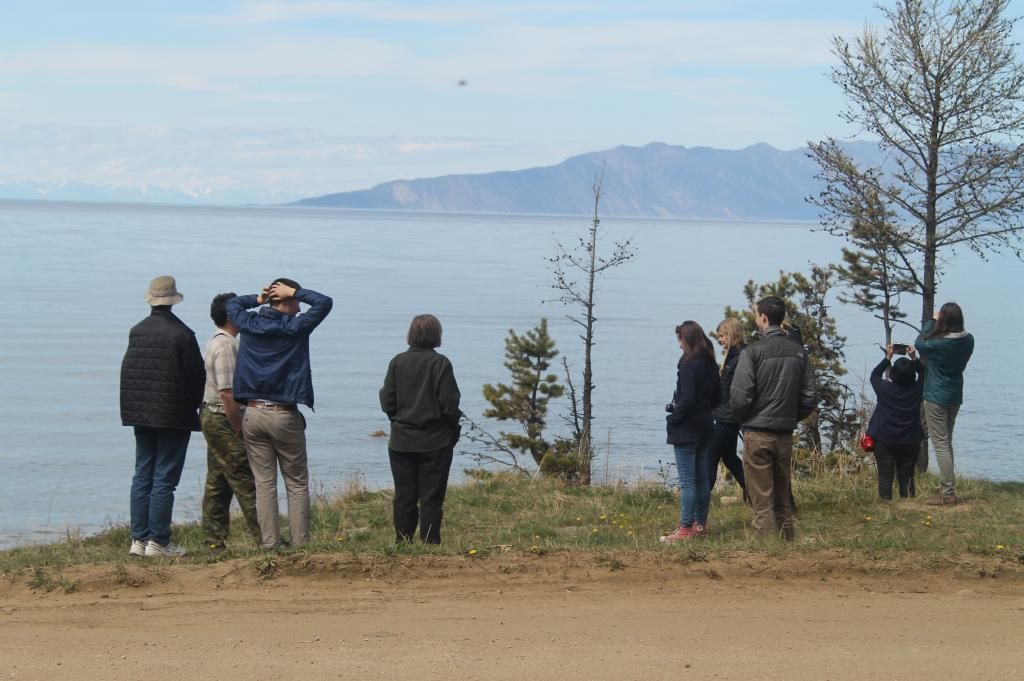
Our first time setting foot on the shore of Lake Baikal.


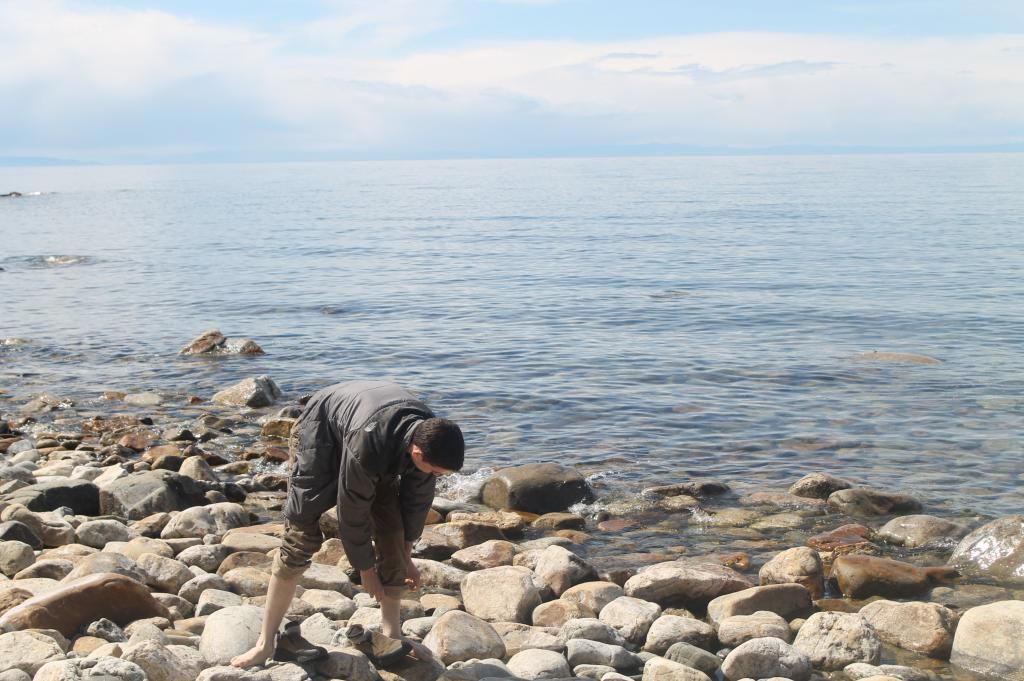
James getting ready to dip his 


We got a chance to jump in the lake a few days later.


The temperature that day was about 38 degrees fahrenheit. This was maybe a little too cold for Chet.


Luckily, we were able to warm up in a nearby hot spring.